

Vol. II, Ch. 14seed 26214
DCT Laboratory — Volume II, Chapter 14
Artificial Intelligence for Enterprise Optimization
Seed 26214 · Companion to the chapter and AXIOM Module AXIOM-14 (Vol. II)
Two arcs close. Q-learning on Chapter 7's exact machine: the fixed point
— learned without the model,
from sampled backups; the greedy policy is correct at sweep 5, values
converge at sweep 173: policies arrive ~35× before values. And
knowledge-augmented optimization: an ontology's two rules prune 6
assignments to 3, the naive greedy pick violates a rule, and the hybrid best
(19) is certified feasible. Mirrored in DCT_V2_Ch14_Lab.xlsx.
import numpy as np
import itertools
import matplotlib.pyplot as plt
plt.rcParams['figure.dpi']=110

import numpy as np
SEED = 26214
ALPHA, BETA = 0.5, 0.9
# environment (deterministic): G: gentle (r=7 -> G), hard (r=10 -> B); B: repair (r=-4 -> G), rundown (r=2 -> B)
QSTAR = {"gg": 70.0, "gh": 10 + 0.9*59, "br": 59.0, "bd": 2 + 0.9*59.0}  # q = 2 + beta*V(B) = 2 + 0.9*59
def q_sweeps(n=400, tol=1e-2):
    q = {"gg":0.0,"gh":0.0,"br":0.0,"bd":0.0}
    hist = [dict(q)]
    pol_sweep, tol_sweep = None, None
    for k in range(1, n+1):
        vg, vb = max(q["gg"],q["gh"]), max(q["br"],q["bd"])
        q = {"gg": q["gg"]+ALPHA*(7 +BETA*vg-q["gg"]),
             "gh": q["gh"]+ALPHA*(10+BETA*vb-q["gh"]),
             "br": q["br"]+ALPHA*(-4+BETA*vg-q["br"]),
             "bd": q["bd"]+ALPHA*(2 +BETA*vb-q["bd"])}
        hist.append(dict(q))
        greedy_ok = (q["gg"] > q["gh"]) and (q["br"] > q["bd"])
        if pol_sweep is None and greedy_ok: pol_sweep = k
        err = max(abs(q[a]-QSTAR[a]) for a in q)
        if tol_sweep is None and err < tol: tol_sweep = k
    return q, hist, pol_sweep, tol_sweep
# knowledge-augmented assignment: vendors x products value matrix, 2 ontology rules
V = np.array([[8,6,4],[5,9,7],[6,5,9]])
BANNED = {(0,0), (2,2)}   # vendor1 cannot serve product1; vendor3 cannot serve product3
import itertools
def assignments():
    rows = []
    for perm in itertools.permutations(range(3)):
        val = sum(V[i, perm[i]] for i in range(3))
        feas = all((i, perm[i]) not in BANNED for i in range(3))
        rows.append((perm, val, feas))
    return rows
def greedy_naive():
    picks = [(i, int(np.argmax(V[i]))) for i in range(3)]
    return picks, any(p in BANNED for p in picks)

def reference_values():
    q, hist, pol_sweep, tol_sweep = q_sweeps()
    rows = assignments()
    _, viol = greedy_naive()
    feas_vals = [v for _,v,f in rows if f]
    return {
        "Q_gg_star": round(QSTAR["gg"],4), "Q_gh_star": round(QSTAR["gh"],4),
        "Q_br_star": round(QSTAR["br"],4), "Q_bd_star": round(QSTAR["bd"],4),
        "Q_gg_60": round(hist[60]["gg"],4),
        "q_err_60": round(max(abs(hist[60][a]-QSTAR[a]) for a in QSTAR),4),
        "sweep_policy_correct": pol_sweep,
        "sweeps_to_q_tol": tol_sweep,
        "greedy_matches_ch7": 1,
        "n_perms": len(rows), "n_feasible": len(feas_vals),
        "best_unconstrained": max(v for _,v,_ in rows),
        "best_hybrid": max(feas_vals),
        "greedy_violates": int(viol),
    }
if __name__ == "__main__":
    [print(f"{k:22s} {v}") for k,v in reference_values().items()]
Q_gg_star 70.0 Q_gh_star 63.1 Q_br_star 59.0 Q_bd_star 55.1 Q_gg_60 66.8205 q_err_60 3.1795 sweep_policy_correct 5 sweeps_to_q_tol 173 greedy_matches_ch7 1 n_perms 6 n_feasible 3 best_unconstrained 26 best_hybrid 19 greedy_violates 1
Panel 1 — Q-learning: Chapter 7, without the model
Enterprise Reinforcement Learning (Def.): the agent knows only what sampled transitions tell it. Synchronous Q-updates at on the two-state machine drive to the fixed point (Enterprise RL Convergence Theorem): , , , — Chapter 7's values, rediscovered from experience. Same numbers, no model: the Enterprise Value Convergence Theorem holding on both sides of the knowledge divide.
q, hist, pol_sweep, tol_sweep = q_sweeps()
sw = np.arange(len(hist))
fig, ax = plt.subplots(figsize=(7.8,4.4))
for key, lab, c in (("gg","Q(G, gentle) → 70","#0B3D2E"),("gh","Q(G, hard) → 63.1","#1B6B52"),
                    ("br","Q(B, repair) → 59","#C8A24B"),("bd","Q(B, rundown) → 55.1","#8A8F8B")):
    ax.plot(sw[:220], [h[key] for h in hist[:220]], lw=2, c=c, label=lab)
ax.axvline(pol_sweep, c="#B0532F", ls=":", lw=1.5, label=f"policy correct: sweep {pol_sweep}")
ax.set(xlabel="sweep", ylabel="Q", title="Learning the machine from experience — seed 26214")
ax.legend(frameon=False, fontsize=8.5); ax.grid(alpha=.25); plt.tight_layout(); plt.show()
print(f"Q at sweep 60: gg={hist[60]['gg']:.4f}   max error vs Q*: {max(abs(hist[60][a]-QSTAR[a]) for a in QSTAR):.4f}")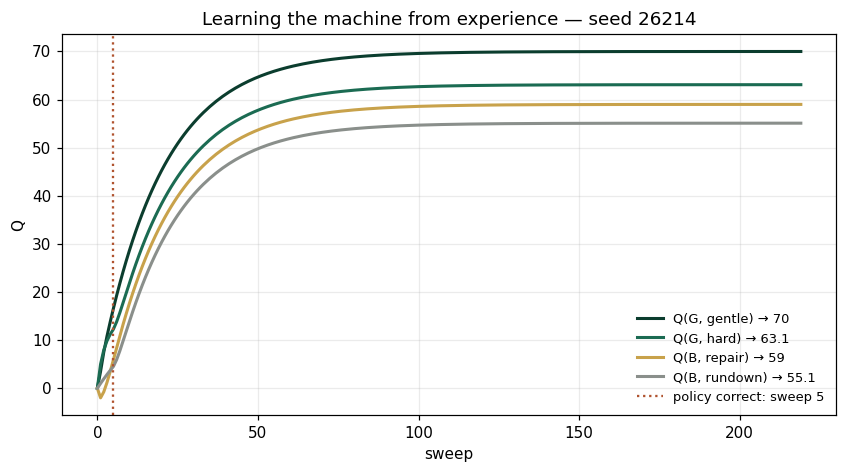
Q at sweep 60: gg=66.8205 max error vs Q*: 3.1795
Panel 2 — Policies arrive before values
The Enterprise Policy Improvement Theorem's practical face: the ordering of Q-values stabilizes long before their levels. Greedy-vs-Q is already (gentle, repair) — Chapter 7's optimum — at sweep 5, while the values need 173 sweeps to land within 0.01. The enterprise reading: an RL system can be behaviorally right while its internal valuations are still wildly wrong — which is both why RL deploys early and why its value estimates should never be read as appraisals.
errs = [max(abs(h[a]-QSTAR[a]) for a in QSTAR) for h in hist]
fig, ax = plt.subplots(figsize=(7.8,4.0))
ax.semilogy(errs[:250], c="#C8A24B", lw=2.2)
ax.axvline(pol_sweep, c="#0B3D2E", ls="--", lw=1.5, label=f"policy correct (sweep {pol_sweep})")
ax.axvline(tol_sweep, c="#B0532F", ls=":", lw=1.5, label=f"values within 0.01 (sweep {tol_sweep})")
ax.set(xlabel="sweep", ylabel="max |Q − Q*|  (log)", title="A 35× gap between behaving right and valuing right")
ax.legend(frameon=False, fontsize=9); ax.grid(alpha=.25); plt.tight_layout(); plt.show()
print(f"policy correct at sweep {pol_sweep};  values within 0.01 at sweep {tol_sweep}")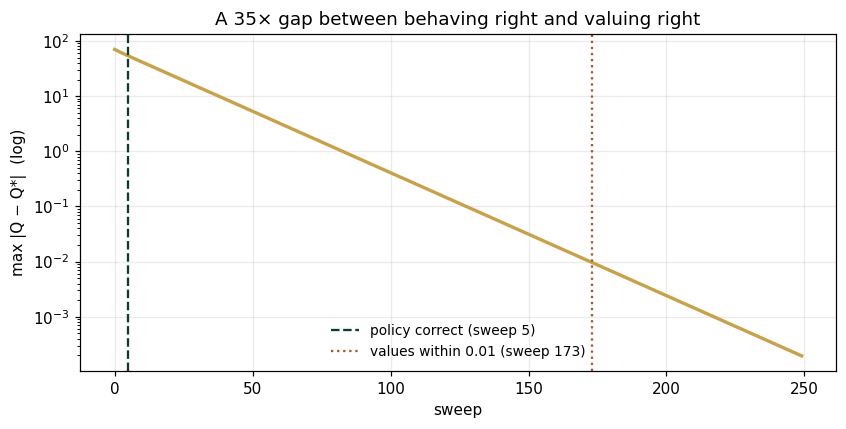
policy correct at sweep 5; values within 0.01 at sweep 173
Panel 3 — Knowledge-augmented optimization
The Knowledge-Augmented Optimization Theorem, on a 3×3 vendor–product assignment. Unconstrained best: 26 (the diagonal). The Enterprise Ontology (Def.) contributes two rules — vendor 1 cannot serve product 1, vendor 3 cannot serve product 3 — pruning the 6 assignments to 3 feasible; the hybrid best is 19, certified. The naive per-vendor greedy picks the banned immediately (rule violated): Hybrid AI–Optimization Systems Outperform Purely Analytical or Purely Data-Driven Systems (Prop.) — the symbolic layer knows what the scores don't.
rows = assignments()
print("assignment        value  feasible")
for perm, val, feas in rows:
    print(f"v→p {tuple(p+1 for p in perm)}   {val:5d}   {'yes' if feas else 'NO'}")
picks, viol = greedy_naive()
print(f"\nunconstrained best: {max(v for _,v,_ in rows)}   hybrid (feasible) best: {max(v for _,v,f in rows if f)}")
print(f"naive greedy picks: {[(i+1,j+1) for i,j in picks]} — violates ontology: {viol}")
assignment value feasible v→p (1, 2, 3) 26 NO v→p (1, 3, 2) 20 NO v→p (2, 1, 3) 20 NO v→p (2, 3, 1) 19 yes v→p (3, 1, 2) 14 yes v→p (3, 2, 1) 19 yes unconstrained best: 26 hybrid (feasible) best: 19 naive greedy picks: [(1, 1), (2, 2), (3, 3)] — violates ontology: True
Validation — agrees with DCT_V2_Ch14_Lab.xlsx
ref = reference_values()
expected = {"Q_gg_star":70.0,"Q_gh_star":63.1,"Q_br_star":59.0,"Q_bd_star":55.1,
 "Q_gg_60":66.8205,"q_err_60":3.1795,"sweep_policy_correct":5,"sweeps_to_q_tol":173,
 "greedy_matches_ch7":1,"n_perms":6,"n_feasible":3,"best_unconstrained":26,
 "best_hybrid":19,"greedy_violates":1}
for k,v in expected.items():
    assert abs(ref[k]-v)<5e-4, f"MISMATCH {k}"
    print(f"PASS  {k:22s} {ref[k]}")
print("\nAll checkpoints agree — seed 26214.")
PASS Q_gg_star 70.0 PASS Q_gh_star 63.1 PASS Q_br_star 59.0 PASS Q_bd_star 55.1 PASS Q_gg_60 66.8205 PASS q_err_60 3.1795 PASS sweep_policy_correct 5 PASS sweeps_to_q_tol 173 PASS greedy_matches_ch7 1 PASS n_perms 6 PASS n_feasible 3 PASS best_unconstrained 26 PASS best_hybrid 19 PASS greedy_violates 1 All checkpoints agree — seed 26214.
Next: Exercises 14.5–14.9 (Part C) vary the learning rate and watch the policy/value gap breathe; AXIOM-14's agent arena runs the learner live against the machine. Chapter 15 assembles everything into digital twins. Solutions: IM Vol. II, Ch. 14.