

AXIOM — Transformation Decision Intelligence
From your data to ranked decisions, a board-ready plan, and tracked results.
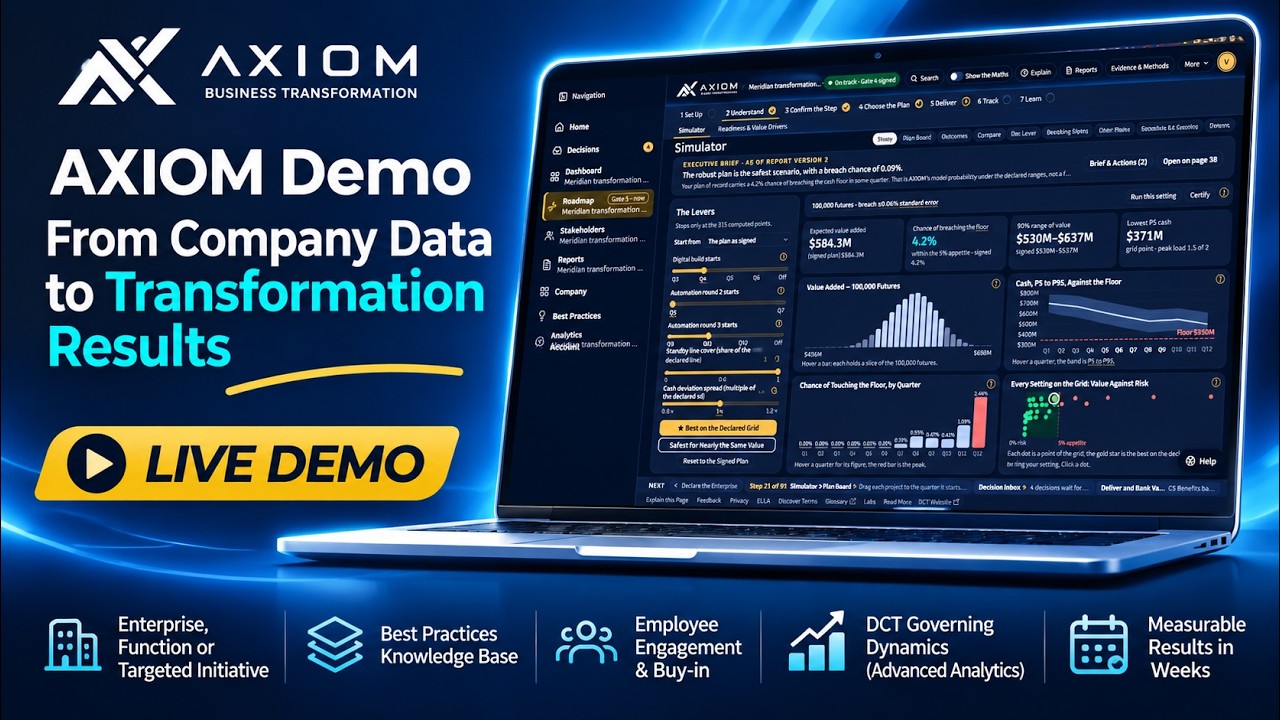
How it works
The icons You Our team Your team AXIOM AXIOM appStep 1 of 5
Define your scope
Choose what AXIOM looks at: the whole company, one function, or one business problem.
Any scope: the whole enterprise, one function, or one business problem.
- What you get
- A transformation set up around your objectives and limits
- Who does it
- You, or our White-glove team
- How long
- Under an hour
Features
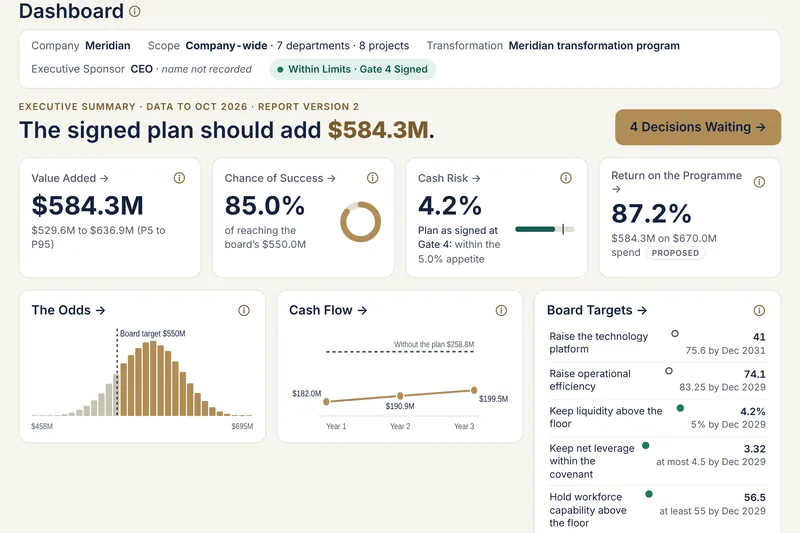
Executive Dashboard
Executive DashboardOne page with the figures that matter to the leadership team: value, cash, risk and progress against the plan.everything on one page
Digital Twin
Digital TwinA working model of your company, built from your own figures and updated whenever you add new ones, so decisions can be tested on the model before they are made in the business.your company, kept up to date
Simulator
SimulatorTry a plan on the Digital Twin and see what it does to value, cash and risk before any money is committed.test plans before committing
Optimisation
OptimisationAXIOM searches the possible plans for the one that adds the most value while staying within the limits you set, such as budget, cash and people.the best plan within your limits
Risk analysis
Risk analysisHow likely the plan is to go wrong, and what drives that. The floor is the minimum cash your board set.the chance cash falls below your floor
Recommendations
RecommendationsThe actions AXIOM recommends, in the order to take them, with the reason for each and what it is expected to add.what to do first
Roadmap and gates
Roadmap and gatesThe plan laid out over time, with seven checkpoints where the sponsor signs off before the next stage starts.seven signed steps
CTAR
CTARThe Comprehensive Transformation Analytics Report: the board-ready report on your programme, with the decision, the odds, the risks and the plan, online and as a PDF.the board-ready report
Stakeholder surveys
Stakeholder surveysShort surveys of your people that show how ready they are for the change and where resistance is likely.readiness and resistance
Best Practices
Best PracticesA library of 235 documented transformations at other companies: what worked, what failed, and how strong the evidence is.235 documented transformations
Monitoring
MonitoringWhenever you add new figures, AXIOM compares actual results with the plan and raises an alarm when a figure drifts off course.actual against plan, with alarms
Financial impact
Financial impactWhat the plan does to the income statement, balance sheet and cash flow, shown as a range of likely outcomes rather than one number.pro forma statements as ranges
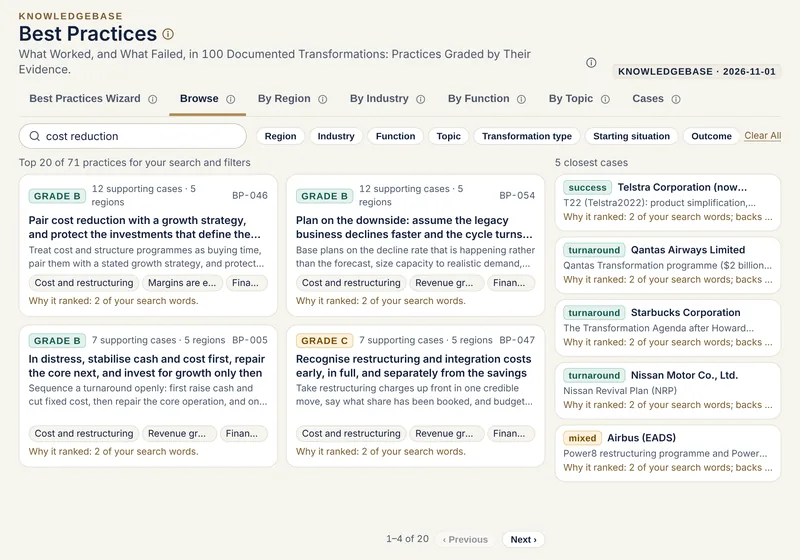
Meridian live demo
$584.3M expected value (90% range90% rangeNine times out of ten, the outcome lands between these two values. $529.6M–$636.9M), 4.2% cash riskcash riskThe chance that cash falls below the minimum your board set.. Fictional, illustrative.
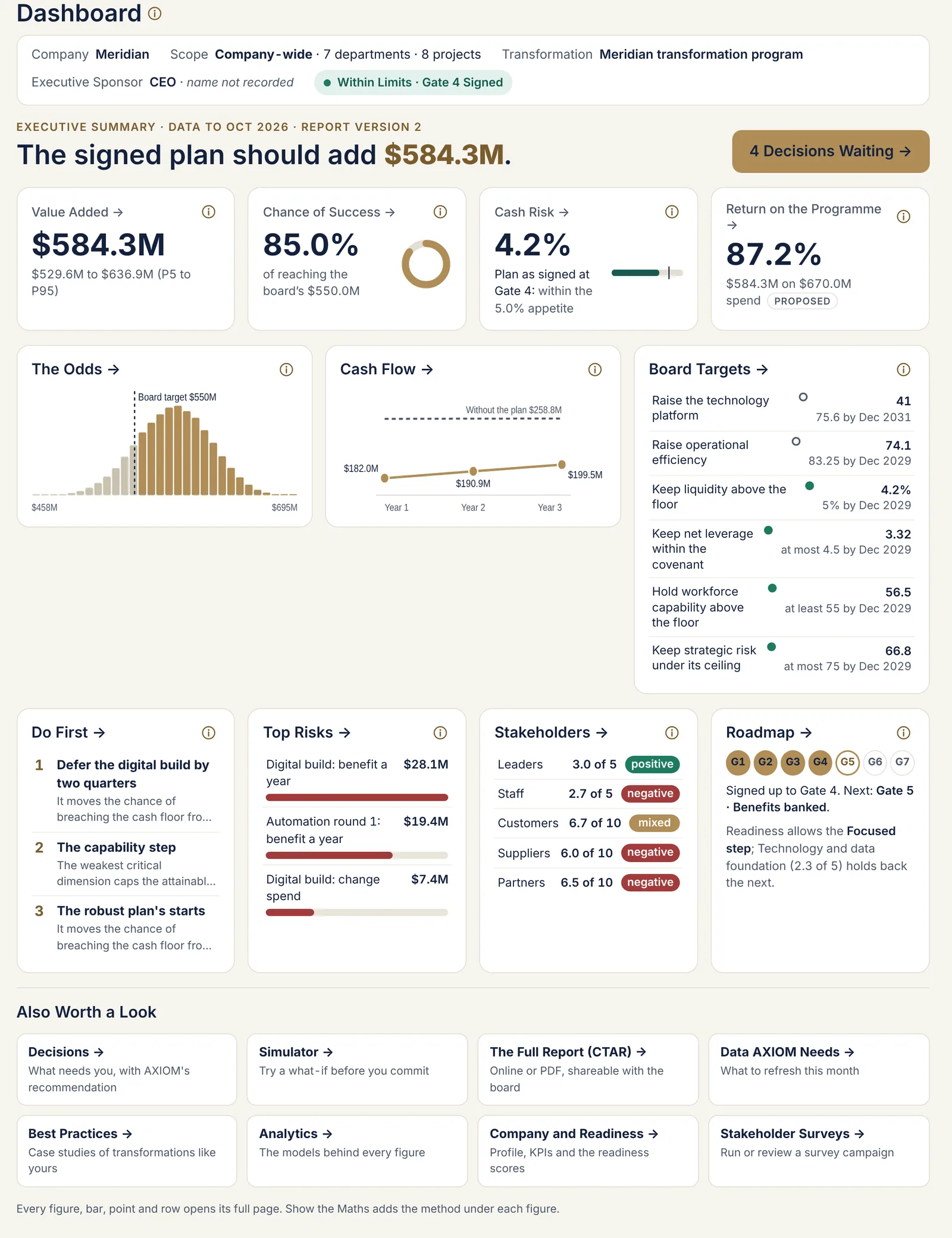
Board-ready report (CTAR)
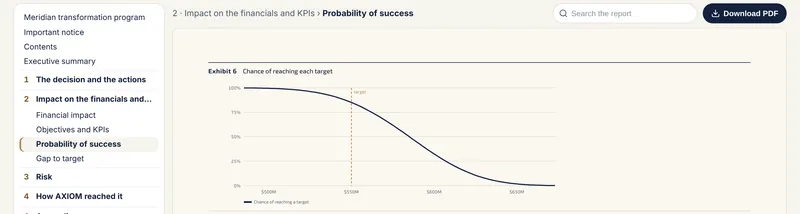
View Sample CTAR (opens in a new tab)
Meridian is a fictitious demonstration company; all of its data is synthetic.
Why AXIOM
| Compared on | Consultants | PMO software | Spreadsheets | AXIOM |
|---|---|---|---|---|
| Compares plans first | Once | No | Manually | Always |
| Quantifies risk | Varies | No | If built | 100,000 futures |
| Tracks value in your accounts | Sometimes | Tasks only | Manually | Verified by finance |
Plans
Per transformation. Billed monthly; 10% off annually.per transformation programmeEach transformation programme has its own subscription. A company with two programmes has two subscriptions, with 5% off for more than one. A programme is one transformation initiative that AXIOM analyses. A company-wide transformation is one programme.
Functional Transformation
Functional TransformationOne department or function runs the programme, for example finance or operations.$2,850/month
billed monthly
or $30,780 a year billed annuallybilled annuallyOne payment a year instead of twelve monthly ones, at 10% off the monthly price. ($2,565 a month)
A specific challenge in one department or function.
Cross-Functional Transformation
Cross-Functional TransformationOne programme shared by several departments on one platform, with their projects in one plan.$5,290/month
billed monthly
or $57,132 a year billed annuallybilled annuallyOne payment a year instead of twelve monthly ones, at 10% off the monthly price. ($4,761 a month)
A specific challenge shared by several departments, such as finance, operations and technology on one platform.
Enterprise-wide Transformation
Enterprise-wide TransformationOne programme across the whole company or business unit, with every department taking part.$9,770/month
billed monthly
or $105,516 a year billed annuallybilled annuallyOne payment a year instead of twelve monthly ones, at 10% off the monthly price. ($8,793 a month)
One transformation across the whole company or business unit.
The AXIOM brochure
Jump to any chapter
Volume I: Foundations and Mathematical Framework
- Ch. 1Introduction to Dynamic Corporate Transformation
- Ch. 2Enterprise Systems and Transformation
- Ch. 3Mathematical Foundations
- Ch. 4Enterprise Modeling Principles
- Ch. 5Enterprise State Representation
- Ch. 6Enterprise Transformation Operators
- Ch. 7Dynamic Enterprise Systems
- Ch. 8Stochastic Enterprise Dynamics
- Ch. 9Enterprise State Architecture
- Ch. 10Enterprise Capital Architecture
- Ch. 11Enterprise Performance Architecture
- Ch. 12Enterprise Risk, Resilience, and Robustness Architecture
- Ch. 13Unified Enterprise Transformation Architecture
- Ch. 14Mathematical Analysis of the Unified Enterprise Transformation Architecture
- Ch. 15Mathematical Formulation of Enterprise Optimization
- Ch. 16Synthesis, Future Directions, and Transition to Volume II
Volume II: Enterprise Optimization & Applications
- Ch. 1Introduction to Enterprise Optimization
- Ch. 2The General Enterprise Optimization Problem Revisited
- Ch. 3Convex Enterprise Optimization
- Ch. 4Nonlinear and Mixed-Integer Enterprise Optimization
- Ch. 5Dynamic Enterprise Optimization
- Ch. 6Optimal Control of Enterprise Systems
- Ch. 7Dynamic Programming for Enterprise Systems
- Ch. 8Hamilton–Jacobi–Bellman Enterprise Framework
- Ch. 9Stochastic Enterprise Optimization
- Ch. 10Neuro-Fuzzy Robust Enterprise Optimization
- Ch. 11Distributionally Robust Enterprise Optimization
- Ch. 12Multi-Objective Enterprise Optimization
- Ch. 13Machine Learning for Enterprise Transformation
- Ch. 14Artificial Intelligence for Enterprise Optimization
- Ch. 15Enterprise Digital Twins and Autonomous Enterprise Transformation
- Ch. 16Enterprise Applications and Integrated Transformation Case Studies
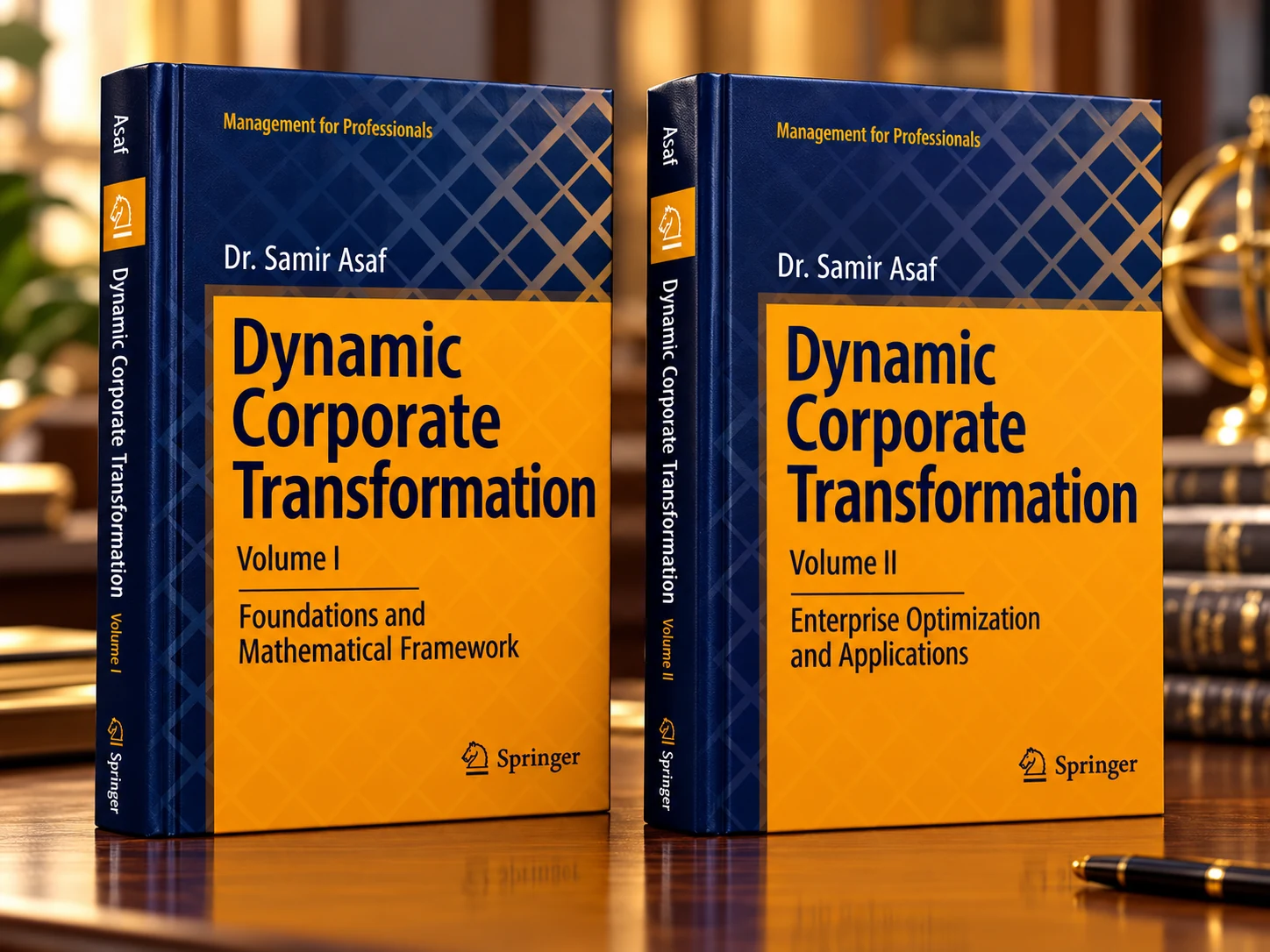
Dynamic Corporate Transformation
Springer Nature · Management for Professionals · Forthcoming 2027
- Volume I — Foundations and Mathematical Framework
- Volume II — Enterprise Optimization & Applications
Jump to any chapter
Volume I: Foundations and Mathematical Framework
- Ch. 1Introduction to Dynamic Corporate Transformation
- Ch. 2Enterprise Systems and Transformation
- Ch. 3Mathematical Foundations
- Ch. 4Enterprise Modeling Principles
- Ch. 5Enterprise State Representation
- Ch. 6Enterprise Transformation Operators
- Ch. 7Dynamic Enterprise Systems
- Ch. 8Stochastic Enterprise Dynamics
- Ch. 9Enterprise State Architecture
- Ch. 10Enterprise Capital Architecture
- Ch. 11Enterprise Performance Architecture
- Ch. 12Enterprise Risk, Resilience, and Robustness Architecture
- Ch. 13Unified Enterprise Transformation Architecture
- Ch. 14Mathematical Analysis of the Unified Enterprise Transformation Architecture
- Ch. 15Mathematical Formulation of Enterprise Optimization
- Ch. 16Synthesis, Future Directions, and Transition to Volume II
Volume II: Enterprise Optimization & Applications
- Ch. 1Introduction to Enterprise Optimization
- Ch. 2The General Enterprise Optimization Problem Revisited
- Ch. 3Convex Enterprise Optimization
- Ch. 4Nonlinear and Mixed-Integer Enterprise Optimization
- Ch. 5Dynamic Enterprise Optimization
- Ch. 6Optimal Control of Enterprise Systems
- Ch. 7Dynamic Programming for Enterprise Systems
- Ch. 8Hamilton–Jacobi–Bellman Enterprise Framework
- Ch. 9Stochastic Enterprise Optimization
- Ch. 10Neuro-Fuzzy Robust Enterprise Optimization
- Ch. 11Distributionally Robust Enterprise Optimization
- Ch. 12Multi-Objective Enterprise Optimization
- Ch. 13Machine Learning for Enterprise Transformation
- Ch. 14Artificial Intelligence for Enterprise Optimization
- Ch. 15Enterprise Digital Twins and Autonomous Enterprise Transformation
- Ch. 16Enterprise Applications and Integrated Transformation Case Studies