
What is DCT
The executive argument in twelve stages, with Meridian as the example.
Meridian is fictional; its numbers are the book's declarations.
01 / 12
The model of the enterprise is usually the problem
Most transformation plans compare destinations and summarize an enterprise in a handful of scores. Two companies in very different positions can then look identical, and a plan can look sound while its path runs through a breach. DCT starts by replacing that model, not by adding another dashboard.
The formal version: Limits of existing frameworks
02 / 12
Describe the enterprise as a state, not a dashboard
A state is the smallest description of the enterprise today from which its future can be worked out. For Meridian the book declares eight readings, each with a declared source and error band. A dashboard of indicators, however rich, is not yet a state.
The formal version: Enterprise state
Meridian is fictional; its numbers are the book's declarations.
- Liquidity
- $620m (index 100)
- Net leverage
- 3.4× EBITDA
- Workforce capability
- 58
- Technology platform
- 41
- Operational efficiency
- 71
- ROIC
- 8.3%
- Strategic risk
- 64 (lower is better)
- Market share
- 19%
Vol. I, Ch. 3, Table 3.1 (as declared in Lab I.1)
03 / 12
Say what “better” means before the analysis
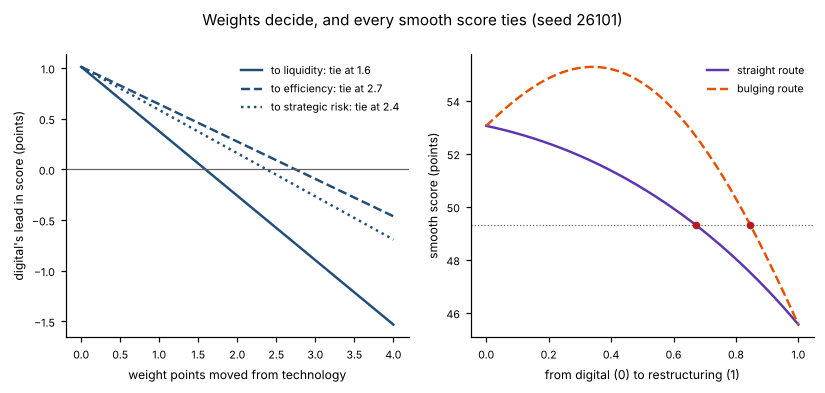
A criterion chosen after the analysis can justify anything. Meridian's CFO weighs three readings and subtracts strategic risk. On that score, digital and restructuring finish a point apart, well inside any forecast error, and the weights rather than the data decide the ranking. DCT asks for the criterion first.
Digital scores 47.1 and restructuring 46.1, a one-point gap well inside any forecast error; the turnaround scores 38.4.Vol. I, Ch. 1, Table 1.9; Lab I.1
The formal version: Performance architecture
04 / 12
Write down what cannot be breached
Covenants, cash floors, capability minimums and governance limits define where the enterprise is allowed to be. Meridian's board declares a $350m liquidity floor and holds capability at or above 55. Written down together, the constraints can be checked against each other before anyone plans around them.
Liquidity floor $350m; capability at or above 55.Vol. II, Ch. 16; Lab II.16
The formal version: Feasible region
05 / 12
Treat programmes as moves with a cost, a duration and a dip
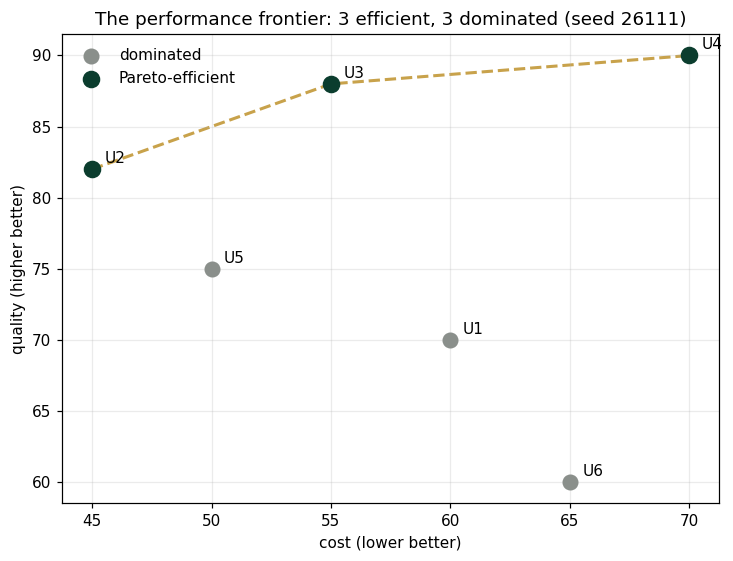
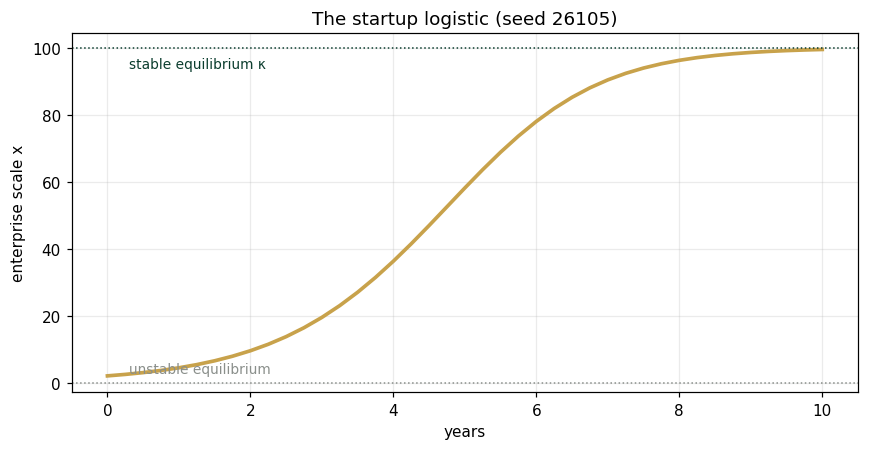
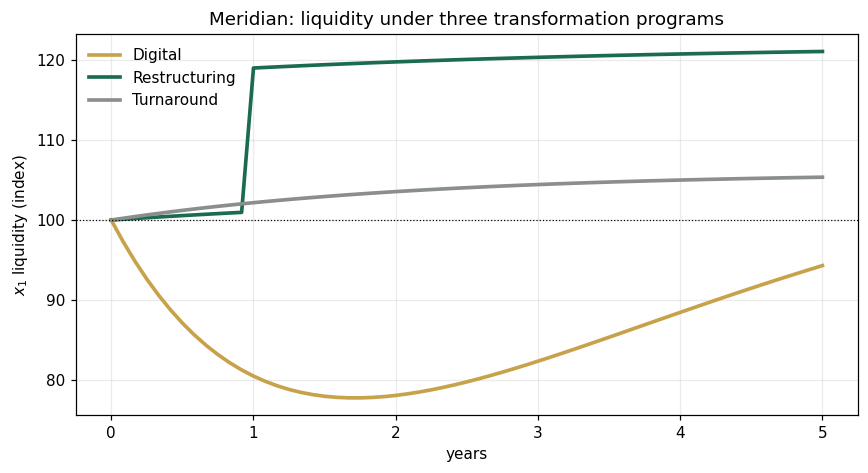
A transformation is a move from one state to another. It costs money and time, and performance often dips before it rises. Meridian's three options, the digital pivot, the restructuring and the turnaround, are three such moves, and their order matters as much as their choice.
The formal version: Transformation operator
06 / 12
Check that the commitments can hold together
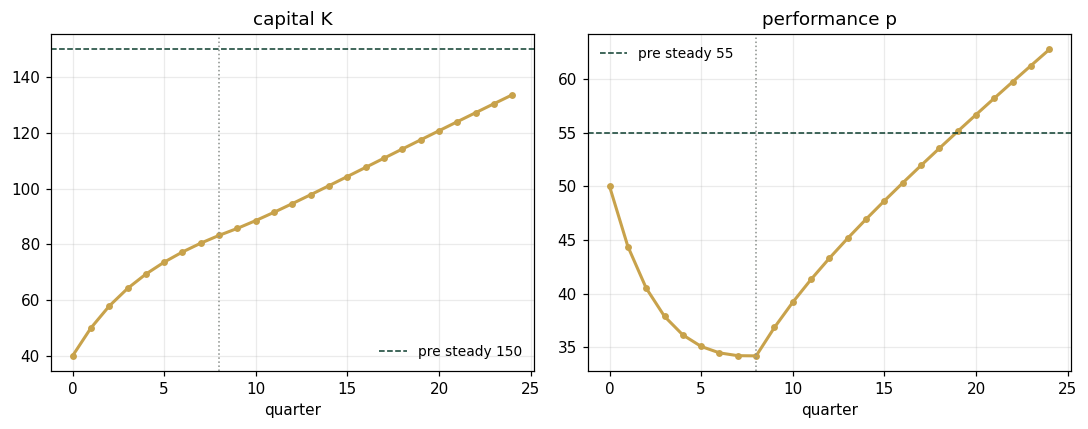
Before optimizing, DCT checks that a plan's commitments are mutually consistent. In Meridian's case every layer passes its own test, yet the whole fails: the same treasury cash is promised twice. No optimization can repair a plan whose commitments contradict each other.
The formal version: Certificates, audits, and readiness gates
07 / 12
Feasible today is not viable tomorrow
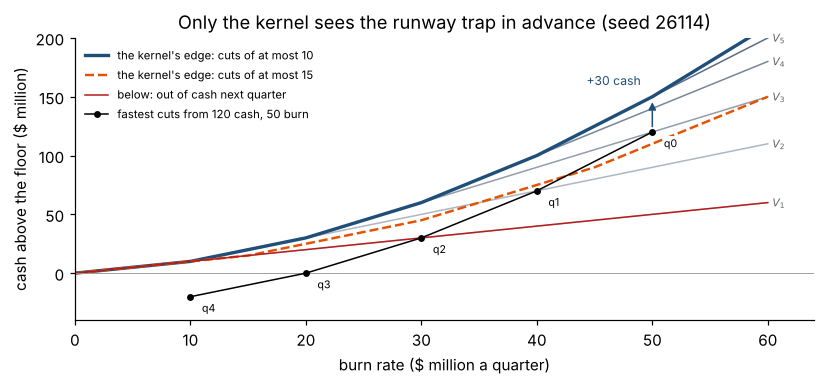
A state can satisfy every limit today and still lie outside the set from which any plan avoids a future breach. DCT computes that set, the viability kernel. For Meridian it flags a runway trap in advance, before any ratio is violated.
The formal version: Viability kernel
08 / 12
Order and money are decisions, and the model prices them
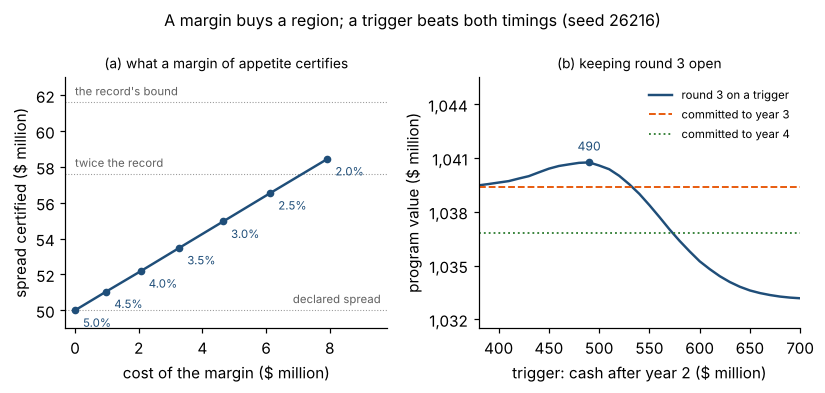
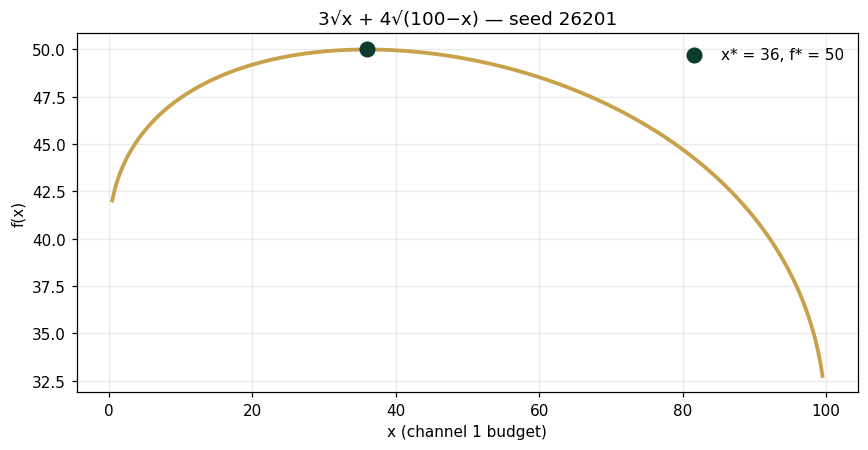
Once the problem is certified, DCT solves for the best policy: what to do, when, and with which capital. Every binding constraint gets a price. For Meridian, neither a standby line nor a committed delay alone meets the board's risk appetite; together they do, for $10.44m.
The formal version: General Enterprise Optimization Problem
09 / 12
Departments step on their own clocks, around shared platforms
An optimal plan still has to move people. DCT Helix carries it through the organization: departments step at different times, shared platforms such as ERP and data are sequenced to serve them, and the capacity for change is budgeted like capital.
The formal version: DCT Helix
Departments still step at different times, but around shared platforms and agreed sync windows. Friction is priced and planned down, change capacity is never overdrawn, and continuous improvement keeps every plateau rising between steps.
Swipe the chart sideways to see the whole timeline.
Illustrative: the shapes show the pattern, not data.
10 / 12
Watch the conditions that would void the plan
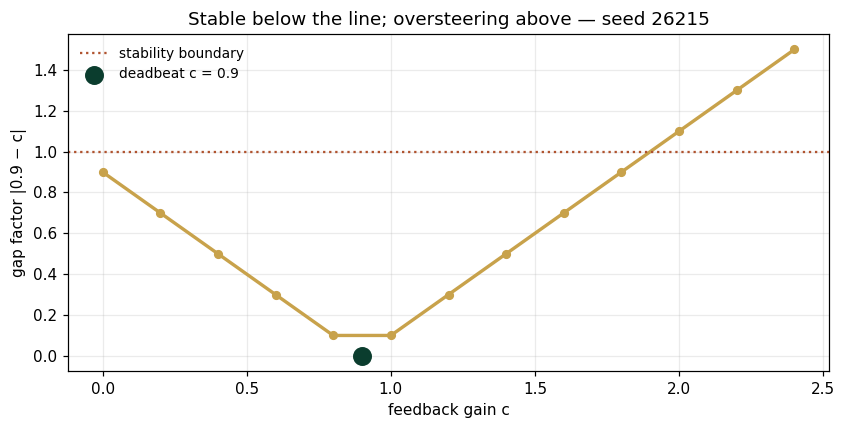
Monitoring in DCT is not a dashboard of results. It tracks the distance to the floor, the stability of the couplings and whether the model still fits the enterprise. In the book's digital-twin chapter, the monitor finds a drift in a median of 12 quarters.
The formal version: Digital twin and autonomy
11 / 12
A shock tests the certificates, not the nerve
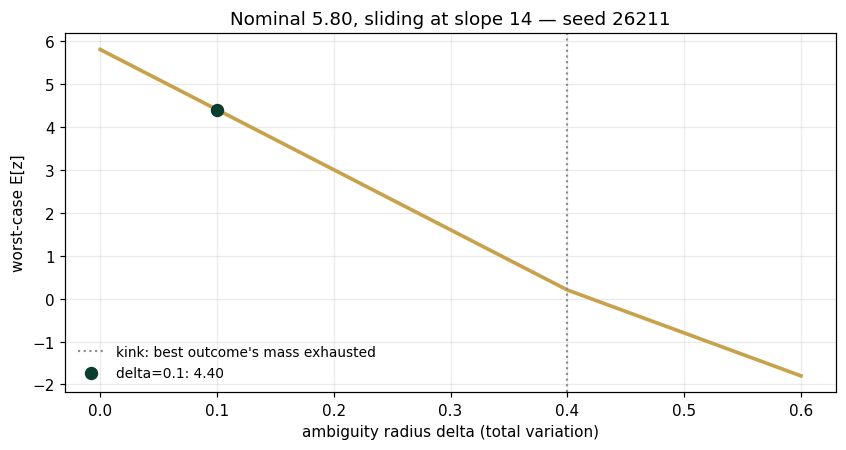
When the world moves, the question is which certificate no longer holds. Under the least favourable law consistent with the records, Volume I's package breaches the floor on 15.8% of paths, more than three times the board's 5% appetite.
The formal version: Uncertainty methods
12 / 12
Re-plan on triggers declared in advance, with fresh certificates
DCT re-solves when a declared trigger fires, not when results disappoint. Each re-solve re-checks consistency, stability and viability, so the change and its reason are on record. For Meridian, a trigger beats both fixed timings. Every end-state becomes the next starting point.
The formal version: Adapt