

Research
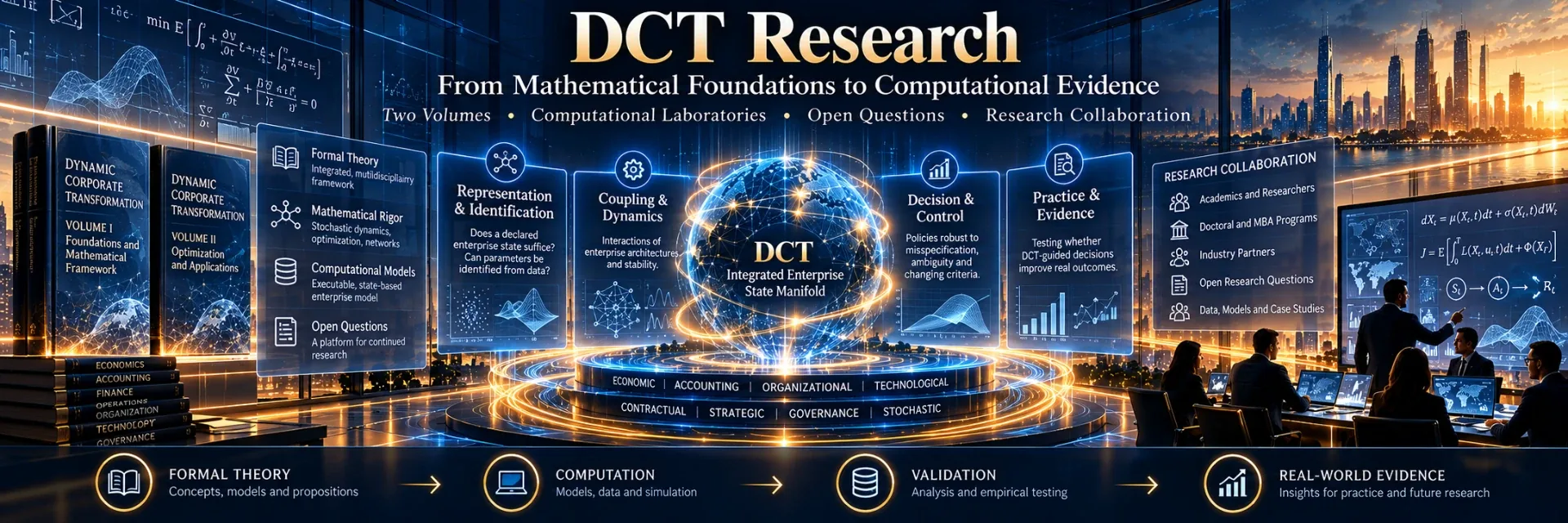
DCT is a research programme: a formal core in two volumes, a computational layer, open questions, and a clear way in for collaborators.
Research streams
Representation and identification
When does a declared state suffice, and can its parameters be identified from data?
Coupling and dynamics
How strong are cross-architecture couplings in real enterprises, and how stable?
Decision and control
Which policies stay good under misspecification, ambiguity and changing criteria?
Practice and evidence
Does DCT-guided decision-making outperform conventional methods, and how would we know?
“The questions the book leaves for organizational researchers are among the most important in applied practice, especially with AI disruption: what are the new and emerging leadership behaviors that build positive workforce cultures, that establish leader-associate trust, and that enable enterprise transformations to scale and succeed.”
Steven M. Howard, endorsement
Go further

Jump to any chapter
Volume I: Foundations and Mathematical Framework
- Ch. 1Introduction to Dynamic Corporate Transformation
- Ch. 2Enterprise Systems and Transformation
- Ch. 3Mathematical Foundations
- Ch. 4Enterprise Modeling Principles
- Ch. 5Enterprise State Representation
- Ch. 6Enterprise Transformation Operators
- Ch. 7Dynamic Enterprise Systems
- Ch. 8Stochastic Enterprise Dynamics
- Ch. 9Enterprise State Architecture
- Ch. 10Enterprise Capital Architecture
- Ch. 11Enterprise Performance Architecture
- Ch. 12Enterprise Risk, Resilience, and Robustness Architecture
- Ch. 13Unified Enterprise Transformation Architecture
- Ch. 14Mathematical Analysis of the Unified Enterprise Transformation Architecture
- Ch. 15Mathematical Formulation of Enterprise Optimization
- Ch. 16Synthesis, Future Directions, and Transition to Volume II
Volume II: Enterprise Optimization & Applications
- Ch. 1Introduction to Enterprise Optimization
- Ch. 2The General Enterprise Optimization Problem Revisited
- Ch. 3Convex Enterprise Optimization
- Ch. 4Nonlinear and Mixed-Integer Enterprise Optimization
- Ch. 5Dynamic Enterprise Optimization
- Ch. 6Optimal Control of Enterprise Systems
- Ch. 7Dynamic Programming for Enterprise Systems
- Ch. 8Hamilton–Jacobi–Bellman Enterprise Framework
- Ch. 9Stochastic Enterprise Optimization
- Ch. 10Neuro-Fuzzy Robust Enterprise Optimization
- Ch. 11Distributionally Robust Enterprise Optimization
- Ch. 12Multi-Objective Enterprise Optimization
- Ch. 13Machine Learning for Enterprise Transformation
- Ch. 14Artificial Intelligence for Enterprise Optimization
- Ch. 15Enterprise Digital Twins and Autonomous Enterprise Transformation
- Ch. 16Enterprise Applications and Integrated Transformation Case Studies
Dynamic Corporate Transformation
Springer Nature · Management for Professionals · Forthcoming 2027
- Volume I — Foundations and Mathematical Framework
- Volume II — Enterprise Optimization & Applications
Buy Volume I: Dynamic Corporate Transformation: Foundations and Mathematical FrameworkBuy Volume II: Dynamic Corporate Transformation: Enterprise Optimization & Applications
Jump to any chapter
Volume I: Foundations and Mathematical Framework
- Ch. 1Introduction to Dynamic Corporate Transformation
- Ch. 2Enterprise Systems and Transformation
- Ch. 3Mathematical Foundations
- Ch. 4Enterprise Modeling Principles
- Ch. 5Enterprise State Representation
- Ch. 6Enterprise Transformation Operators
- Ch. 7Dynamic Enterprise Systems
- Ch. 8Stochastic Enterprise Dynamics
- Ch. 9Enterprise State Architecture
- Ch. 10Enterprise Capital Architecture
- Ch. 11Enterprise Performance Architecture
- Ch. 12Enterprise Risk, Resilience, and Robustness Architecture
- Ch. 13Unified Enterprise Transformation Architecture
- Ch. 14Mathematical Analysis of the Unified Enterprise Transformation Architecture
- Ch. 15Mathematical Formulation of Enterprise Optimization
- Ch. 16Synthesis, Future Directions, and Transition to Volume II
Volume II: Enterprise Optimization & Applications
- Ch. 1Introduction to Enterprise Optimization
- Ch. 2The General Enterprise Optimization Problem Revisited
- Ch. 3Convex Enterprise Optimization
- Ch. 4Nonlinear and Mixed-Integer Enterprise Optimization
- Ch. 5Dynamic Enterprise Optimization
- Ch. 6Optimal Control of Enterprise Systems
- Ch. 7Dynamic Programming for Enterprise Systems
- Ch. 8Hamilton–Jacobi–Bellman Enterprise Framework
- Ch. 9Stochastic Enterprise Optimization
- Ch. 10Neuro-Fuzzy Robust Enterprise Optimization
- Ch. 11Distributionally Robust Enterprise Optimization
- Ch. 12Multi-Objective Enterprise Optimization
- Ch. 13Machine Learning for Enterprise Transformation
- Ch. 14Artificial Intelligence for Enterprise Optimization
- Ch. 15Enterprise Digital Twins and Autonomous Enterprise Transformation
- Ch. 16Enterprise Applications and Integrated Transformation Case Studies