
DCT for CFOs, investors and corporate-finance leaders
DCT treats a transformation as a capital-allocation problem in which every constraint has a price. The solved problem tells you what each limit costs, what the plan is worth as a range rather than a single number, and when waiting is worth more than starting.
What is each constraint costing us?
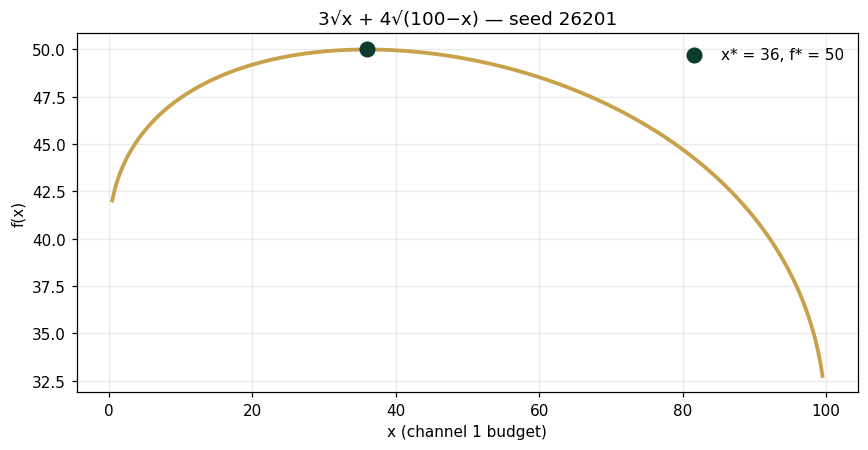
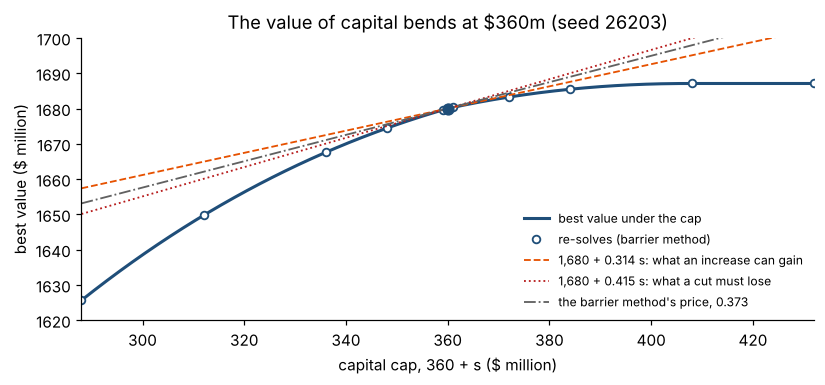
Every binding constraint has a price: the change in the best achievable value per unit of the limit. DCT reads these prices off the solved problem, so a covenant, a hiring cap and a budget line can be compared in one currency, and the costates price the state itself.
What is the plan worth as a range, not a number?
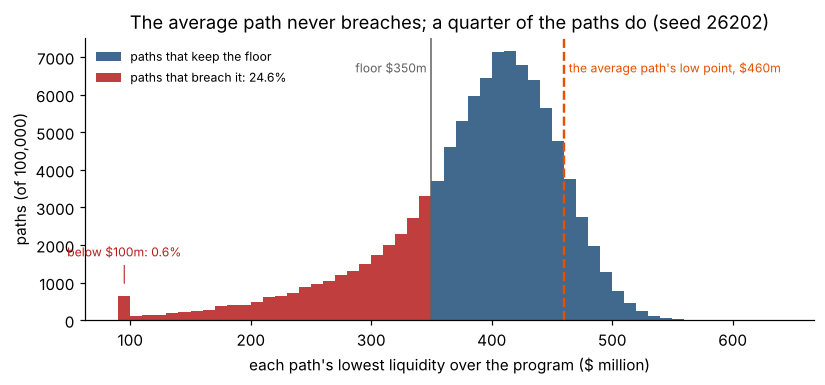
DCT evaluates a plan across simulated futures and reports the distribution: the median, the tails, and the chance of breaching a floor at any point on the path, not only at the end. An average path can look safe while a quarter of the paths breach.
When is waiting worth more than starting?
Most transformation steps cannot be undone. Under uncertainty, irreversibility gives timing an option value, and the solved problem says how long to wait and what the delay is worth, instead of leaving it to the calendar.
| Topic | DCT object | Where to read | Lab finding |
|---|---|---|---|
| Capital allocation | Costates and multipliers: the internal prices of capital | ||
| Transformation economics | Plans as distributions | ||
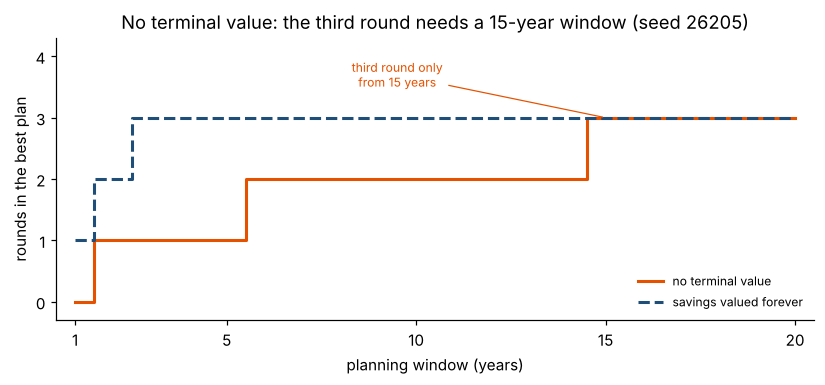
| Valuation | The objective and its terminal value | ||
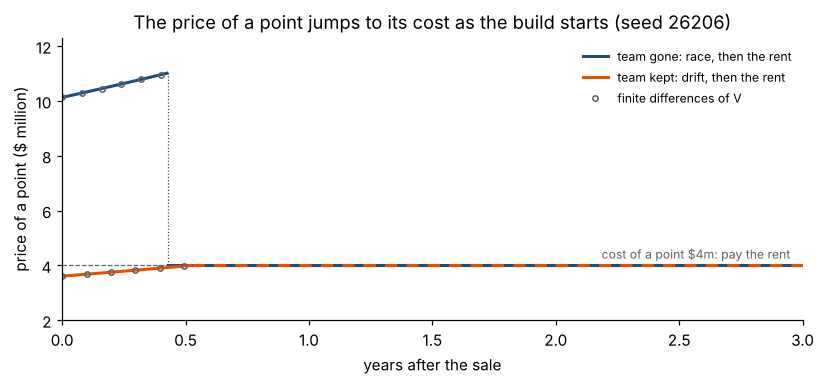
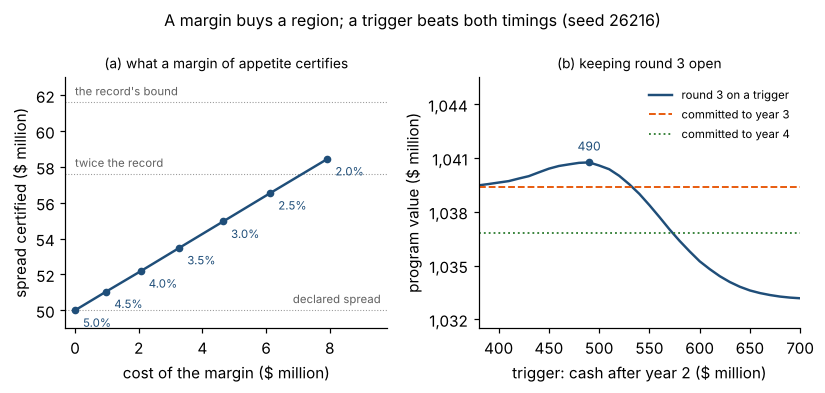
| Financing | A standby line and a committed delay, priced against the board's appetite | ||
| Risk-adjusted return | Coherent risk measures inside the criterion | ||
| Optionality and sequencing | The option value of timing; steps that do not commute |
Meridian Group is the book's fictional company. These are the finance steps of its programme, each a figure from the laboratories.
Meridian is fictional; its numbers are the book's declarations.
- 1
Meridian's state today, as the book declares it.
Meridian is fictional; its numbers are the book's declarations.
- Liquidity
- $620m (index 100)
- Net leverage
- 3.4× EBITDA
- Workforce capability
- 58
- Technology platform
- 41
- Operational efficiency
- 71
- ROIC
- 8.3%
- Strategic risk
- 64 (lower is better)
- Market share
- 19%
Vol. I, Ch. 3, Table 3.1 (as declared in Lab I.1)
- 2
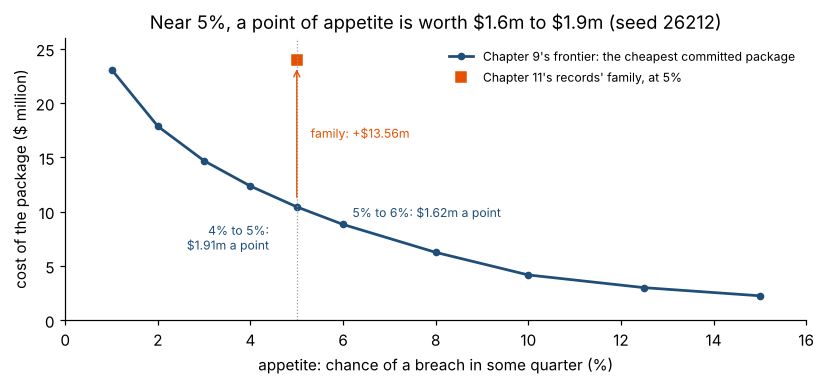
Meridian's board declares a $350m liquidity floor and a 5% risk appetite.Vol. II, Ch. 16; Lab II.16
- 3
- 4
- 5
- 6
- 1Vol. II, Ch. 1Introduction to Enterprise Optimization
The $10.44m package: two levers priced against the board's appetite.
- 2Vol. I, Ch. 10Enterprise Capital Architecture
Ten forms of capital, each carried as part of the state.
- 3Vol. I, Ch. 12Enterprise Risk, Resilience, and Robustness Architecture
Risk measures fit for optimization, and resilience as margin and rate.
- 4Vol. II, Ch. 3Convex Enterprise Optimization
Convex optimization, where every constraint receives a price.
- 5Vol. II, Ch. 6Optimal Control of Enterprise Systems
Optimal control, and the costate as the price of the state.
- 6Vol. II, Ch. 9Stochastic Enterprise Optimization
Stochastic optimization: chance constraints and plans as distributions.
- 7Vol. II, Ch. 12Multi-Objective Enterprise Optimization
The trade-off frontier and the price of the board's appetite.
- 8Vol. II, Ch. 16Enterprise Applications and Integrated Transformation Case Studies
The integrated case: the whole programme, sequenced and financed.
0 of 8 read
Cases to read
Endorsements
…should be particularly valuable to investors, corporate finance professionals, advisors, and senior executives seeking to understand how enterprise value evolves over time.
Affiliations are listed for identification only.