

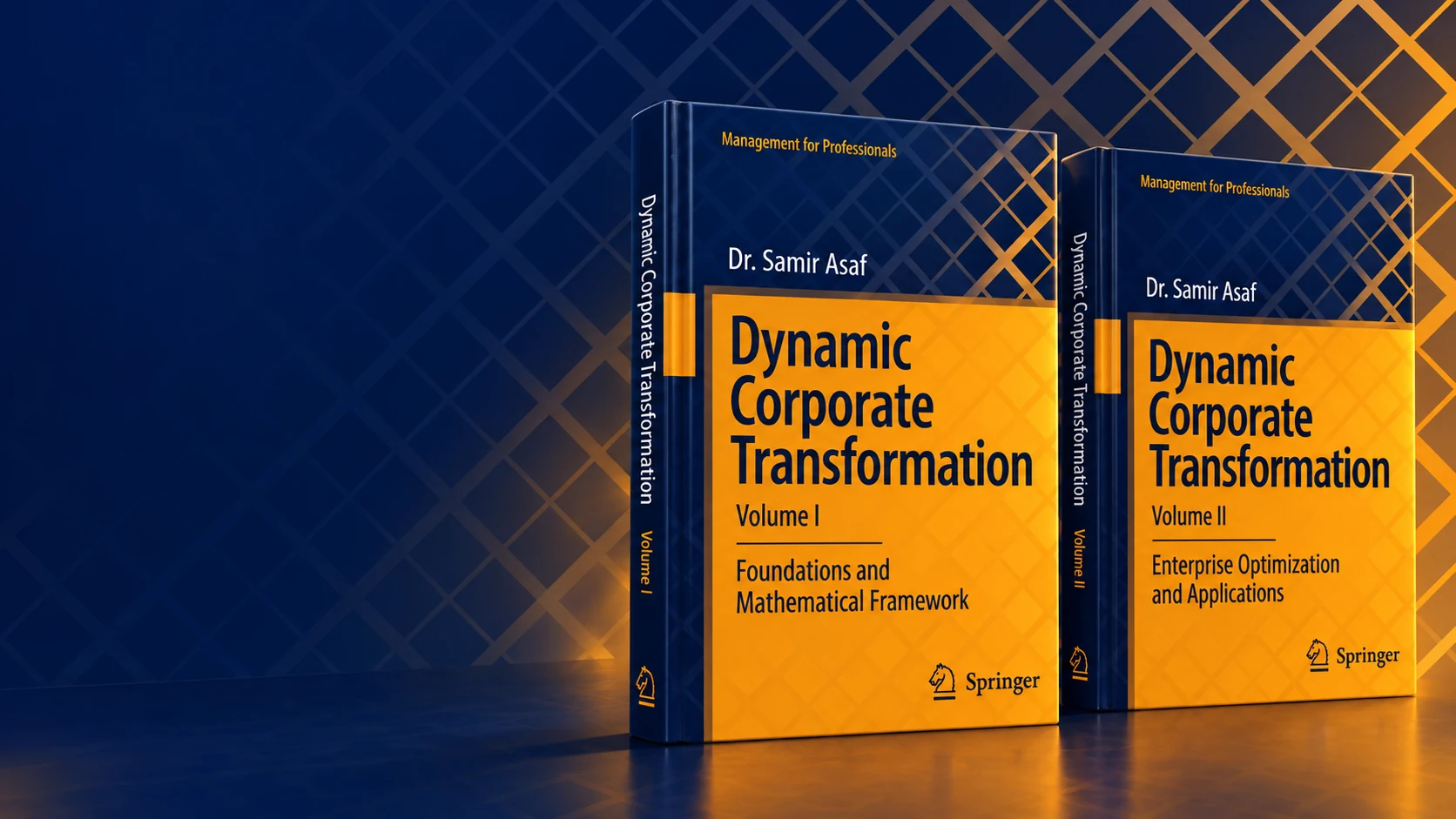
Dynamic Corporate Transformation
Springer Nature · Management for Professionals · Forthcoming 2027
Overview
DCT is the mathematical discipline that represents the enterprise as a dynamic system: an evolving enterprise state x(t) ∈ X, governed by transformation operators, resourced by a multidimensional capital architecture, measured by a performance architecture, exposed through a risk, resilience and robustness architecture, integrated in a unified architecture, and optimized through the General Enterprise Optimization Problem.
Volume I: Foundations and Mathematical Framework
Foundations and mathematical framework: states, operators, dynamics, and the five enterprise architectures — culminating in the General Enterprise Optimization Problem.
16 chapters · 80 learning outcomes
Part 1. Foundations
Part 2. Mathematical Representation
Part 3. Enterprise Architectures
Part 4. Integration and Transition
Volume II: Enterprise Optimization & Applications
Convex, nonlinear, dynamic, optimal-control, stochastic, robust, multi-objective, and AI-assisted solution theory — through digital twins and integrated case studies.
16 chapters · 80 learning outcomes
Part 1. Enterprise Optimization Foundations
Part 2. Dynamic Enterprise Optimization
Part 3. Enterprise Optimization Under Uncertainty
Part 4. Multi-Objective and Intelligent Enterprise Optimization
Part 5. Applications and Synthesis
The three-part teaching system
The book is the controlling document of a chapter-aligned ecosystem: the two-volume text, this course website, and the AXIOM computational laboratory. Every chapter page carries its Learning Outcome Statements, a reading guide, its AXIOM Lab, and three downloadable companions — a lecture deck, a seeded Python notebook, and a seeded Excel workbook that reproduce the book's numbers and check them.
Endorsements
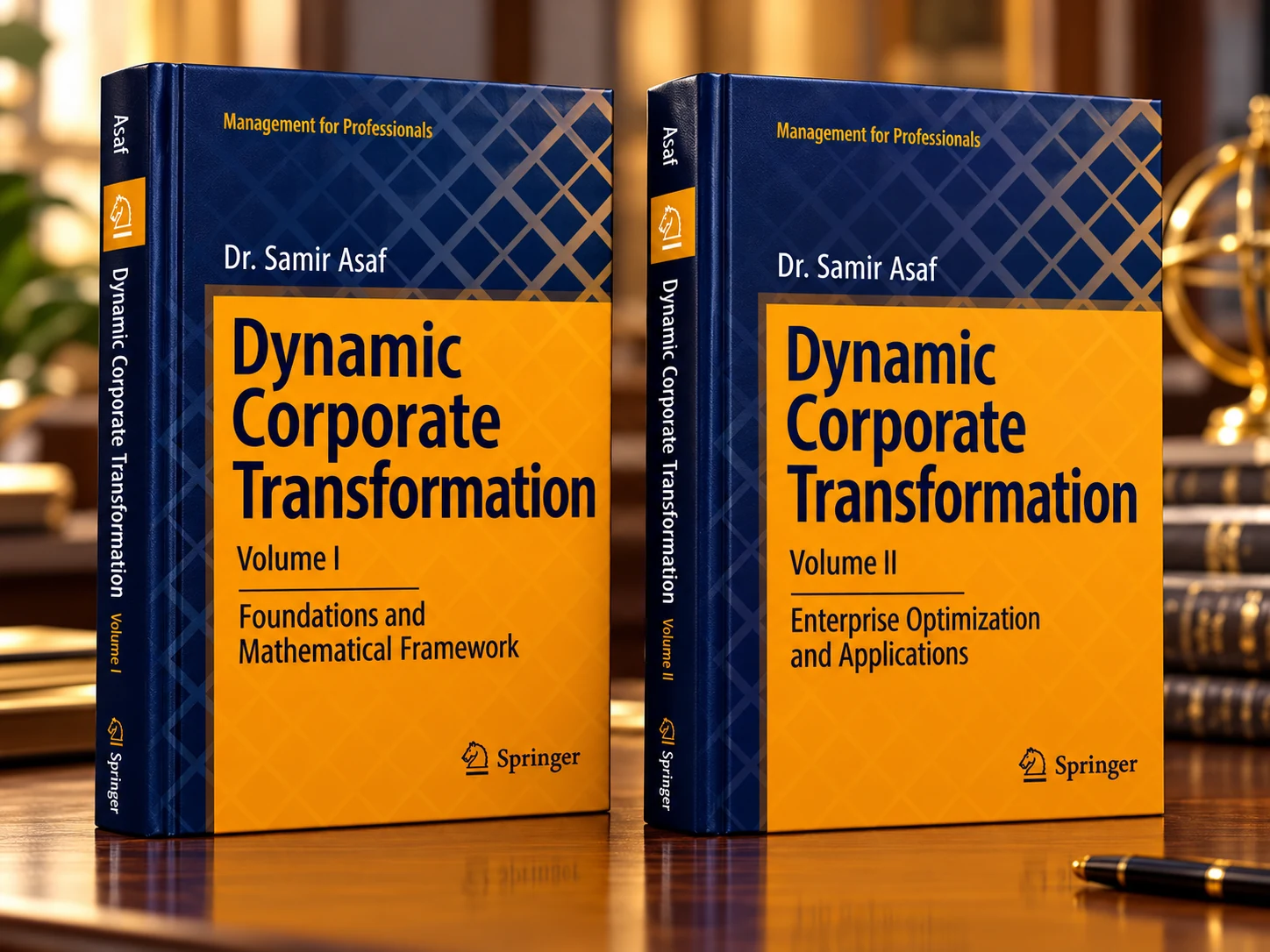
Jump to any chapter
Volume I: Foundations and Mathematical Framework
- Ch. 1Introduction to Dynamic Corporate Transformation
- Ch. 2Enterprise Systems and Transformation
- Ch. 3Mathematical Foundations
- Ch. 4Enterprise Modeling Principles
- Ch. 5Enterprise State Representation
- Ch. 6Enterprise Transformation Operators
- Ch. 7Dynamic Enterprise Systems
- Ch. 8Stochastic Enterprise Dynamics
- Ch. 9Enterprise State Architecture
- Ch. 10Enterprise Capital Architecture
- Ch. 11Enterprise Performance Architecture
- Ch. 12Enterprise Risk, Resilience, and Robustness Architecture
- Ch. 13Unified Enterprise Transformation Architecture
- Ch. 14Mathematical Analysis of the Unified Enterprise Transformation Architecture
- Ch. 15Mathematical Formulation of Enterprise Optimization
- Ch. 16Synthesis, Future Directions, and Transition to Volume II
Volume II: Enterprise Optimization & Applications
- Ch. 1Introduction to Enterprise Optimization
- Ch. 2The General Enterprise Optimization Problem Revisited
- Ch. 3Convex Enterprise Optimization
- Ch. 4Nonlinear and Mixed-Integer Enterprise Optimization
- Ch. 5Dynamic Enterprise Optimization
- Ch. 6Optimal Control of Enterprise Systems
- Ch. 7Dynamic Programming for Enterprise Systems
- Ch. 8Hamilton–Jacobi–Bellman Enterprise Framework
- Ch. 9Stochastic Enterprise Optimization
- Ch. 10Neuro-Fuzzy Robust Enterprise Optimization
- Ch. 11Distributionally Robust Enterprise Optimization
- Ch. 12Multi-Objective Enterprise Optimization
- Ch. 13Machine Learning for Enterprise Transformation
- Ch. 14Artificial Intelligence for Enterprise Optimization
- Ch. 15Enterprise Digital Twins and Autonomous Enterprise Transformation
- Ch. 16Enterprise Applications and Integrated Transformation Case Studies
The world is undergoing a deep and difficult geopolitical, technological, sociological, and cultural transformation. The corporate world has no option but to adapt and transform itself.
Through the two volumes of Dynamic Corporate Transformation, Samir Asaf brilliantly guides us through this process, drawing on his outstanding background, exceptional experience, and unique pedagogical skills. Thank you, Samir, for sharing your exceptional knowledge and distinctive analysis.
Dynamic Corporate Transformation (DCT) provides a rigorous analytical framework to think about how to choose among competing change programs, sequence them wisely, and make visible their respective costs and impacts.
Dr. Samir Asaf’s 20-year work begins with defining corporate transformation, then builds his central argument that the paths transformations take matters as much as their destinations. His framework and suggested optimizations reminded me of Professor Edward Deming’s challenge to my Operations Class, “What do you actually control? What are you able to measure? What needs to be measured? Do those measures truly reflect what is happening?”
The DCT framework is brought to life through decisions facing “The Meridian Group”, the author’s example of a diversified industrial-technology company whose board is weighing digital transformation, restructuring, and operational turnaround as competing paths forward. This gives readers a consistent business context in which to apply each concept, work through interesting decision alternative and calculation exercises, and explore impact, risk, and optimization scenarios using AXIOM Laboratory software. While the math may appear intimidating, the accompanying visualizations make the calculations “approachable” and help bring their “so what’s” to life.
Leaders who work with consultancies such as Accenture on Enterprise Operating Models, on redesigning work processes, on talent and future skill assessments, and on change navigation and adoption will find this work a useful complement. Dr. Asaf’s DCT provides an integrated mathematical framework which helps make visible the potential consequences of transformation decision pathways. The questions the book leaves for organizational researchers are among the most important in applied practice, especially with AI disruption: what are the new and emerging leadership behaviors that build positive workforce cultures, that establish leader-associate trust, and that enable enterprise transformations to scale and succeed.
Dynamic Corporate Transformation is an ambitious and important contribution to the way we think about the modern enterprise. Dr. Samir Asaf brings together strategy, finance, economics, governance, technology, risk, and organizational design within a rigorous and integrated framework for understanding how firms evolve and create value.
What distinguishes DCT is its attempt to move beyond static models of the corporation toward a dynamic, computational view of the enterprise—one that recognizes uncertainty, interdependence, and continuous transformation. The two volumes combine intellectual depth with practical relevance and provide executives, investors, consultants, and scholars with a powerful framework for analyzing and managing increasingly complex organizations. DCT is a substantial and thought-provoking work that should stimulate both academic discussion and practical application.
In Dynamic Corporate Transformation, Dr. Samir Asaf delivers a ground-breaking and rigorous mathematical foundation for how complex enterprises adapt, optimize, and execute strategy in a fast-evolving global economy. By bridging the traditional divide between corporate finance, dynamic control systems, strategic management, and enterprise architecture, Dr. Asaf provides executives and scholars alike with a comprehensive, executable framework. Volumes I and II elevate enterprise transformation from an intuitive art into a disciplined, measurable science. This two-volume work is essential reading for corporate leaders, chief architects, board members, and practitioners committed to driving long-term value, resilience, and strategic agility.
Dynamic Corporate Transformation offers a compelling new way to understand the modern enterprise as an integrated, evolving system rather than a collection of separate functions. By connecting strategy, finance, governance, technology, risk, and execution, Dr. Samir Asaf provides a rigorous framework for navigating complexity and corporate change. DCT is a timely and valuable contribution for executives, advisors, investors, and scholars seeking a more comprehensive approach to enterprise transformation.
Corporate transformation is increasingly driven by the interaction of strategy, data, technology, people, and capital. Dynamic Corporate Transformation brings these dimensions together in a rigorous and systematic framework. Dr. Samir Asaf provides leaders with a valuable way to think about the enterprise not as a static organization, but as a continuously evolving system that can be analyzed, managed, and transformed.
Dynamic Corporate Transformation offers a sophisticated perspective on corporate value creation by recognizing that financial performance cannot be separated from strategy, organizational capabilities, risk, governance, and execution. Dr. Samir Asaf has developed a comprehensive framework that should be particularly valuable to investors, corporate finance professionals, advisors, and senior executives seeking to understand how enterprise value evolves over time.
Affiliations are listed for identification only.
Specification
- Author
- Dr. Samir Asaf, PhD, CFA, CMA, CTP
- Publisher
- Springer Nature
- Series
- Management for Professionals
- Status
- Forthcoming 2027
How to cite
Jump to any chapter
Volume I: Foundations and Mathematical Framework
- Ch. 1Introduction to Dynamic Corporate Transformation
- Ch. 2Enterprise Systems and Transformation
- Ch. 3Mathematical Foundations
- Ch. 4Enterprise Modeling Principles
- Ch. 5Enterprise State Representation
- Ch. 6Enterprise Transformation Operators
- Ch. 7Dynamic Enterprise Systems
- Ch. 8Stochastic Enterprise Dynamics
- Ch. 9Enterprise State Architecture
- Ch. 10Enterprise Capital Architecture
- Ch. 11Enterprise Performance Architecture
- Ch. 12Enterprise Risk, Resilience, and Robustness Architecture
- Ch. 13Unified Enterprise Transformation Architecture
- Ch. 14Mathematical Analysis of the Unified Enterprise Transformation Architecture
- Ch. 15Mathematical Formulation of Enterprise Optimization
- Ch. 16Synthesis, Future Directions, and Transition to Volume II
Volume II: Enterprise Optimization & Applications
- Ch. 1Introduction to Enterprise Optimization
- Ch. 2The General Enterprise Optimization Problem Revisited
- Ch. 3Convex Enterprise Optimization
- Ch. 4Nonlinear and Mixed-Integer Enterprise Optimization
- Ch. 5Dynamic Enterprise Optimization
- Ch. 6Optimal Control of Enterprise Systems
- Ch. 7Dynamic Programming for Enterprise Systems
- Ch. 8Hamilton–Jacobi–Bellman Enterprise Framework
- Ch. 9Stochastic Enterprise Optimization
- Ch. 10Neuro-Fuzzy Robust Enterprise Optimization
- Ch. 11Distributionally Robust Enterprise Optimization
- Ch. 12Multi-Objective Enterprise Optimization
- Ch. 13Machine Learning for Enterprise Transformation
- Ch. 14Artificial Intelligence for Enterprise Optimization
- Ch. 15Enterprise Digital Twins and Autonomous Enterprise Transformation
- Ch. 16Enterprise Applications and Integrated Transformation Case Studies
APA
Asaf, S. (forthcoming 2027). Dynamic Corporate Transformation (Vols. I–II). Management for Professionals. Springer Nature.
Chicago
Asaf, S. Dynamic Corporate Transformation. Vols. I–II. Management for Professionals. Springer Nature, forthcoming 2027.
BibTeX
@book{asaf2027dct,
  author    = {Asaf, S.},
  title     = {Dynamic Corporate Transformation},
  volume    = {I--II},
  publisher = {Springer Nature},
  series    = {Management for Professionals},
  year      = {2027},
  note      = {forthcoming 2027},
}Other books
The General Equilibrium Theory of Private Capital Valuation
by Dr. Samir Asaf
Chapman & Hall/CRC · Chapman & Hall/CRC Financial Mathematics Series · 2026
liquidityillusion.comExecutive Corporate Finance
The Business of Enhancing Shareholder Value
by Dr. Samir Asaf
Prentice Hall / Financial Times · 2004
Master Open-Source Engagement to Improve Change Management and Digital Transformation Effectiveness by 3X
by Dr. Samir Asaf
Performax Business Press · 2019