

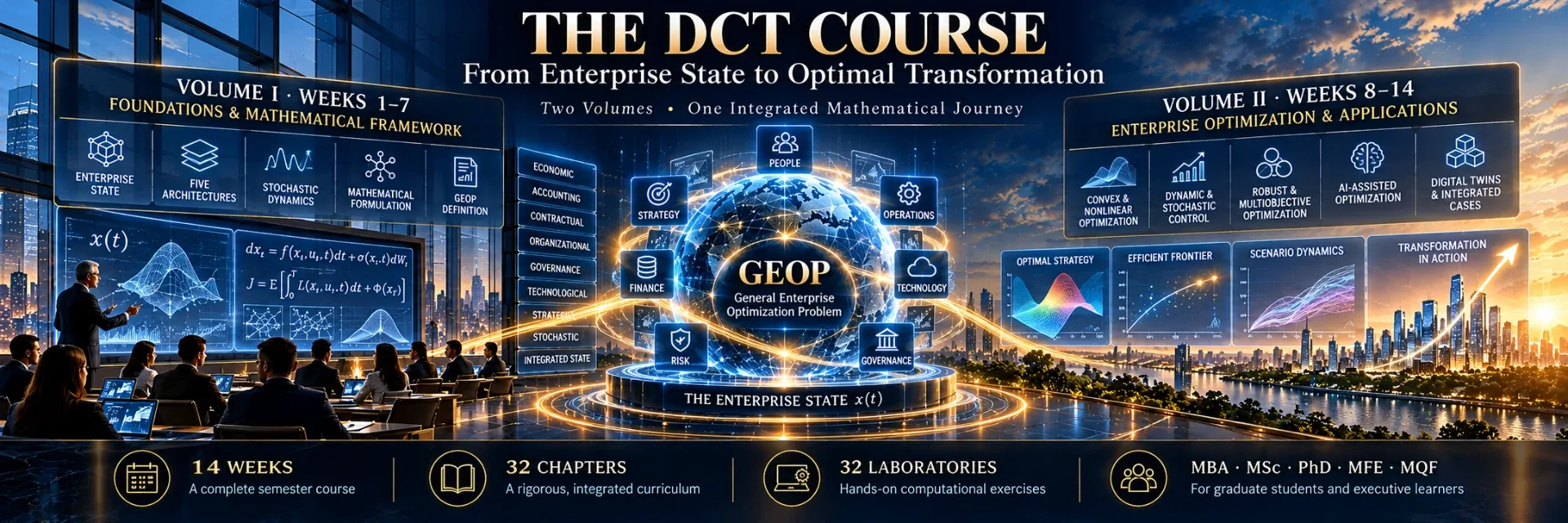
![The DCT course — from enterprise state to optimal transformation: two volumes, one integrated mathematical journey. On the left, Volume I, weeks 1 to 7, foundations and mathematical framework, with five panels — enterprise state, five architectures, stochastic dynamics, mathematical formulation and the GEOP definition — above an executive classroom where graduate students face a lecturer before glowing screens showing the state equation dx = f(x, u, t)dt + sigma(x, t)dW and the objective J = E[integral of L(x, u, t)dt plus the terminal cost]. A column of nine tags names the economic, accounting, contractual, organizational, governance, technological, strategic and stochastic architectures and the integrated state. In the centre, a glowing globe of the General Enterprise Optimization Problem (GEOP) ringed by orbiting golden rings and seven badges — people, operations, technology, governance, risk, finance and strategy — standing on a plinth labelled the enterprise state x(t). On the right, Volume II, weeks 8 to 14, enterprise optimization and applications, with five panels — convex and nonlinear optimization, dynamic and stochastic control, robust and multiobjective optimization, AI-assisted optimization, and digital twins and integrated cases — above four screens: optimal strategy, efficient frontier, scenario dynamics and transformation in action. Along the foot, four notes on the length of the semester, the chapters, the laboratories and the degrees the course serves.](/__l5e/assets-v1/74f22be8-9d1b-435e-8b5b-55afac94141d/dct-course-foundations-to-transformation.webp)
The DCT course
One-semester graduate course · MBA, MSc, PhD, MFE, MQF
Dynamic Corporate Transformation (DCT) develops the enterprise as a dynamic system and enterprise transformation as a mathematical optimization problem. Weeks 1–7 build the framework (Volume I) and culminate in the General Enterprise Optimization Problem; weeks 8–14 solve it (Volume II) across convex, nonlinear, dynamic, stochastic, robust, multi-objective, and AI-assisted formulations, closing with digital twins and integrated case studies.
14weeks
32chapters
32laboratories
2recorded lectures
14-Week Schedule
- W1DCT vision; enterprise systems
- W2Mathematical foundations; modeling principles
- W3Enterprise state; transformation operators
- W4Dynamic systems; stochastic dynamics
- W5The architectures: state, capital, performance
- W6Risk, resilience, robustness; UETA
- W7Analysis of UETA; the GEOP; synthesis
- W8Enterprise optimization; GEOP revisited
- W9Convex; nonlinear
- W10Dynamic optimization; optimal control (PMP)
- W11The Bellman arc: DP, HJB, stochastic control
- W12The robustness pair: NF-REO, DRO
- W13Multi-objective; machine learning
- W14AI; digital twins; case-study capstone
Everything for the course
Dynamic Corporate Transformation


