

Consulting
DCT Helix™
The transformation framework for enterprises that never stop changing.
Corporate transformation is not incremental change. It is a deliberate step-change: a decision to move the enterprise to a new equilibrium of capability and value, paid for in effort, time and money, and carried by hard and soft systems together.
And no enterprise moves as one. Finance, people, customer experience and operations each transform on their own clock, while ERP, data and the operating model cut across them all. DCT Helix™ orchestrates those asynchronous step-changes into shareholder value: each department climbs in steps, continuous improvement holds every gain, shared platforms keep the departments in step, and the whole portfolio is re-planned as the world moves. The loop never closes. It climbs.
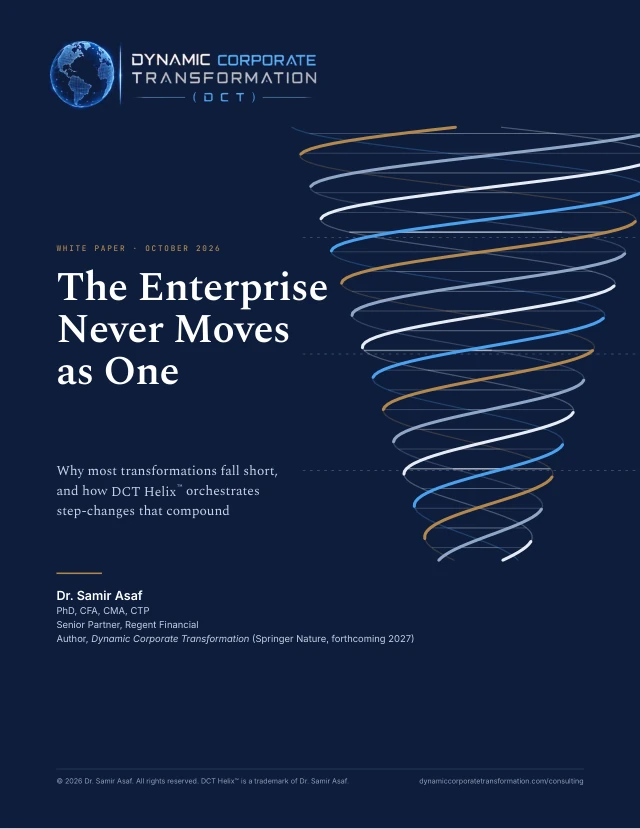 Read the white paperThe Enterprise Never Moves as One
Strands: departmentsRungs: shared programmesDots: a department's projectEach level: a new equilibrium
Readiness decides how far you can climb
Ten readiness dimensions are scored; three of them are critical. The weakest of those three sets the step a company can actually attempt — not the average, which is why a strong profile with one weak critical capability still gets capped. Point at a level to read it.
White paper
The Enterprise Never Moves as One
Why most transformations fall short, and how DCT Helix™ orchestrates step-changes that compound
A 54-page paper by Dr. Samir Asaf for boards, executives, transformation leaders and consulting firms. It reads the evidence on why most transformations fall short, sets out DCT Helix™ in full, and reads four public transformations (DBS, Microsoft, Ford and Danaher) through the Helix lens, with 37 exhibits and 114 references.
Inside the paper
Part I
Why transformations fall short
- The evidence, read correctly
- Fat tails: why averages mislead
- The AI wave repeats the pattern
- Seven misreadings
Part II
The DCT Helix
- Strands, rungs and clocks
- The shallow dip
- The change budget
- The Helix map
- Plans as distributions
- Twenty principles
Part III
Making it real
- Readiness and the weakest link
- Enterprise architecture
- AXIOM, the engine room
- Cases: DBS, Microsoft, Ford, Danaher
- Governance and the board
Part IV
Working together
- How an engagement runs
- For consulting firms
- About the author
Full contents
Part I: Why transformations fall short
- Transformation is not change
- The evidence, read correctly
- Fat tails: why averages mislead
- The AI wave repeats the pattern
- Complex, misunderstood, misapplied
- Seven misreadings
- Case: Target Canada, Lidl, Hershey
Part II: The DCT Helix
- At a glance
- Strands, rungs and clocks
- Orchestration
- The shallow dip
- The change budget
- Friction
- The loop and its gates
- The Helix map
- Gates as options; the benefits ledger
- The four systems
- Leadership, incentives and culture
- The engines
- Value
- Plans as distributions
- The strategy–execution gap
- Risk, advantage and trends
- The mathematics underneath
- Twenty principles
Part III: Making it real
- Readiness and the weakest link
- Methods you already use
- Enterprise architecture
- AXIOM, the engine room
- Case: DBS
- Case: Microsoft
- Case: Ford
- Case: Danaher
- Governance and the board
Part IV: Working together
- How an engagement runs
- For consulting firms
- About the author
- Start the conversation
01
Why transformations stall
The same four departments, three ways to transform them. Switch between the regimes and watch where the friction appears.
Departments still step at different times, but around shared platforms and agreed sync windows. Friction is priced and planned down, change capacity is never overdrawn, and continuous improvement keeps every plateau rising between steps.
Swipe the chart sideways to see the whole timeline.
Illustrative: the shapes show the pattern, not data.
02
Seven parts, one system
DCT Helix™ has seven parts. Each is useful on its own; together they turn a set of department projects into one enterprise transformation that never has to stop.
- 01The LoopSeven moves, run again and again
The seven moves of Dynamic Corporate Transformation applied to implementation: Represent the enterprise honestly, Analyze its dynamics, Certify the step it can take, Optimize the design and the path, Execute, Monitor, and Adapt. Each move ends at a gate that issues a certificate: what was declared, what was checked, what remains open, and who owns it. Adapt hands the next Represent a new baseline, so the loop has no end-state.
- 02The StrandsEvery department on its own clock
Finance, people, customer experience, operations, procurement, technology, risk and product each transform at their own time, from their own maturity, at their own pace. DCT Helix™ treats asynchrony as a fact to be orchestrated, not a failure to be eliminated.
- 03The RungsCross-cutting programs that bind the strands
ERP and core systems, the data and AI platform, end-to-end processes, the operating model, leadership and culture, and M&A integration cut across departments. Well timed, they let strands move independently without breaking each other; mistimed, they force rework everywhere they touch.
- 04The OrchestratorThe portfolio brain
Decides when each strand steps and how far, under real constraints: dependencies, budget, the organization's capacity for change, scarce experts and release windows. It prices the friction of being out of step, schedules sync windows, and re-optimizes the portfolio every quarter on stochastic pro forma statements.
- 05The Four SystemsWhat every step must move
Value (why we transform), Hard (what we change), Soft (who makes it happen) and Control (how we know and steer). A step that moves the hard system without the soft one does not hold; a step without the control system cannot be steered.
- 06The EnginesWhat runs between the steps
Continuous improvement, change management, financial discipline, operational excellence, learning, risk and best-practice transfer. The engines hold each new equilibrium and extend it, so the next step starts from higher ground.
- 07ReadinessCapability sets the attainable step
A maturity assessment by department and dimension decides where to start, how large a step each strand can take, and in what order. For coupled strands a weakest-link rule applies: no department can step further than the capabilities it depends on.
03
The Helix map
Seven moves across, four systems down. Every box is a piece of work with an owner; open it for what it is and why it matters. Strands, rungs and engines sit around the grid.
1 · G1Represent: Diagnose the enterprise
Value
Hard
Soft
Control
2 · G2Analyze: Understand the dynamics
Value
Hard
Soft
Control
3 · G3Certify: Size and certify the step
Value
Hard
Soft
Control
4 · G4Optimize: Design the target and the path
Value
Hard
Soft
Control
5 · G5Execute: Mobilize and deliver
Value
Hard
Soft
Control
6 · G6Monitor: Measure, sense and steer
Value
Hard
Soft
Control
7 · G7Adapt: Embed, learn and renew
Value
Hard
Soft
Control
StrandsDepartments, each on its own clock
RungsPrograms that cut across them
EnginesRunning between the steps
04
Readiness self-check
Capability sets the attainable step. Score your organization on ten dimensions; the check applies the weakest-link rule and suggests where to start. It takes two minutes and is not the full diagnostic.
Defined: Value drivers defined and linked to strategy
Defined: Journeys mapped; customer metrics reported
Defined: Top team aligned on goals
Defined: A common change method with trained sponsors
Defined: End-to-end processes defined with owners
Defined: Integrated core and a governed data model
Defined: Balanced scorecards at the top
Defined: Benefits tracked against plan
Defined: Lean or Six Sigma practiced in pockets
Defined: Risks owned, with appetites declared
05
Twenty principles
The ideas the framework is built on, in the order a transformation meets them.
- 01
Step-change, not drift
Transformation is a deliberate, discontinuous move to a new equilibrium, paid for in effort, time and money. Incremental change alone never gets there.
- 02
Value is the scoreboard
The end is shareholder value through sustainable, profitable growth, organic and acquisitive. Growth counts only where returns beat the cost of capital.
- 03
Start outside-in
Begin with customers, competitors and trends, not with the organization chart. Advantage is earned in the market and defended there.
- 04
Hard and soft together
Systems and processes move only as fast as vision, leadership and incentives move people. Neither holds without the other.
- 05
Readiness sets the step
Organizational maturity decides how large a step can succeed, and the weakest critical capability caps it.
- 06
Departments move on their own clocks
Finance, people, customer experience and operations transform at different times. Asynchrony is a fact to orchestrate, not a failure to eliminate.
- 07
Price the friction
Being out of step costs money: reconciliations, workarounds, duplicate data and conflicting KPIs. Measure it, own it and plan it down.
- 08
Shared platforms first
ERP, data and end-to-end processes are sequenced so that departments can move without breaking each other.
- 09
Respect the change budget
The capacity to absorb change is finite and recovers slowly. Overload fails more transformations than ambition does.
- 10
Plans are distributions
Business cases, forecasts and pro forma statements are stochastic. Commit with a stated chance of success, not a single number.
- 11
Fund like options
Release money in tranches at gates, with kill criteria written before it is spent.
- 12
Certify every gate
Nothing advances without a certificate: what was declared, what was checked, what remains open and who owns it.
- 13
Close the strategy-execution gap
Engagement, incentives, communication and alignment, vertical and horizontal, turn plans into results.
- 14
Pay for outperformance at every level
And audit every measure that is paid on, before it becomes a target to be gamed.
- 15
Listen for blind spots
Customers, employees and partners see what management cannot. Their feedback is an instrument, not a survey.
- 16
Measure what steers
KPIs, balanced scorecards, process and customer metrics, from the board to the front line, read in time to act.
- 17
Bank benefits; don't promise them
Value counts when it shows in the income statement, the balance sheet or cash.
- 18
Marry the step to continuous improvement
Every step-change is held and extended by Lean Six Sigma, kaizen and daily improvement.
- 19
Best practice as DNA
Industry best practice, adopted and adapted, becomes the company's habit rather than a project.
- 20
The loop never closes
There is no end-state. The portfolio is re-planned every quarter, and the next step is triggered before a crisis forces it.
06
Discuss a transformation
DCT Helix™ engagements start with a readiness diagnostic and a transformation inventory: where the enterprise stands, what is already moving, and the step it can take next.
Detailed playbook
The detailed playbook behind every element of the map (key activities, deliverables, KPIs, questions for the board, failure modes and the DCT methods behind them) is available to clients and invited readers. Request access, and you will receive a code by email.
© 2026 Samir Asaf. All rights reserved. DCT Helix™ is a trademark of Samir Asaf.