

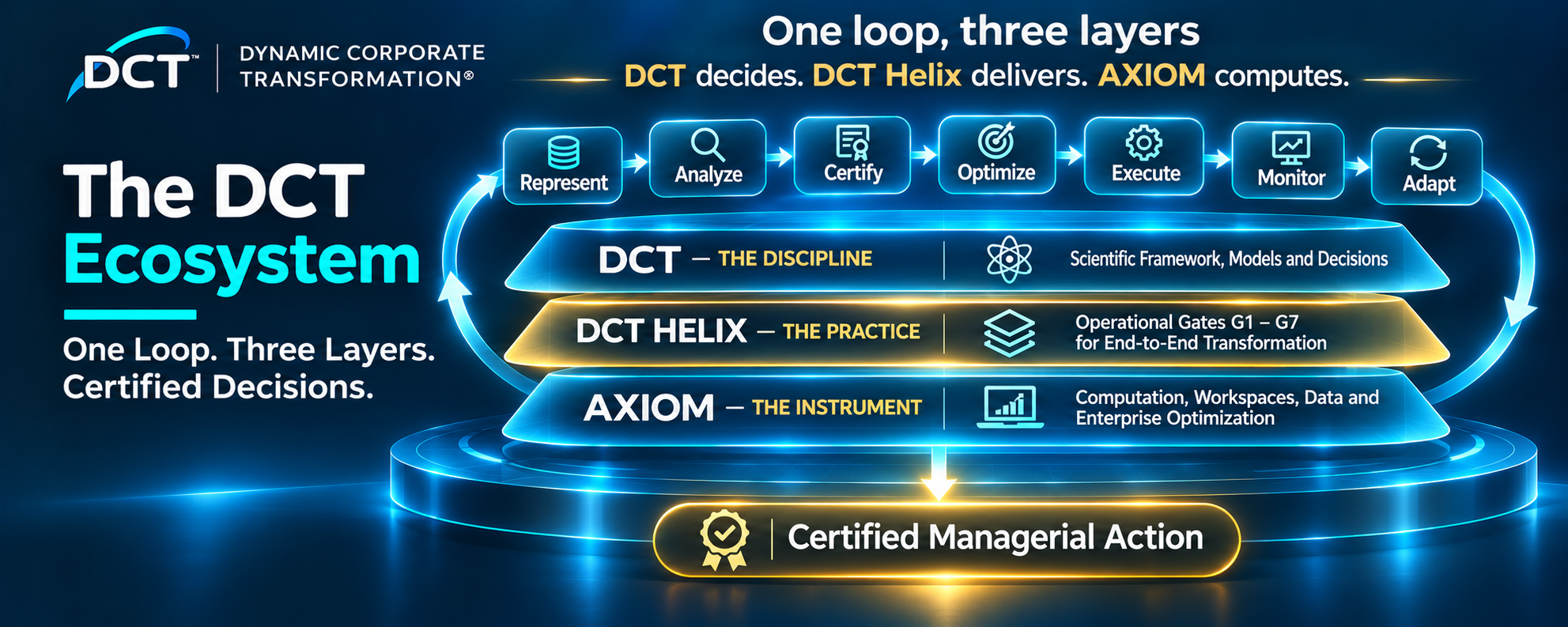
One loop, three layers
DCT decides. DCT Helix delivers. AXIOM computes.
The same seven moves run in all three; each layer answers a different question about them.
Adapt hands the next Represent a new baseline: every end-state becomes the next starting point.
What DCT measures and improves: every outcome has a quantity
- Value
- the objective J
- Resilience
- margin and recovery rate
- Capital efficiency
- the costates
- Risk
- breach probability inside coherent limits
- Strategic agility
- the reachable set
- Execution
- benefits banked against plan
- Adaptability
- re-certification on declared triggers
Sources: the DCT Helix gates; the AXIOM workspaces from the DCT Helix white paper (October 2026), Exhibit 29; the DCT column condenses the hands-on notes of the DCT Map’s seven moves.
Move by move
DCT
What is the enterprise, mathematically?
Declare state, controls, disturbances, dynamics
DCT Helix
Diagnose the enterprise
G1 Baseline certified: state declared and owned
AXIOM
Structure, Dashboard
health, valuation, KPIs
Map concepts in this move · 12
- The transformation question
- Enterprise as open adaptive system
- Limits of existing frameworks
- Need for state, dynamics, control, optimization
- Mathematical language
- Modeling principles
- Enterprise state
- Management controls
- Environment and disturbance
- Transformation operator
- Dynamic enterprise systems
- Stochastic enterprise dynamics
DCT
What is it made of, and how do the parts move each other?
Five architectures and the coupling register M
DCT Helix
Understand the dynamics
G2 Diagnosis certified: value drivers, couplings
AXIOM
Profitability, Feedback
where value is made and lost
Map concepts in this move · 6
DCT
Is the problem fit to optimize — and how would we know if it were not?
Consistency, ρ(A) < 1, x₀ in the viability kernel
DCT Helix
Size and certify the step
G3 Step certified: value range, appetite, first tranche
AXIOM
Optimization
value as a distribution
Map concepts in this move · 5
DCT Helix work in this move · 4
DCT
Which admissible policy is best, and in what precise sense?
Solve the GEOP: policy π*, multipliers, costates
DCT Helix
Design the target and the path
G4 Design certified: fits budget and change capacity
AXIOM
Strategy, Planning, Financing
strategy maps, forecasts, pro formas
Map concepts in this move · 5
DCT
How does an optimal policy become a decision someone actually takes?
Sequence by operator order and allocate by costates
AXIOM
PMO, Execution
initiatives, capacity
Map concepts in this move · 2
DCT
Is the enterprise where the model says it should be?
Estimate the state; watch the certificate conditions
DCT Helix
Measure, sense and steer
G6 New equilibrium certified: the step holds
AXIOM
Dashboard, Execution
KPIs, executive brief
Map concepts in this move · 2
DCT Helix work in this move · 6
DCT
What changes when the world does?
Re-estimate, re-certify, re-solve on declared triggers
DCT Helix
Embed, learn and renew
G7 Renewal decision: hold, extend or start the next turn
AXIOM
Planning, Strategy
re-forecast and re-plan
Map concepts in this move · 2
DCT Helix work in this move · 5
Go deeper

Jump to any chapter
Volume I: Foundations and Mathematical Framework
- Ch. 1Introduction to Dynamic Corporate Transformation
- Ch. 2Enterprise Systems and Transformation
- Ch. 3Mathematical Foundations
- Ch. 4Enterprise Modeling Principles
- Ch. 5Enterprise State Representation
- Ch. 6Enterprise Transformation Operators
- Ch. 7Dynamic Enterprise Systems
- Ch. 8Stochastic Enterprise Dynamics
- Ch. 9Enterprise State Architecture
- Ch. 10Enterprise Capital Architecture
- Ch. 11Enterprise Performance Architecture
- Ch. 12Enterprise Risk, Resilience, and Robustness Architecture
- Ch. 13Unified Enterprise Transformation Architecture
- Ch. 14Mathematical Analysis of the Unified Enterprise Transformation Architecture
- Ch. 15Mathematical Formulation of Enterprise Optimization
- Ch. 16Synthesis, Future Directions, and Transition to Volume II
Volume II: Enterprise Optimization & Applications
- Ch. 1Introduction to Enterprise Optimization
- Ch. 2The General Enterprise Optimization Problem Revisited
- Ch. 3Convex Enterprise Optimization
- Ch. 4Nonlinear and Mixed-Integer Enterprise Optimization
- Ch. 5Dynamic Enterprise Optimization
- Ch. 6Optimal Control of Enterprise Systems
- Ch. 7Dynamic Programming for Enterprise Systems
- Ch. 8Hamilton–Jacobi–Bellman Enterprise Framework
- Ch. 9Stochastic Enterprise Optimization
- Ch. 10Neuro-Fuzzy Robust Enterprise Optimization
- Ch. 11Distributionally Robust Enterprise Optimization
- Ch. 12Multi-Objective Enterprise Optimization
- Ch. 13Machine Learning for Enterprise Transformation
- Ch. 14Artificial Intelligence for Enterprise Optimization
- Ch. 15Enterprise Digital Twins and Autonomous Enterprise Transformation
- Ch. 16Enterprise Applications and Integrated Transformation Case Studies
Dynamic Corporate Transformation
Springer Nature · Management for Professionals · Forthcoming 2027
- Volume I — Foundations and Mathematical Framework
- Volume II — Enterprise Optimization & Applications
Jump to any chapter
Volume I: Foundations and Mathematical Framework
- Ch. 1Introduction to Dynamic Corporate Transformation
- Ch. 2Enterprise Systems and Transformation
- Ch. 3Mathematical Foundations
- Ch. 4Enterprise Modeling Principles
- Ch. 5Enterprise State Representation
- Ch. 6Enterprise Transformation Operators
- Ch. 7Dynamic Enterprise Systems
- Ch. 8Stochastic Enterprise Dynamics
- Ch. 9Enterprise State Architecture
- Ch. 10Enterprise Capital Architecture
- Ch. 11Enterprise Performance Architecture
- Ch. 12Enterprise Risk, Resilience, and Robustness Architecture
- Ch. 13Unified Enterprise Transformation Architecture
- Ch. 14Mathematical Analysis of the Unified Enterprise Transformation Architecture
- Ch. 15Mathematical Formulation of Enterprise Optimization
- Ch. 16Synthesis, Future Directions, and Transition to Volume II
Volume II: Enterprise Optimization & Applications
- Ch. 1Introduction to Enterprise Optimization
- Ch. 2The General Enterprise Optimization Problem Revisited
- Ch. 3Convex Enterprise Optimization
- Ch. 4Nonlinear and Mixed-Integer Enterprise Optimization
- Ch. 5Dynamic Enterprise Optimization
- Ch. 6Optimal Control of Enterprise Systems
- Ch. 7Dynamic Programming for Enterprise Systems
- Ch. 8Hamilton–Jacobi–Bellman Enterprise Framework
- Ch. 9Stochastic Enterprise Optimization
- Ch. 10Neuro-Fuzzy Robust Enterprise Optimization
- Ch. 11Distributionally Robust Enterprise Optimization
- Ch. 12Multi-Objective Enterprise Optimization
- Ch. 13Machine Learning for Enterprise Transformation
- Ch. 14Artificial Intelligence for Enterprise Optimization
- Ch. 15Enterprise Digital Twins and Autonomous Enterprise Transformation
- Ch. 16Enterprise Applications and Integrated Transformation Case Studies