

Vol. II, Ch. 12seed 26212
DCT Laboratory — Volume II, Chapter 12
Multi-Objective Enterprise Optimization
Seed 26212 · Companion to the chapter and AXIOM Module AXIOM-12 (Vol. II)
When the enterprise wants several things at once. Three acts: Pareto
dominance sorted by hand over eight candidate policies (five efficient,
three dominated), the scalarization gap exhibited — policy D sits in a
non-convex dent of the frontier that no weighted sum can select, but a
weighted-Chebyshev compromise finds it — and a continuous frontier where
the Trade-Off Theorem's slope identity is verified point by point.
Mirrored in DCT_V2_Ch12_Lab.xlsx.
import numpy as np
import matplotlib.pyplot as plt
plt.rcParams['figure.dpi']=110

import numpy as np
SEED = 26212
NAMES = list("ABCDEFGH")
PTS = {"A":(2,9.0),"B":(4,8.0),"C":(5,5.0),"D":(6,6.5),"E":(7,4.0),"F":(8,6.0),"G":(9,2.0),"H":(3,6.0)}
def dominated(name):
    g,r = PTS[name]
    return any((g2 >= g and r2 >= r and (g2 > g or r2 > r)) for n2,(g2,r2) in PTS.items() if n2 != name)
def pareto_set(): return [n for n in NAMES if not dominated(n)]
def ws_winner(w):
    vals = {n: w*g + (1-w)*r for n,(g,r) in PTS.items()}
    return max(vals, key=vals.get)
def ws_selects_D():
    return int(any(ws_winner(round(0.05*i,2)) == "D" for i in range(21)))
# weighted Chebyshev compromise to the ideal point (9, 9), weights (1, 1.5)
IDEAL = (9.0, 9.0); WCH = (1.0, 1.5)
def cheb(name):
    g,r = PTS[name]
    return max(WCH[0]*abs(IDEAL[0]-g), WCH[1]*abs(IDEAL[1]-r))
def cheb_winner():
    return min(pareto_set(), key=cheb)
# continuous frontier: f1 = x, f2 = 1 - x^2 on [0,1]; weighted sum w*f1+(1-w)*f2
def x_star(w): return min(1.0, w/(2*(1-w))) if w < 1 else 1.0
def w_corner(step=0.1):
    for i in range(1,10):
        w = round(step*i,2)
        if w/(2*(1-w)) >= 1.0: return w
    return None

def reference_values():
    return {
        "n_candidates": len(NAMES),
        "n_pareto": len(pareto_set()),
        "n_dominated": len(NAMES)-len(pareto_set()),
        "D_is_pareto": int("D" in pareto_set()),
        "ws_selects_D": ws_selects_D(),
        "cheb_D": round(cheb("D"),4), "cheb_F": round(cheb("F"),4),
        "cheb_winner_is_D": int(cheb_winner() == "D"),
        "x_star_w05": round(x_star(0.5),4),
        "f1_w05": round(x_star(0.5),4),
        "f2_w05": round(1-x_star(0.5)**2,4),
        "tradeoff_w05": round(-2*x_star(0.5),4),
        "w_corner": w_corner(),
    }
if __name__ == "__main__":
    print("pareto set:", pareto_set(), "  chebyshev winner:", cheb_winner())
    [print(f"{k:18s} {v}") for k,v in reference_values().items()]
pareto set: ['A', 'B', 'D', 'F', 'G'] chebyshev winner: D n_candidates 8 n_pareto 5 n_dominated 3 D_is_pareto 1 ws_selects_D 0 cheb_D 3.75 cheb_F 4.5 cheb_winner_is_D 1 x_star_w05 0.5 f1_w05 0.5 f2_w05 0.75 tradeoff_w05 -1.0 w_corner 0.7
Panel 1 — Dominance does the first cut
Eight candidate policies scored on growth and resilience. Pareto Dominance (Def.): a policy is dominated if another is at least as good in both objectives and strictly better in one. Three fall — C to D, E to F, H to B — and five survive: the Pareto set (Pareto Optimal Enterprise Policy, Def.). No Single Efficient Solution Optimizes All Objectives (Prop.): among survivors, every move that gains growth costs resilience — the disagreement that remains after logic has done all it can.
fig, ax = plt.subplots(figsize=(7.6,4.6))
for n,(g,r) in PTS.items():
    on = n in pareto_set()
    ax.scatter([g],[r], s=110, c="#C8A24B" if on else "#8A8F8B", zorder=5,
               edgecolors="#0B3D2E", linewidths=1.2 if on else 0.5)
    ax.annotate(n, (g,r), textcoords="offset points", xytext=(7,5), fontsize=11,
                color="#0B3D2E" if on else "#8A8F8B", fontweight="bold" if on else "normal")
ps = sorted([PTS[n] for n in pareto_set()])
ax.plot([p[0] for p in ps],[p[1] for p in ps], "--", c="#C8A24B", lw=1.6, alpha=.7)
ax.set(xlabel="growth", ylabel="resilience", title="Five efficient, three dominated — seed 26212")
ax.grid(alpha=.25); plt.tight_layout(); plt.show()
print(f"Pareto set: {pareto_set()}   dominated: {[n for n in NAMES if dominated(n)]}")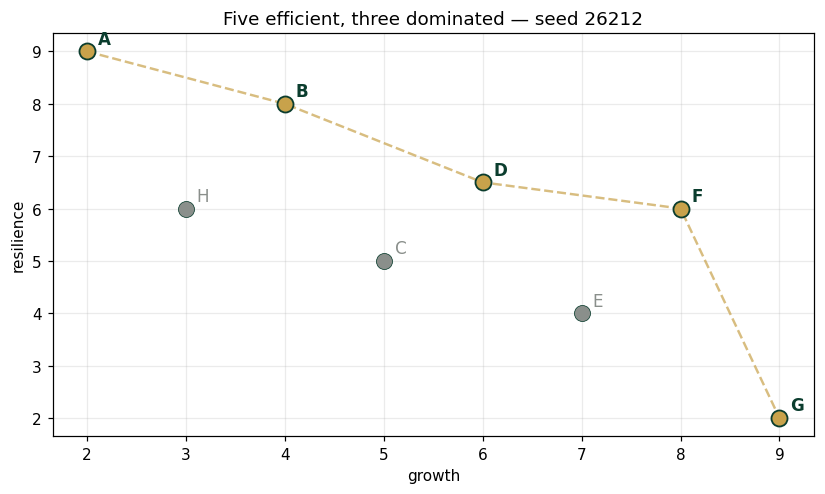
Pareto set: ['A', 'B', 'D', 'F', 'G'] dominated: ['C', 'E', 'H']
Panel 2 — The scalarization gap, and the compromise that closes it
The Weighted-Sum Representation Theorem selects only points on the frontier's convex upper boundary. Policy D is Pareto-optimal but sits in a dent — sweeping the weight across all 21 grid values, D wins zero times: some efficient policies are invisible to every weighted sum. The Enterprise Compromise Solution (Def.): minimize the weighted Chebyshev distance to the ideal point with stakeholder weights — and D wins (3.75 against F's 4.5). Stakeholder Preferences Select Among Pareto-Optimal Solutions (Prop.), with a method whose reach covers the whole frontier.
winners = [ws_winner(round(0.05*i,2)) for i in range(21)]
print("weighted-sum winners across w = 0.00 .. 1.00:", "".join(winners))
print(f"D selected by any weighted sum: {bool(ws_selects_D())}")
print(f"\nweighted Chebyshev to ideal (9,9), weights (1, 1.5):")
for n in pareto_set(): print(f"  {n}: {cheb(n):.4f}")
print(f"compromise winner: {cheb_winner()} — the dent, reached")
weighted-sum winners across w = 0.00 .. 1.00: AAAAAAAFFFFFFFFFFGGGG D selected by any weighted sum: False weighted Chebyshev to ideal (9,9), weights (1, 1.5): A: 7.0000 B: 5.0000 D: 3.7500 F: 4.5000 G: 10.5000 compromise winner: D — the dent, reached
Panel 3 — The continuous frontier and the trade-off identity
Objectives , on : every is efficient (Pareto Frontier Existence Theorem). The weighted sum has interior optimum — at : , , and the frontier's slope there is : exactly — the Enterprise Trade-Off Theorem: the chosen point is where the frontier's exchange rate equals the decision-maker's. Past the optimum hits the corner : strong enough growth preference exhausts the frontier (first grid : 0.7).
xs = np.linspace(0, 1, 200)
fig, ax = plt.subplots(figsize=(7.6,4.4))
ax.plot(xs, 1-xs**2, c="#0B3D2E", lw=2.4, label="frontier f2 = 1 − f1²")
for w in (0.3, 0.5, 0.7):
    x = x_star(w)
    ax.scatter([x],[1-x*x], s=80, c="#C8A24B", zorder=5)
    ax.annotate(f"w={w}", (x,1-x*x), textcoords="offset points", xytext=(6,6), fontsize=10, color="#0B3D2E")
ax.set(xlabel="f1 (growth)", ylabel="f2 (resilience)", title="The weight ratio picks the tangency — seed 26212")
ax.legend(frameon=False); ax.grid(alpha=.25); plt.tight_layout(); plt.show()
print(f"w=0.5: x* = {x_star(0.5):.4f}, f = ({x_star(0.5):.4f}, {1-x_star(0.5)**2:.4f}), slope = {-2*x_star(0.5):.4f}")
print(f"corner reached at grid w = {w_corner()}")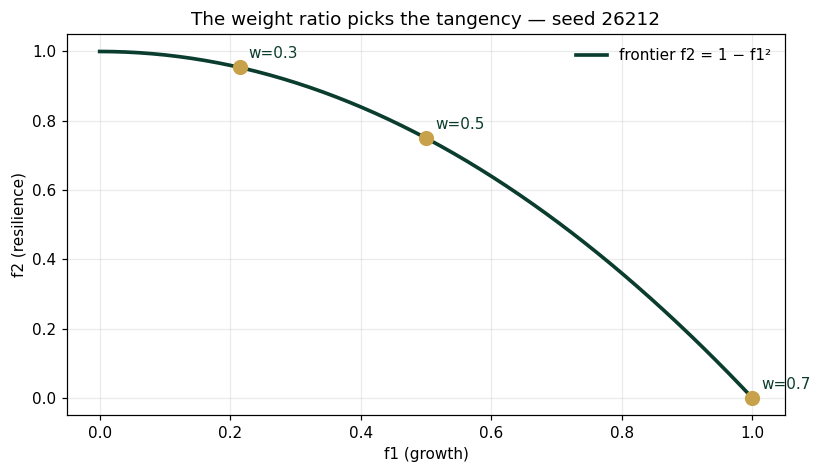
w=0.5: x* = 0.5000, f = (0.5000, 0.7500), slope = -1.0000
corner reached at grid w = 0.7
Validation — agrees with DCT_V2_Ch12_Lab.xlsx
ref = reference_values()
expected = {"n_candidates":8,"n_pareto":5,"n_dominated":3,"D_is_pareto":1,"ws_selects_D":0,
 "cheb_D":3.75,"cheb_F":4.5,"cheb_winner_is_D":1,"x_star_w05":0.5,"f1_w05":0.5,
 "f2_w05":0.75,"tradeoff_w05":-1.0,"w_corner":0.7}
for k,v in expected.items():
    assert abs(ref[k]-v)<5e-4, f"MISMATCH {k}"
    print(f"PASS  {k:18s} {ref[k]}")
print("\nAll checkpoints agree — seed 26212.")
PASS n_candidates 8 PASS n_pareto 5 PASS n_dominated 3 PASS D_is_pareto 1 PASS ws_selects_D 0 PASS cheb_D 3.75 PASS cheb_F 4.5 PASS cheb_winner_is_D 1 PASS x_star_w05 0.5 PASS f1_w05 0.5 PASS f2_w05 0.75 PASS tradeoff_w05 -1.0 PASS w_corner 0.7 All checkpoints agree — seed 26212.
Next: Exercises 12.5–12.9 (Part C) bend the dent deeper and watch goal programming and evolutionary methods handle it; AXIOM-12's frontier studio lets stakeholders drag the reference point live. Chapter 13 sends optimization to learn: machine learning. Solutions: IM Vol. II, Ch. 12.