

Skip to content

DCT Lexicon · Risk and uncertainty

Floor

The level of cash, service or a covenant ratio below which performance must not fall; the board draws it, and the programme's path is shown against it as a range.

Drafted for the author's approval from the DCT Helix white paper (The shallow dip; HX.CB.3) and Vol. I, Worked Example 8.1

In depth

In the method

For a board, the practical test is simple. Draw the floor below which performance must not fall (cash, service level, a covenant ratio), and ask the program to show its path against it. A plan that crosses the floor is not ambitious; it is fragile.

DCT Helix white paper (October 2026), The shallow dip, verbatim

Formal statement

For a reading xkx_k (quarter-end cash, say) and a floor x‾\underline{x}, the commitment is Gk=x‾−xk≤0G_k = \underline{x} - x_k \le 0 at every review k=1,…,Kk = 1, \dots, K; it is breached on a path when Gk>0G_k > 0 at some review.

Drafted for the author's approval: the floor as a commitment in the sense of Vol. II, Definition 9.1

Executive example

Chapters 1 and 5 drew the digital program’s liquidity path (Figure 5.2): it dips from $620 million to a trough of $482 million in quarter 7, $132 million above the board’s floor of $350 million (Table 5.4), and recovers to $510 million by the end of year 3.

Vol. I, Worked Example 8.1, verbatim

Common misreading

Plan on distributions where curvature lives; when a single path must be quoted, label it as the mean or as a percentile, never as “the case”.

Vol. I, Section 8.8, verbatim

How AXIOM uses it

A floor is always the company's own declaration, with an owner; AXIOM never supplies a default. Every plan, scenario and recommendation is tested against every declared floor on the same simulated paths, and the result is read as a breach probability against the board's appetite.

Drafted for the author's approval, from D-036 and AXIOM's passport "R4 floor, joint test"

In the book: Vol. I, Ch. 8: Stochastic Enterprise Dynamics · Vol. II, Ch. 9: Stochastic Enterprise Optimization

Related: Breach probability · Risk appetite · Viability Kernels · Viability kernel

HX.CB.3 · V1.WE.8.1 · V2.Def.9.1
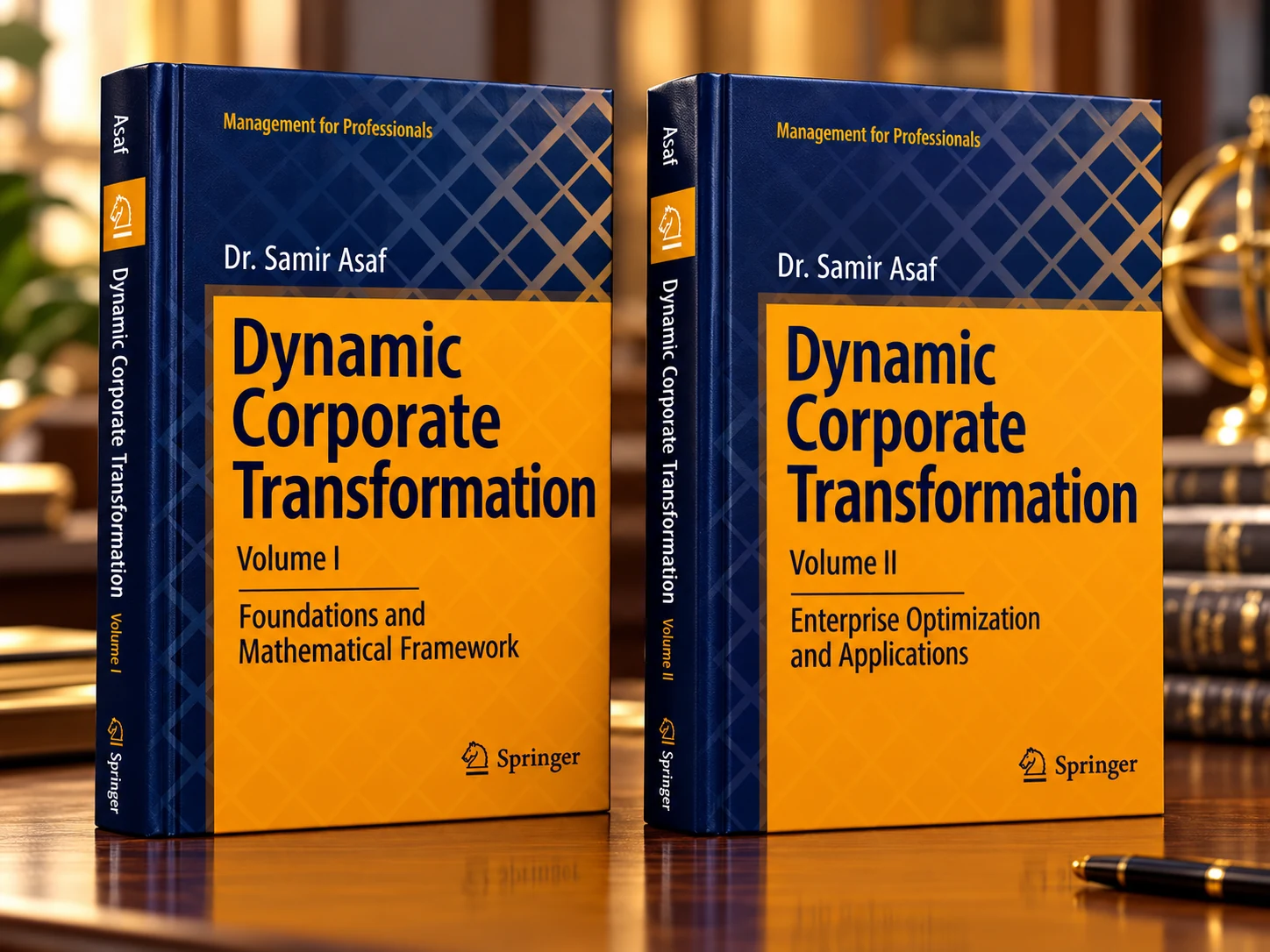
Dynamic Corporate Transformation — Volume I: Foundations and Mathematical Framework; Volume II: Enterprise Optimization & Applications
Jump to any chapter

Volume I: Foundations and Mathematical Framework

  1. Ch. 1Introduction to Dynamic Corporate Transformation
  2. Ch. 2Enterprise Systems and Transformation
  3. Ch. 3Mathematical Foundations
  4. Ch. 4Enterprise Modeling Principles
  5. Ch. 5Enterprise State Representation
  6. Ch. 6Enterprise Transformation Operators
  7. Ch. 7Dynamic Enterprise Systems
  8. Ch. 8Stochastic Enterprise Dynamics
  9. Ch. 9Enterprise State Architecture
  10. Ch. 10Enterprise Capital Architecture
  11. Ch. 11Enterprise Performance Architecture
  12. Ch. 12Enterprise Risk, Resilience, and Robustness Architecture
  13. Ch. 13Unified Enterprise Transformation Architecture
  14. Ch. 14Mathematical Analysis of the Unified Enterprise Transformation Architecture
  15. Ch. 15Mathematical Formulation of Enterprise Optimization
  16. Ch. 16Synthesis, Future Directions, and Transition to Volume II

Volume II: Enterprise Optimization & Applications

  1. Ch. 1Introduction to Enterprise Optimization
  2. Ch. 2The General Enterprise Optimization Problem Revisited
  3. Ch. 3Convex Enterprise Optimization
  4. Ch. 4Nonlinear and Mixed-Integer Enterprise Optimization
  5. Ch. 5Dynamic Enterprise Optimization
  6. Ch. 6Optimal Control of Enterprise Systems
  7. Ch. 7Dynamic Programming for Enterprise Systems
  8. Ch. 8Hamilton–Jacobi–Bellman Enterprise Framework
  9. Ch. 9Stochastic Enterprise Optimization
  10. Ch. 10Neuro-Fuzzy Robust Enterprise Optimization
  11. Ch. 11Distributionally Robust Enterprise Optimization
  12. Ch. 12Multi-Objective Enterprise Optimization
  13. Ch. 13Machine Learning for Enterprise Transformation
  14. Ch. 14Artificial Intelligence for Enterprise Optimization
  15. Ch. 15Enterprise Digital Twins and Autonomous Enterprise Transformation
  16. Ch. 16Enterprise Applications and Integrated Transformation Case Studies

Dynamic Corporate Transformation

Springer Nature · Management for Professionals · Forthcoming 2027

  • Volume I — Foundations and Mathematical Framework
  • Volume II — Enterprise Optimization & Applications
Buy Volume I: Dynamic Corporate Transformation: Foundations and Mathematical FrameworkBuy Volume II: Dynamic Corporate Transformation: Enterprise Optimization & Applications
Jump to any chapter

Volume I: Foundations and Mathematical Framework

  1. Ch. 1Introduction to Dynamic Corporate Transformation
  2. Ch. 2Enterprise Systems and Transformation
  3. Ch. 3Mathematical Foundations
  4. Ch. 4Enterprise Modeling Principles
  5. Ch. 5Enterprise State Representation
  6. Ch. 6Enterprise Transformation Operators
  7. Ch. 7Dynamic Enterprise Systems
  8. Ch. 8Stochastic Enterprise Dynamics
  9. Ch. 9Enterprise State Architecture
  10. Ch. 10Enterprise Capital Architecture
  11. Ch. 11Enterprise Performance Architecture
  12. Ch. 12Enterprise Risk, Resilience, and Robustness Architecture
  13. Ch. 13Unified Enterprise Transformation Architecture
  14. Ch. 14Mathematical Analysis of the Unified Enterprise Transformation Architecture
  15. Ch. 15Mathematical Formulation of Enterprise Optimization
  16. Ch. 16Synthesis, Future Directions, and Transition to Volume II

Volume II: Enterprise Optimization & Applications

  1. Ch. 1Introduction to Enterprise Optimization
  2. Ch. 2The General Enterprise Optimization Problem Revisited
  3. Ch. 3Convex Enterprise Optimization
  4. Ch. 4Nonlinear and Mixed-Integer Enterprise Optimization
  5. Ch. 5Dynamic Enterprise Optimization
  6. Ch. 6Optimal Control of Enterprise Systems
  7. Ch. 7Dynamic Programming for Enterprise Systems
  8. Ch. 8Hamilton–Jacobi–Bellman Enterprise Framework
  9. Ch. 9Stochastic Enterprise Optimization
  10. Ch. 10Neuro-Fuzzy Robust Enterprise Optimization
  11. Ch. 11Distributionally Robust Enterprise Optimization
  12. Ch. 12Multi-Objective Enterprise Optimization
  13. Ch. 13Machine Learning for Enterprise Transformation
  14. Ch. 14Artificial Intelligence for Enterprise Optimization
  15. Ch. 15Enterprise Digital Twins and Autonomous Enterprise Transformation
  16. Ch. 16Enterprise Applications and Integrated Transformation Case Studies