

Skip to content

DCT Lexicon · Risk and uncertainty

Risk appetite

The largest chance of breaching a floor, over the whole programme, that the board accepts; Meridian's board tolerates at most 5 percent.

Drafted for the author's approval from Vol. I, Worked Example 8.1, and Vol. II, Glossary of Key Terms ("Chance constraint")

In depth

In the book

The board’s risk appetite statement tolerates at most a 5 percent chance of breaching the floor during the program. It asks the question a single line cannot answer: with what probability does liquidity fall below the floor in some quarter of the three years?

Vol. I, Worked Example 8.1, verbatim

Formal statement

P(max⁡k≤KGk>0)  ≤  α.\mathbb{P}\Big(\max_{k \le K} G_k > 0\Big) \;\le\; \alpha.

Drafted for the author's approval: the appetite $\alpha$ of a joint chance constraint (Vol. II, Definition 9.1, Proposition 9.2)

Executive example

The cheapest package that meets the appetite is a $170 million standby line with two months’ delay, for $10.4 million, and the appetite’s price, about $1.8 million per percentage point, says the board implicitly values a breach at about $180 million.

Vol. I, Section 1.5 (The DCT Map: How the Two Volumes Fit Together), on Worked Example 15.1, verbatim

How to read it

An optimized program has no slack. If a continuous lever raises the program’s value and moves its chance of a breach continuously, a best program uses its whole appetite: at the declared law its chance equals the appetite, and if the chance rises strictly with an adverse parameter, any adverse change in it breaks the program.

Vol. II, Theorem 16.3(i), verbatim

Common misreading

A common mistake is to trust an evolutionary gallery without checking it by bounds, or to treat an appetite as a fact rather than a point chosen on a frontier.

Vol. II, LOS 12.5, verbatim

How AXIOM uses it

The board declares the appetite, with an owner. AXIOM reads every plan's joint breach probability against it, prices it (the best certified value at each appetite the board could set), and reports each declared risk's reverse-stress multiple: how far that risk can grow before the breach probability passes the appetite.

Drafted for the author's approval, from D-036 and the Impact and Decide tabs

In the book: Vol. I, Ch. 8: Stochastic Enterprise Dynamics · Vol. I, Ch. 15: Mathematical Formulation of Enterprise Optimization · Vol. II, Ch. 9: Stochastic Enterprise Optimization · Vol. II, Ch. 16: Enterprise Applications and Integrated Transformation Case Studies

Related: Breach probability · Floor · Chance Constraints and Certificates · Reverse stress test · Price of robustness (cost of doubt)

V1.WE.8.1 · V1.WE.15.1 · V2.Prop.9.2 · V2.Thm.16.3
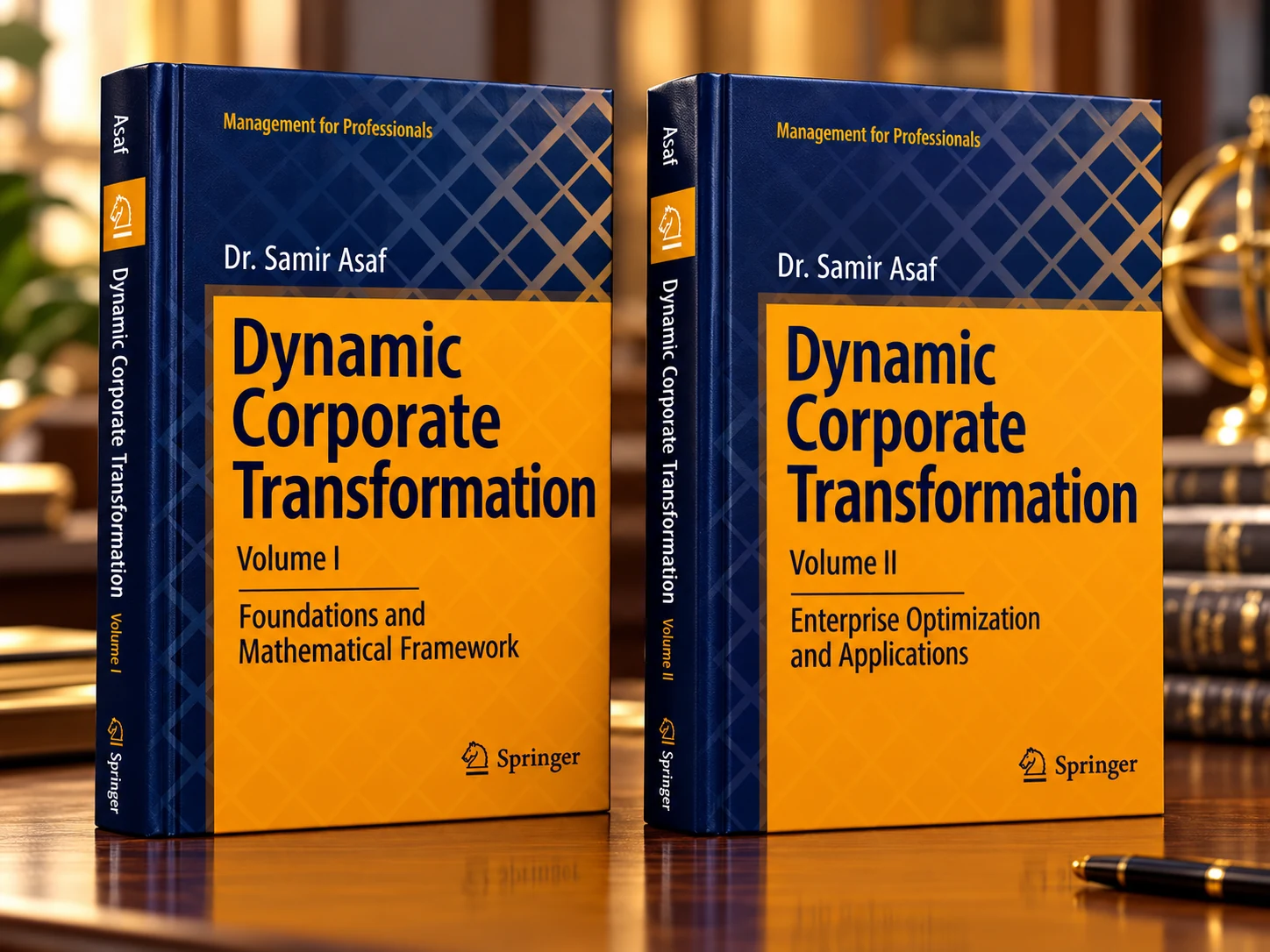
Dynamic Corporate Transformation — Volume I: Foundations and Mathematical Framework; Volume II: Enterprise Optimization & Applications
Jump to any chapter

Volume I: Foundations and Mathematical Framework

  1. Ch. 1Introduction to Dynamic Corporate Transformation
  2. Ch. 2Enterprise Systems and Transformation
  3. Ch. 3Mathematical Foundations
  4. Ch. 4Enterprise Modeling Principles
  5. Ch. 5Enterprise State Representation
  6. Ch. 6Enterprise Transformation Operators
  7. Ch. 7Dynamic Enterprise Systems
  8. Ch. 8Stochastic Enterprise Dynamics
  9. Ch. 9Enterprise State Architecture
  10. Ch. 10Enterprise Capital Architecture
  11. Ch. 11Enterprise Performance Architecture
  12. Ch. 12Enterprise Risk, Resilience, and Robustness Architecture
  13. Ch. 13Unified Enterprise Transformation Architecture
  14. Ch. 14Mathematical Analysis of the Unified Enterprise Transformation Architecture
  15. Ch. 15Mathematical Formulation of Enterprise Optimization
  16. Ch. 16Synthesis, Future Directions, and Transition to Volume II

Volume II: Enterprise Optimization & Applications

  1. Ch. 1Introduction to Enterprise Optimization
  2. Ch. 2The General Enterprise Optimization Problem Revisited
  3. Ch. 3Convex Enterprise Optimization
  4. Ch. 4Nonlinear and Mixed-Integer Enterprise Optimization
  5. Ch. 5Dynamic Enterprise Optimization
  6. Ch. 6Optimal Control of Enterprise Systems
  7. Ch. 7Dynamic Programming for Enterprise Systems
  8. Ch. 8Hamilton–Jacobi–Bellman Enterprise Framework
  9. Ch. 9Stochastic Enterprise Optimization
  10. Ch. 10Neuro-Fuzzy Robust Enterprise Optimization
  11. Ch. 11Distributionally Robust Enterprise Optimization
  12. Ch. 12Multi-Objective Enterprise Optimization
  13. Ch. 13Machine Learning for Enterprise Transformation
  14. Ch. 14Artificial Intelligence for Enterprise Optimization
  15. Ch. 15Enterprise Digital Twins and Autonomous Enterprise Transformation
  16. Ch. 16Enterprise Applications and Integrated Transformation Case Studies

Dynamic Corporate Transformation

Springer Nature · Management for Professionals · Forthcoming 2027

  • Volume I — Foundations and Mathematical Framework
  • Volume II — Enterprise Optimization & Applications
Buy Volume I: Dynamic Corporate Transformation: Foundations and Mathematical FrameworkBuy Volume II: Dynamic Corporate Transformation: Enterprise Optimization & Applications
Jump to any chapter

Volume I: Foundations and Mathematical Framework

  1. Ch. 1Introduction to Dynamic Corporate Transformation
  2. Ch. 2Enterprise Systems and Transformation
  3. Ch. 3Mathematical Foundations
  4. Ch. 4Enterprise Modeling Principles
  5. Ch. 5Enterprise State Representation
  6. Ch. 6Enterprise Transformation Operators
  7. Ch. 7Dynamic Enterprise Systems
  8. Ch. 8Stochastic Enterprise Dynamics
  9. Ch. 9Enterprise State Architecture
  10. Ch. 10Enterprise Capital Architecture
  11. Ch. 11Enterprise Performance Architecture
  12. Ch. 12Enterprise Risk, Resilience, and Robustness Architecture
  13. Ch. 13Unified Enterprise Transformation Architecture
  14. Ch. 14Mathematical Analysis of the Unified Enterprise Transformation Architecture
  15. Ch. 15Mathematical Formulation of Enterprise Optimization
  16. Ch. 16Synthesis, Future Directions, and Transition to Volume II

Volume II: Enterprise Optimization & Applications

  1. Ch. 1Introduction to Enterprise Optimization
  2. Ch. 2The General Enterprise Optimization Problem Revisited
  3. Ch. 3Convex Enterprise Optimization
  4. Ch. 4Nonlinear and Mixed-Integer Enterprise Optimization
  5. Ch. 5Dynamic Enterprise Optimization
  6. Ch. 6Optimal Control of Enterprise Systems
  7. Ch. 7Dynamic Programming for Enterprise Systems
  8. Ch. 8Hamilton–Jacobi–Bellman Enterprise Framework
  9. Ch. 9Stochastic Enterprise Optimization
  10. Ch. 10Neuro-Fuzzy Robust Enterprise Optimization
  11. Ch. 11Distributionally Robust Enterprise Optimization
  12. Ch. 12Multi-Objective Enterprise Optimization
  13. Ch. 13Machine Learning for Enterprise Transformation
  14. Ch. 14Artificial Intelligence for Enterprise Optimization
  15. Ch. 15Enterprise Digital Twins and Autonomous Enterprise Transformation
  16. Ch. 16Enterprise Applications and Integrated Transformation Case Studies