

Skip to content

DCT Lexicon · Governing Dynamics

Pareto Frontiers

When value, risk, capability and time cannot be collapsed into one number, the efficient set is a frontier, not a point: the strategies no other strategy improves on every objective.

DCT Governing Dynamics

In depth

Formal statement

For objectives F=(f1,…,fm)F = (f_1,\dots,f_m) on a feasible set X\mathcal{X}, x⋆x^\star is Pareto efficient if no x∈Xx \in \mathcal{X} dominates it.

∄ x∈X:    fi(x)≤fi(x⋆) ∀i    and    fj(x)<fj(x⋆) for some j\nexists\, x \in \mathcal{X}:\;\; f_i(x) \le f_i(x^\star)\ \forall i \;\;\text{and}\;\; f_j(x) < f_j(x^\star)\ \text{for some } jmin⁡x∈X  f1(x)s.t.fi(x)≤εi,    i=2,…,m(ε-constraint)\min_{x \in \mathcal{X}}\; f_1(x)\quad \text{s.t.}\quad f_i(x) \le \varepsilon_i,\;\; i = 2,\dots,m \qquad (\varepsilon\text{-constraint})

DCT Governing Dynamics: the element's drawer (/governing-dynamics)

Scalarisation

Every minimiser of a strictly positive weighted sum ∑iwifi\sum_i w_i f_i is Pareto efficient; for convex problems every efficient point is a minimiser for some nonnegative weights. Nonconvex frontiers have points no weighted sum reaches, which the ε\varepsilon-constraint method still finds.

DCT Governing Dynamics: the element's drawer (/governing-dynamics)

In DCT

The board chooses on the frontier, not the analyst: the mathematics delivers the efficient set and the price of moving along it (how much value one point of risk buys), and governance selects the point. This separation is what Meridian's GEOP formalises.

DCT Governing Dynamics: the element's drawer (/governing-dynamics)

Limits

Weighted sums hide unsupported efficient points and make weights look like preferences when they are only supporting prices. The frontier of a stochastic problem depends on the risk measure chosen for each objective.

DCT Governing Dynamics: the element's drawer (/governing-dynamics)

Go next

  • Meridian GEOP: The GEOP selects the board's point on the frontier (Pathway 7).
  • Dynamic Risk Measures: Risk objectives on the frontier are dynamic risk measures.
  • Fenchel–Rockafellar Duality and Dual Bounds: The frontier's slopes are dual prices.

DCT Governing Dynamics: the element's drawer (/governing-dynamics)

References

  • Miettinen (1999), Nonlinear Multiobjective Optimization
  • Ehrgott (2005), Multicriteria Optimization

DCT Governing Dynamics: the element's drawer (/governing-dynamics)

In the book: Vol. II, Ch. 12: Multi-Objective Enterprise Optimization

Related: Meridian GEOP · Dynamic Risk Measures · Fenchel–Rockafellar Duality and Dual Bounds

GD.09
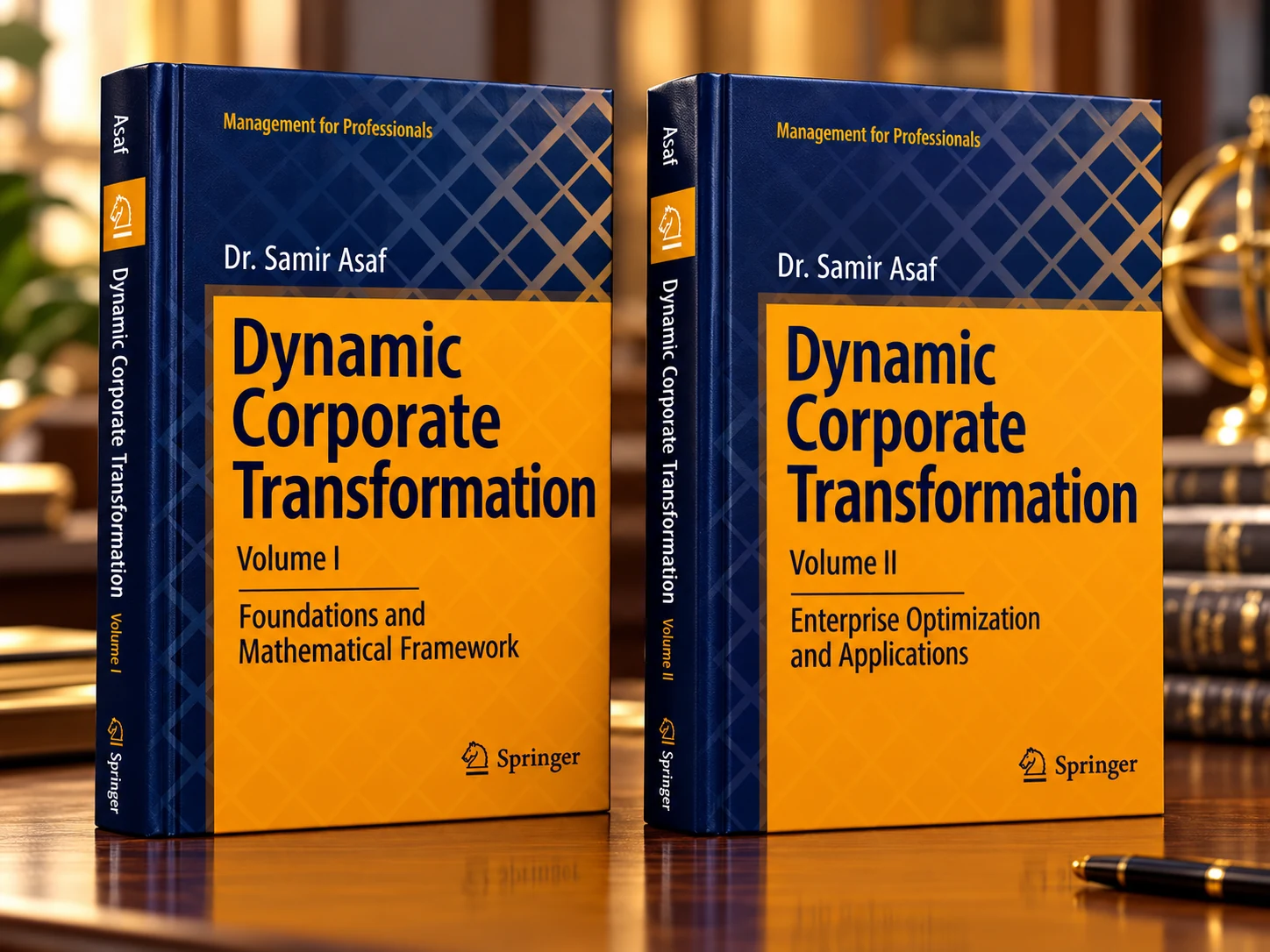
Dynamic Corporate Transformation — Volume I: Foundations and Mathematical Framework; Volume II: Enterprise Optimization & Applications
Jump to any chapter

Volume I: Foundations and Mathematical Framework

  1. Ch. 1Introduction to Dynamic Corporate Transformation
  2. Ch. 2Enterprise Systems and Transformation
  3. Ch. 3Mathematical Foundations
  4. Ch. 4Enterprise Modeling Principles
  5. Ch. 5Enterprise State Representation
  6. Ch. 6Enterprise Transformation Operators
  7. Ch. 7Dynamic Enterprise Systems
  8. Ch. 8Stochastic Enterprise Dynamics
  9. Ch. 9Enterprise State Architecture
  10. Ch. 10Enterprise Capital Architecture
  11. Ch. 11Enterprise Performance Architecture
  12. Ch. 12Enterprise Risk, Resilience, and Robustness Architecture
  13. Ch. 13Unified Enterprise Transformation Architecture
  14. Ch. 14Mathematical Analysis of the Unified Enterprise Transformation Architecture
  15. Ch. 15Mathematical Formulation of Enterprise Optimization
  16. Ch. 16Synthesis, Future Directions, and Transition to Volume II

Volume II: Enterprise Optimization & Applications

  1. Ch. 1Introduction to Enterprise Optimization
  2. Ch. 2The General Enterprise Optimization Problem Revisited
  3. Ch. 3Convex Enterprise Optimization
  4. Ch. 4Nonlinear and Mixed-Integer Enterprise Optimization
  5. Ch. 5Dynamic Enterprise Optimization
  6. Ch. 6Optimal Control of Enterprise Systems
  7. Ch. 7Dynamic Programming for Enterprise Systems
  8. Ch. 8Hamilton–Jacobi–Bellman Enterprise Framework
  9. Ch. 9Stochastic Enterprise Optimization
  10. Ch. 10Neuro-Fuzzy Robust Enterprise Optimization
  11. Ch. 11Distributionally Robust Enterprise Optimization
  12. Ch. 12Multi-Objective Enterprise Optimization
  13. Ch. 13Machine Learning for Enterprise Transformation
  14. Ch. 14Artificial Intelligence for Enterprise Optimization
  15. Ch. 15Enterprise Digital Twins and Autonomous Enterprise Transformation
  16. Ch. 16Enterprise Applications and Integrated Transformation Case Studies

Dynamic Corporate Transformation

Springer Nature · Management for Professionals · Forthcoming 2027

  • Volume I — Foundations and Mathematical Framework
  • Volume II — Enterprise Optimization & Applications
Buy Volume I: Dynamic Corporate Transformation: Foundations and Mathematical FrameworkBuy Volume II: Dynamic Corporate Transformation: Enterprise Optimization & Applications
Jump to any chapter

Volume I: Foundations and Mathematical Framework

  1. Ch. 1Introduction to Dynamic Corporate Transformation
  2. Ch. 2Enterprise Systems and Transformation
  3. Ch. 3Mathematical Foundations
  4. Ch. 4Enterprise Modeling Principles
  5. Ch. 5Enterprise State Representation
  6. Ch. 6Enterprise Transformation Operators
  7. Ch. 7Dynamic Enterprise Systems
  8. Ch. 8Stochastic Enterprise Dynamics
  9. Ch. 9Enterprise State Architecture
  10. Ch. 10Enterprise Capital Architecture
  11. Ch. 11Enterprise Performance Architecture
  12. Ch. 12Enterprise Risk, Resilience, and Robustness Architecture
  13. Ch. 13Unified Enterprise Transformation Architecture
  14. Ch. 14Mathematical Analysis of the Unified Enterprise Transformation Architecture
  15. Ch. 15Mathematical Formulation of Enterprise Optimization
  16. Ch. 16Synthesis, Future Directions, and Transition to Volume II

Volume II: Enterprise Optimization & Applications

  1. Ch. 1Introduction to Enterprise Optimization
  2. Ch. 2The General Enterprise Optimization Problem Revisited
  3. Ch. 3Convex Enterprise Optimization
  4. Ch. 4Nonlinear and Mixed-Integer Enterprise Optimization
  5. Ch. 5Dynamic Enterprise Optimization
  6. Ch. 6Optimal Control of Enterprise Systems
  7. Ch. 7Dynamic Programming for Enterprise Systems
  8. Ch. 8Hamilton–Jacobi–Bellman Enterprise Framework
  9. Ch. 9Stochastic Enterprise Optimization
  10. Ch. 10Neuro-Fuzzy Robust Enterprise Optimization
  11. Ch. 11Distributionally Robust Enterprise Optimization
  12. Ch. 12Multi-Objective Enterprise Optimization
  13. Ch. 13Machine Learning for Enterprise Transformation
  14. Ch. 14Artificial Intelligence for Enterprise Optimization
  15. Ch. 15Enterprise Digital Twins and Autonomous Enterprise Transformation
  16. Ch. 16Enterprise Applications and Integrated Transformation Case Studies