

Skip to content

DCT Lexicon · Governing Dynamics

Fenchel–Rockafellar Duality and Dual Bounds

Duality gives every optimisation problem a shadow: a lower bound computed from prices. Where the bound meets the primal value, the gap is zero and the solution is certified optimal.

DCT Governing Dynamics

In depth

Formal statement

For min⁡xf(x)+g(Ax)\min_x f(x) + g(Ax) with f,gf,g proper, convex and lower semicontinuous, the Fenchel–Rockafellar dual is:

p⋆=inf⁡x{f(x)+g(Ax)},d⋆=sup⁡y{−f∗(−A⊤y)−g∗(y)}p^\star = \inf_x \big\{ f(x) + g(Ax) \big\},\qquad d^\star = \sup_y \big\{ -f^*(-A^{\top} y) - g^*(y) \big\}f∗(s)=sup⁡x{⟨s,x⟩−f(x)},d⋆≤p⋆    (weak duality)f^*(s) = \sup_x \big\{ \langle s, x\rangle - f(x) \big\},\qquad d^\star \le p^\star \;\;\text{(weak duality)}

DCT Governing Dynamics: the element's drawer (/governing-dynamics)

Fenchel–Rockafellar strong duality

If 0∈int(dom g−A dom f)0 \in \mathrm{int}\big(\mathrm{dom}\, g - A\,\mathrm{dom}\, f\big) (a Slater-type condition), then p⋆=d⋆p^\star = d^\star and the dual supremum is attained. The duality gap of any primal–dual pair bounds its suboptimality.

0  ≤  f(x)+g(Ax)−p⋆  ≤  f(x)+g(Ax)+f∗(−A⊤y)+g∗(y)0 \;\le\; f(x) + g(Ax) - p^\star \;\le\; f(x) + g(Ax) + f^*(-A^{\top}y) + g^*(y)

DCT Governing Dynamics: the element's drawer (/governing-dynamics)

In DCT

A dual bound is an audit: it proves that no programme can do better than a stated value, without enumerating programmes. The duality gap is the optimisation certificate's residual, and the dual variables are the prices that reappear in Lagrangian coordination.

DCT Governing Dynamics: the element's drawer (/governing-dynamics)

Limits

Strong duality fails without a constraint qualification, and nonconvex problems have a positive gap in general. Integer structure (lumpy rounds) makes the gap a true measure of what convexification cannot see.

DCT Governing Dynamics: the element's drawer (/governing-dynamics)

Go next

  • Lagrangian Dual Coordination: Dual multipliers coordinate resource allocation (Pathway 6).
  • Occupation Measures: Stochastic control becomes a linear program over occupation measures, whose dual is the value function.
  • Full Certificates: A zero duality gap is part of a full certificate.
  • Nonsmooth Optimality and Generalized KKT: A primal–dual optimal pair satisfies the generalised KKT system.

DCT Governing Dynamics: the element's drawer (/governing-dynamics)

References

  • Rockafellar (1970), Convex Analysis
  • Bauschke & Combettes (2017), Convex Analysis and Monotone Operator Theory in Hilbert Spaces

DCT Governing Dynamics: the element's drawer (/governing-dynamics)

In the book: Vol. II, Ch. 3: Convex Enterprise Optimization

Related: Lagrangian Dual Coordination · Occupation Measures · Full Certificates · Nonsmooth Optimality and Generalized KKT

GD.08
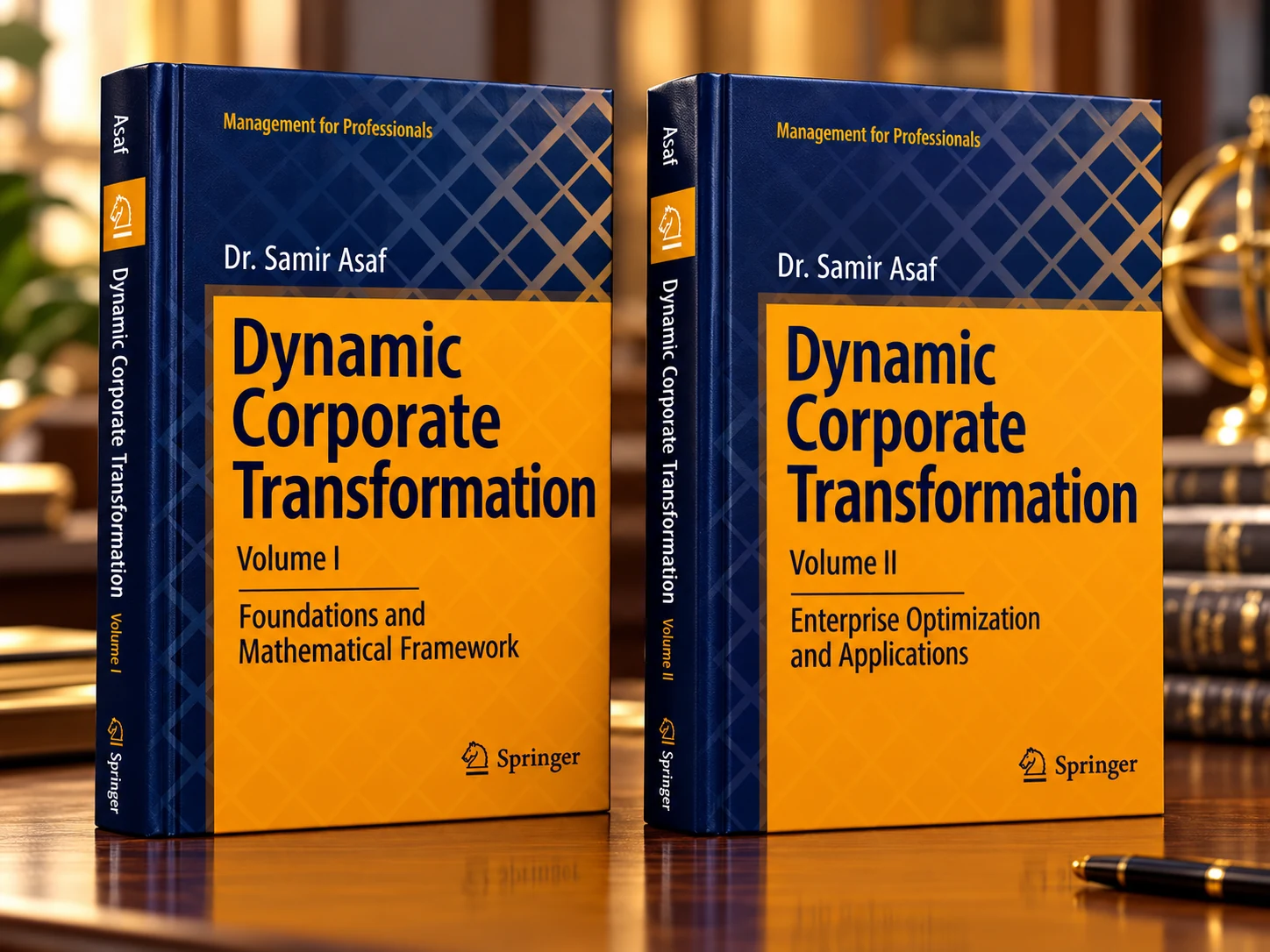
Dynamic Corporate Transformation — Volume I: Foundations and Mathematical Framework; Volume II: Enterprise Optimization & Applications
Jump to any chapter

Volume I: Foundations and Mathematical Framework

  1. Ch. 1Introduction to Dynamic Corporate Transformation
  2. Ch. 2Enterprise Systems and Transformation
  3. Ch. 3Mathematical Foundations
  4. Ch. 4Enterprise Modeling Principles
  5. Ch. 5Enterprise State Representation
  6. Ch. 6Enterprise Transformation Operators
  7. Ch. 7Dynamic Enterprise Systems
  8. Ch. 8Stochastic Enterprise Dynamics
  9. Ch. 9Enterprise State Architecture
  10. Ch. 10Enterprise Capital Architecture
  11. Ch. 11Enterprise Performance Architecture
  12. Ch. 12Enterprise Risk, Resilience, and Robustness Architecture
  13. Ch. 13Unified Enterprise Transformation Architecture
  14. Ch. 14Mathematical Analysis of the Unified Enterprise Transformation Architecture
  15. Ch. 15Mathematical Formulation of Enterprise Optimization
  16. Ch. 16Synthesis, Future Directions, and Transition to Volume II

Volume II: Enterprise Optimization & Applications

  1. Ch. 1Introduction to Enterprise Optimization
  2. Ch. 2The General Enterprise Optimization Problem Revisited
  3. Ch. 3Convex Enterprise Optimization
  4. Ch. 4Nonlinear and Mixed-Integer Enterprise Optimization
  5. Ch. 5Dynamic Enterprise Optimization
  6. Ch. 6Optimal Control of Enterprise Systems
  7. Ch. 7Dynamic Programming for Enterprise Systems
  8. Ch. 8Hamilton–Jacobi–Bellman Enterprise Framework
  9. Ch. 9Stochastic Enterprise Optimization
  10. Ch. 10Neuro-Fuzzy Robust Enterprise Optimization
  11. Ch. 11Distributionally Robust Enterprise Optimization
  12. Ch. 12Multi-Objective Enterprise Optimization
  13. Ch. 13Machine Learning for Enterprise Transformation
  14. Ch. 14Artificial Intelligence for Enterprise Optimization
  15. Ch. 15Enterprise Digital Twins and Autonomous Enterprise Transformation
  16. Ch. 16Enterprise Applications and Integrated Transformation Case Studies

Dynamic Corporate Transformation

Springer Nature · Management for Professionals · Forthcoming 2027

  • Volume I — Foundations and Mathematical Framework
  • Volume II — Enterprise Optimization & Applications
Buy Volume I: Dynamic Corporate Transformation: Foundations and Mathematical FrameworkBuy Volume II: Dynamic Corporate Transformation: Enterprise Optimization & Applications
Jump to any chapter

Volume I: Foundations and Mathematical Framework

  1. Ch. 1Introduction to Dynamic Corporate Transformation
  2. Ch. 2Enterprise Systems and Transformation
  3. Ch. 3Mathematical Foundations
  4. Ch. 4Enterprise Modeling Principles
  5. Ch. 5Enterprise State Representation
  6. Ch. 6Enterprise Transformation Operators
  7. Ch. 7Dynamic Enterprise Systems
  8. Ch. 8Stochastic Enterprise Dynamics
  9. Ch. 9Enterprise State Architecture
  10. Ch. 10Enterprise Capital Architecture
  11. Ch. 11Enterprise Performance Architecture
  12. Ch. 12Enterprise Risk, Resilience, and Robustness Architecture
  13. Ch. 13Unified Enterprise Transformation Architecture
  14. Ch. 14Mathematical Analysis of the Unified Enterprise Transformation Architecture
  15. Ch. 15Mathematical Formulation of Enterprise Optimization
  16. Ch. 16Synthesis, Future Directions, and Transition to Volume II

Volume II: Enterprise Optimization & Applications

  1. Ch. 1Introduction to Enterprise Optimization
  2. Ch. 2The General Enterprise Optimization Problem Revisited
  3. Ch. 3Convex Enterprise Optimization
  4. Ch. 4Nonlinear and Mixed-Integer Enterprise Optimization
  5. Ch. 5Dynamic Enterprise Optimization
  6. Ch. 6Optimal Control of Enterprise Systems
  7. Ch. 7Dynamic Programming for Enterprise Systems
  8. Ch. 8Hamilton–Jacobi–Bellman Enterprise Framework
  9. Ch. 9Stochastic Enterprise Optimization
  10. Ch. 10Neuro-Fuzzy Robust Enterprise Optimization
  11. Ch. 11Distributionally Robust Enterprise Optimization
  12. Ch. 12Multi-Objective Enterprise Optimization
  13. Ch. 13Machine Learning for Enterprise Transformation
  14. Ch. 14Artificial Intelligence for Enterprise Optimization
  15. Ch. 15Enterprise Digital Twins and Autonomous Enterprise Transformation
  16. Ch. 16Enterprise Applications and Integrated Transformation Case Studies