

Skip to content

DCT Lexicon · Governing Dynamics

Nonsmooth Optimality and Generalized KKT

Transformation problems are constrained and often nonsmooth: kinks from thresholds, max-type penalties and piecewise costs. Generalised KKT conditions characterise optimality where gradients do not exist.

DCT Governing Dynamics

In depth

Formal statement

For min⁡f(x)\min f(x) subject to gi(x)≤0g_i(x) \le 0, hj(x)=0h_j(x) = 0, with f,gif, g_i locally Lipschitz, Clarke's generalised gradient ∂f(x)\partial f(x) replaces ∇f(x)\nabla f(x). At a local minimiser satisfying a constraint qualification, there are multipliers with the conditions below, where Ωf\Omega_f is the null set on which ff is not differentiable (Rademacher's theorem).

0∈∂f(x⋆)+∑iλi ∂gi(x⋆)+∑jμj ∂hj(x⋆)0 \in \partial f(x^\star) + \sum_i \lambda_i\, \partial g_i(x^\star) + \sum_j \mu_j\, \partial h_j(x^\star)λi≥0,λi gi(x⋆)=0,∂f(x)=co{lim⁡k∇f(xk):xk→x, xk∉Ωf}\lambda_i \ge 0,\qquad \lambda_i\, g_i(x^\star) = 0,\qquad \partial f(x) = \mathrm{co}\Big\{\lim_{k} \nabla f(x_k) : x_k \to x,\ x_k \notin \Omega_f\Big\}

DCT Governing Dynamics: the element's drawer (/governing-dynamics)

Clarke's multiplier rule

Under the Mangasarian–Fromovitz constraint qualification, every local minimiser of a Lipschitz program satisfies the generalised KKT system above; without a qualification, only the Fritz John form, with a possibly zero multiplier on ff, holds.

DCT Governing Dynamics: the element's drawer (/governing-dynamics)

In DCT

The multipliers are the prices of binding commitments: the marginal value of a dollar of room above the floor, of a point of capability, of a point of appetite. A KKT certificate is a solution together with its prices and its residual.

DCT Governing Dynamics: the element's drawer (/governing-dynamics)

Limits

KKT points are necessary, not sufficient, without convexity. Mixed-integer decisions (whole rounds, whole quarters) leave the theory entirely: half a round is no round, and branch-and-bound replaces stationarity.

DCT Governing Dynamics: the element's drawer (/governing-dynamics)

Go next

  • Fenchel–Rockafellar Duality and Dual Bounds: Duality turns the multipliers into bounds and certificates (Pathway 6).
  • Lagrangian Dual Coordination: The same multipliers coordinate decentralised decisions.
  • Meridian GEOP: The GEOP's optimality conditions are a generalised KKT system.

DCT Governing Dynamics: the element's drawer (/governing-dynamics)

References

  • Clarke (1983), Optimization and Nonsmooth Analysis
  • Rockafellar & Wets (1998), Variational Analysis

DCT Governing Dynamics: the element's drawer (/governing-dynamics)

In the book: Vol. II, Ch. 3: Convex Enterprise Optimization · Vol. II, Ch. 4: Nonlinear and Mixed-Integer Enterprise Optimization · Vol. I, Ch. 15: Mathematical Formulation of Enterprise Optimization

Related: Fenchel–Rockafellar Duality and Dual Bounds · Lagrangian Dual Coordination · Meridian GEOP

GD.07
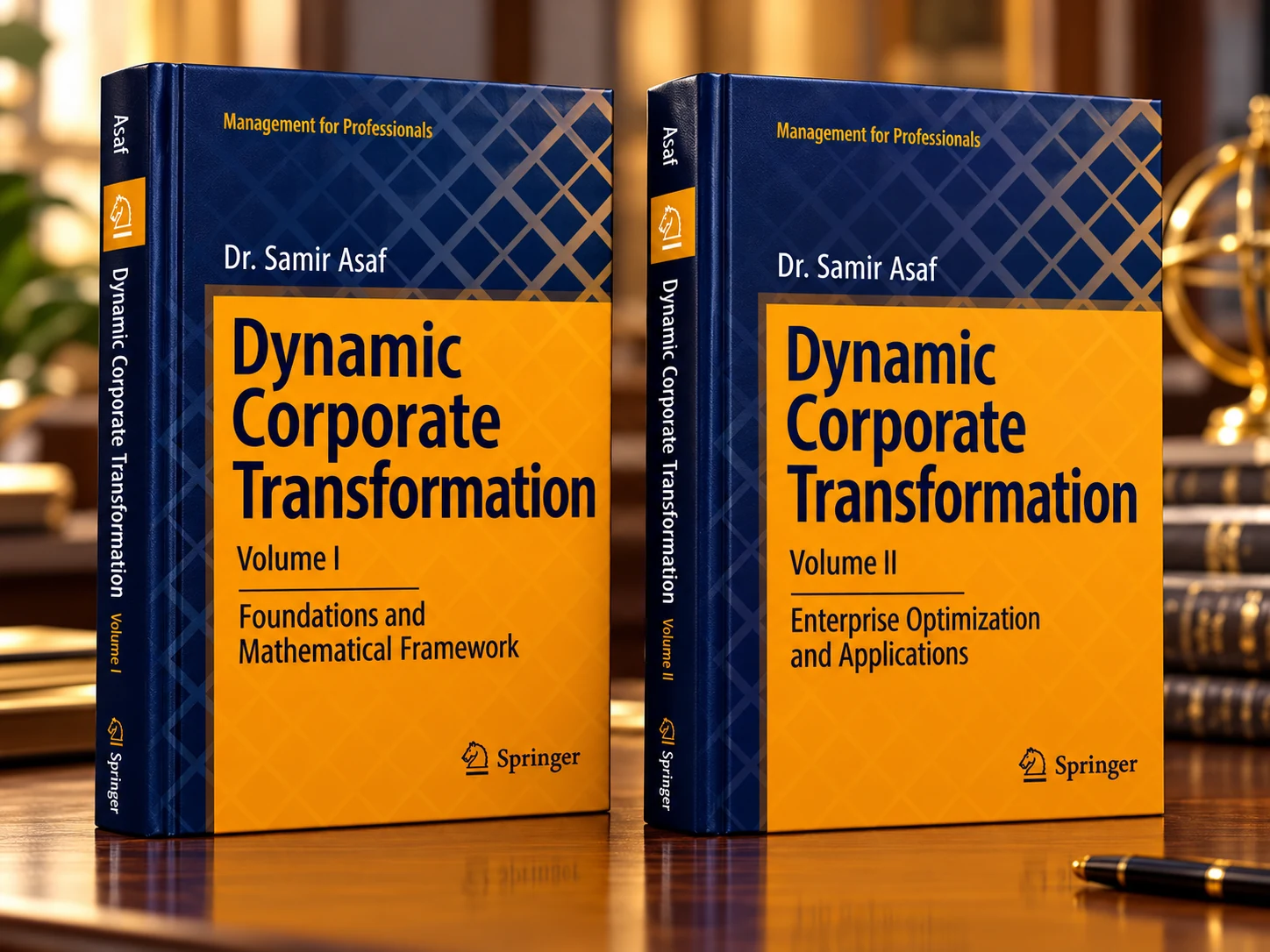
Dynamic Corporate Transformation — Volume I: Foundations and Mathematical Framework; Volume II: Enterprise Optimization & Applications
Jump to any chapter

Volume I: Foundations and Mathematical Framework

  1. Ch. 1Introduction to Dynamic Corporate Transformation
  2. Ch. 2Enterprise Systems and Transformation
  3. Ch. 3Mathematical Foundations
  4. Ch. 4Enterprise Modeling Principles
  5. Ch. 5Enterprise State Representation
  6. Ch. 6Enterprise Transformation Operators
  7. Ch. 7Dynamic Enterprise Systems
  8. Ch. 8Stochastic Enterprise Dynamics
  9. Ch. 9Enterprise State Architecture
  10. Ch. 10Enterprise Capital Architecture
  11. Ch. 11Enterprise Performance Architecture
  12. Ch. 12Enterprise Risk, Resilience, and Robustness Architecture
  13. Ch. 13Unified Enterprise Transformation Architecture
  14. Ch. 14Mathematical Analysis of the Unified Enterprise Transformation Architecture
  15. Ch. 15Mathematical Formulation of Enterprise Optimization
  16. Ch. 16Synthesis, Future Directions, and Transition to Volume II

Volume II: Enterprise Optimization & Applications

  1. Ch. 1Introduction to Enterprise Optimization
  2. Ch. 2The General Enterprise Optimization Problem Revisited
  3. Ch. 3Convex Enterprise Optimization
  4. Ch. 4Nonlinear and Mixed-Integer Enterprise Optimization
  5. Ch. 5Dynamic Enterprise Optimization
  6. Ch. 6Optimal Control of Enterprise Systems
  7. Ch. 7Dynamic Programming for Enterprise Systems
  8. Ch. 8Hamilton–Jacobi–Bellman Enterprise Framework
  9. Ch. 9Stochastic Enterprise Optimization
  10. Ch. 10Neuro-Fuzzy Robust Enterprise Optimization
  11. Ch. 11Distributionally Robust Enterprise Optimization
  12. Ch. 12Multi-Objective Enterprise Optimization
  13. Ch. 13Machine Learning for Enterprise Transformation
  14. Ch. 14Artificial Intelligence for Enterprise Optimization
  15. Ch. 15Enterprise Digital Twins and Autonomous Enterprise Transformation
  16. Ch. 16Enterprise Applications and Integrated Transformation Case Studies

Dynamic Corporate Transformation

Springer Nature · Management for Professionals · Forthcoming 2027

  • Volume I — Foundations and Mathematical Framework
  • Volume II — Enterprise Optimization & Applications
Buy Volume I: Dynamic Corporate Transformation: Foundations and Mathematical FrameworkBuy Volume II: Dynamic Corporate Transformation: Enterprise Optimization & Applications
Jump to any chapter

Volume I: Foundations and Mathematical Framework

  1. Ch. 1Introduction to Dynamic Corporate Transformation
  2. Ch. 2Enterprise Systems and Transformation
  3. Ch. 3Mathematical Foundations
  4. Ch. 4Enterprise Modeling Principles
  5. Ch. 5Enterprise State Representation
  6. Ch. 6Enterprise Transformation Operators
  7. Ch. 7Dynamic Enterprise Systems
  8. Ch. 8Stochastic Enterprise Dynamics
  9. Ch. 9Enterprise State Architecture
  10. Ch. 10Enterprise Capital Architecture
  11. Ch. 11Enterprise Performance Architecture
  12. Ch. 12Enterprise Risk, Resilience, and Robustness Architecture
  13. Ch. 13Unified Enterprise Transformation Architecture
  14. Ch. 14Mathematical Analysis of the Unified Enterprise Transformation Architecture
  15. Ch. 15Mathematical Formulation of Enterprise Optimization
  16. Ch. 16Synthesis, Future Directions, and Transition to Volume II

Volume II: Enterprise Optimization & Applications

  1. Ch. 1Introduction to Enterprise Optimization
  2. Ch. 2The General Enterprise Optimization Problem Revisited
  3. Ch. 3Convex Enterprise Optimization
  4. Ch. 4Nonlinear and Mixed-Integer Enterprise Optimization
  5. Ch. 5Dynamic Enterprise Optimization
  6. Ch. 6Optimal Control of Enterprise Systems
  7. Ch. 7Dynamic Programming for Enterprise Systems
  8. Ch. 8Hamilton–Jacobi–Bellman Enterprise Framework
  9. Ch. 9Stochastic Enterprise Optimization
  10. Ch. 10Neuro-Fuzzy Robust Enterprise Optimization
  11. Ch. 11Distributionally Robust Enterprise Optimization
  12. Ch. 12Multi-Objective Enterprise Optimization
  13. Ch. 13Machine Learning for Enterprise Transformation
  14. Ch. 14Artificial Intelligence for Enterprise Optimization
  15. Ch. 15Enterprise Digital Twins and Autonomous Enterprise Transformation
  16. Ch. 16Enterprise Applications and Integrated Transformation Case Studies