

Skip to content

DCT Lexicon · Governing Dynamics

Lagrangian Dual Coordination

Lagrangian dual coordination lets units decide separately and still reach the enterprise optimum: a central price on shared resources replaces a central plan.

DCT Governing Dynamics

In depth

Formal statement

For units i=1,…,Ni = 1,\dots,N sharing a resource budget, dualising the coupling constraint decomposes the problem; the master problem updates the price by a (sub)gradient step.

min⁡x1,…,xN∑ifi(xi)    s.t.    ∑iAixi≤b(λ≥0)\min_{x_1,\dots,x_N} \sum_i f_i(x_i) \;\;\text{s.t.}\;\; \sum_i A_i x_i \le b \quad (\lambda \ge 0)L(x,λ)=∑i(fi(xi)+λ⊤Aixi)−λ⊤b,λk+1=[λk+ηk(∑iAixik−b)]+L(x,\lambda) = \sum_i \big( f_i(x_i) + \lambda^{\top} A_i x_i \big) - \lambda^{\top} b,\qquad \lambda_{k+1} = \Big[ \lambda_k + \eta_k \Big( \sum_i A_i x_i^{k} - b \Big) \Big]_+

DCT Governing Dynamics: the element's drawer (/governing-dynamics)

Dual decomposition

The dual function q(λ)=min⁡xL(x,λ)q(\lambda) = \min_x L(x,\lambda) is concave and separable across units; its maximum equals the primal optimum under convexity and Slater's condition, and subgradient ascent converges with diminishing steps. ADMM adds a proximal term and converges under weaker conditions.

DCT Governing Dynamics: the element's drawer (/governing-dynamics)

In DCT

Shadow prices are the language of coordination between business units, treasury and the transformation office: a unit that sees the right price for room above the floor, or for engineers, makes the enterprise-optimal choice without seeing the whole enterprise.

DCT Governing Dynamics: the element's drawer (/governing-dynamics)

Limits

Without convexity, prices alone may not coordinate (a duality gap means some optimal allocations are unsupported by any price). Lumpy decisions need a primal recovery step.

DCT Governing Dynamics: the element's drawer (/governing-dynamics)

Go next

  • Fenchel–Rockafellar Duality and Dual Bounds: Coordination prices are Fenchel–Rockafellar dual variables (Pathway 6).
  • Meridian GEOP: The GEOP coordinates the units' programmes into one.
  • Forward–Backward SDEs and Costates: In dynamic problems the prices evolve as costates.

DCT Governing Dynamics: the element's drawer (/governing-dynamics)

References

  • Everett (1963)
  • Bertsekas (1999), Nonlinear Programming
  • Boyd et al. (2011), Distributed Optimization via ADMM

DCT Governing Dynamics: the element's drawer (/governing-dynamics)

In the book: Vol. II, Ch. 3: Convex Enterprise Optimization · Vol. II, Ch. 2: The General Enterprise Optimization Problem Revisited

Related: Fenchel–Rockafellar Duality and Dual Bounds · Meridian GEOP · Forward–Backward SDEs and Costates

GD.20
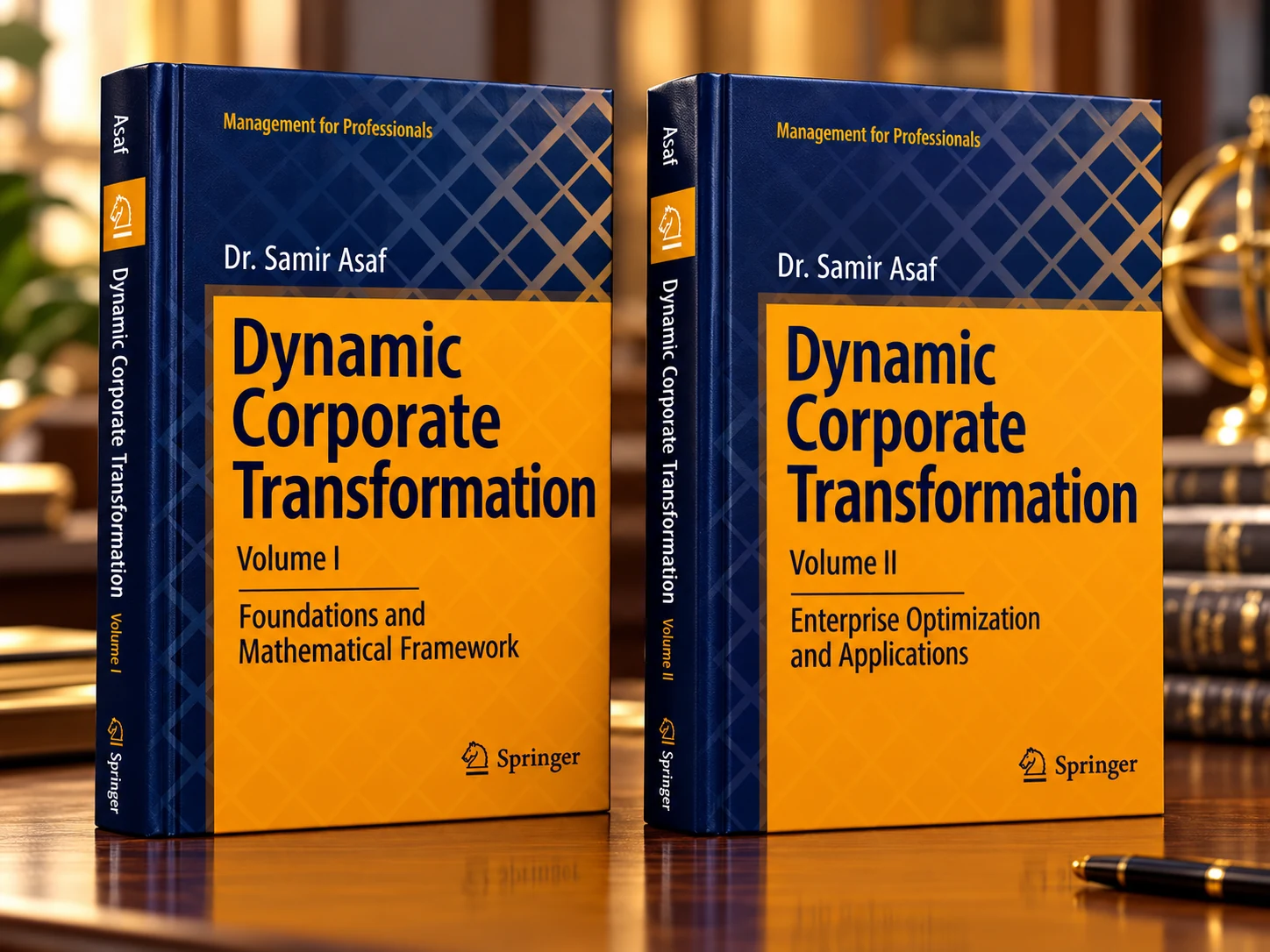
Dynamic Corporate Transformation — Volume I: Foundations and Mathematical Framework; Volume II: Enterprise Optimization & Applications
Jump to any chapter

Volume I: Foundations and Mathematical Framework

  1. Ch. 1Introduction to Dynamic Corporate Transformation
  2. Ch. 2Enterprise Systems and Transformation
  3. Ch. 3Mathematical Foundations
  4. Ch. 4Enterprise Modeling Principles
  5. Ch. 5Enterprise State Representation
  6. Ch. 6Enterprise Transformation Operators
  7. Ch. 7Dynamic Enterprise Systems
  8. Ch. 8Stochastic Enterprise Dynamics
  9. Ch. 9Enterprise State Architecture
  10. Ch. 10Enterprise Capital Architecture
  11. Ch. 11Enterprise Performance Architecture
  12. Ch. 12Enterprise Risk, Resilience, and Robustness Architecture
  13. Ch. 13Unified Enterprise Transformation Architecture
  14. Ch. 14Mathematical Analysis of the Unified Enterprise Transformation Architecture
  15. Ch. 15Mathematical Formulation of Enterprise Optimization
  16. Ch. 16Synthesis, Future Directions, and Transition to Volume II

Volume II: Enterprise Optimization & Applications

  1. Ch. 1Introduction to Enterprise Optimization
  2. Ch. 2The General Enterprise Optimization Problem Revisited
  3. Ch. 3Convex Enterprise Optimization
  4. Ch. 4Nonlinear and Mixed-Integer Enterprise Optimization
  5. Ch. 5Dynamic Enterprise Optimization
  6. Ch. 6Optimal Control of Enterprise Systems
  7. Ch. 7Dynamic Programming for Enterprise Systems
  8. Ch. 8Hamilton–Jacobi–Bellman Enterprise Framework
  9. Ch. 9Stochastic Enterprise Optimization
  10. Ch. 10Neuro-Fuzzy Robust Enterprise Optimization
  11. Ch. 11Distributionally Robust Enterprise Optimization
  12. Ch. 12Multi-Objective Enterprise Optimization
  13. Ch. 13Machine Learning for Enterprise Transformation
  14. Ch. 14Artificial Intelligence for Enterprise Optimization
  15. Ch. 15Enterprise Digital Twins and Autonomous Enterprise Transformation
  16. Ch. 16Enterprise Applications and Integrated Transformation Case Studies

Dynamic Corporate Transformation

Springer Nature · Management for Professionals · Forthcoming 2027

  • Volume I — Foundations and Mathematical Framework
  • Volume II — Enterprise Optimization & Applications
Buy Volume I: Dynamic Corporate Transformation: Foundations and Mathematical FrameworkBuy Volume II: Dynamic Corporate Transformation: Enterprise Optimization & Applications
Jump to any chapter

Volume I: Foundations and Mathematical Framework

  1. Ch. 1Introduction to Dynamic Corporate Transformation
  2. Ch. 2Enterprise Systems and Transformation
  3. Ch. 3Mathematical Foundations
  4. Ch. 4Enterprise Modeling Principles
  5. Ch. 5Enterprise State Representation
  6. Ch. 6Enterprise Transformation Operators
  7. Ch. 7Dynamic Enterprise Systems
  8. Ch. 8Stochastic Enterprise Dynamics
  9. Ch. 9Enterprise State Architecture
  10. Ch. 10Enterprise Capital Architecture
  11. Ch. 11Enterprise Performance Architecture
  12. Ch. 12Enterprise Risk, Resilience, and Robustness Architecture
  13. Ch. 13Unified Enterprise Transformation Architecture
  14. Ch. 14Mathematical Analysis of the Unified Enterprise Transformation Architecture
  15. Ch. 15Mathematical Formulation of Enterprise Optimization
  16. Ch. 16Synthesis, Future Directions, and Transition to Volume II

Volume II: Enterprise Optimization & Applications

  1. Ch. 1Introduction to Enterprise Optimization
  2. Ch. 2The General Enterprise Optimization Problem Revisited
  3. Ch. 3Convex Enterprise Optimization
  4. Ch. 4Nonlinear and Mixed-Integer Enterprise Optimization
  5. Ch. 5Dynamic Enterprise Optimization
  6. Ch. 6Optimal Control of Enterprise Systems
  7. Ch. 7Dynamic Programming for Enterprise Systems
  8. Ch. 8Hamilton–Jacobi–Bellman Enterprise Framework
  9. Ch. 9Stochastic Enterprise Optimization
  10. Ch. 10Neuro-Fuzzy Robust Enterprise Optimization
  11. Ch. 11Distributionally Robust Enterprise Optimization
  12. Ch. 12Multi-Objective Enterprise Optimization
  13. Ch. 13Machine Learning for Enterprise Transformation
  14. Ch. 14Artificial Intelligence for Enterprise Optimization
  15. Ch. 15Enterprise Digital Twins and Autonomous Enterprise Transformation
  16. Ch. 16Enterprise Applications and Integrated Transformation Case Studies