

Skip to content

DCT Lexicon · Governing Dynamics

Forward–Backward SDEs and Costates

The stochastic maximum principle couples the state, running forward from today, to a costate, running backward from the horizon. The costate is the marginal value of the state: a price that evolves.

DCT Governing Dynamics

In depth

Formal statement

The Hamiltonian is H(x,u,p,q)=r(x,u)+b(x,u)⊤p+tr(σ(x,u)⊤q)H(x,u,p,q) = r(x,u) + b(x,u)^{\top}p + \mathrm{tr}(\sigma(x,u)^{\top} q). Optimality couples a forward SDE to a backward SDE for the adjoint pair (pt,qt)(p_t, q_t).

dXt=b(Xt,ut) dt+σ(Xt,ut) dWt,X0=x0dX_t = b(X_t,u_t)\,dt + \sigma(X_t,u_t)\,dW_t,\qquad X_0 = x_0dpt=−∇xH(Xt,ut,pt,qt) dt+qt dWt,pT=∇g(XT),ut∈arg⁡max⁡uH(Xt,u,pt,qt)dp_t = -\nabla_x H(X_t,u_t,p_t,q_t)\,dt + q_t\, dW_t,\qquad p_T = \nabla g(X_T),\qquad u_t \in \arg\max_u H(X_t,u,p_t,q_t)

DCT Governing Dynamics: the element's drawer (/governing-dynamics)

Pontryagin, Peng and Pardoux

When the diffusion does not depend on the control, an optimal control maximises the Hamiltonian along the solution of the coupled FBSDE; when it does, Peng's maximum principle adds a second-order adjoint equation. Pardoux–Peng give existence and uniqueness for Lipschitz backward equations; where the value function is smooth, pt=∇V(t,Xt)p_t = \nabla V(t, X_t).

DCT Governing Dynamics: the element's drawer (/governing-dynamics)

In DCT

The costate is the time-varying price of a unit of each state: what a dollar of liquidity or a point of efficiency is worth at each date. Its path over the programme shows when a unit of each resource matters most.

DCT Governing Dynamics: the element's drawer (/governing-dynamics)

Limits

Fully coupled FBSDEs may have no solution over long horizons without monotonicity conditions. With a control-dependent diffusion and a nonconvex control set, the first-order adjoint is not enough.

DCT Governing Dynamics: the element's drawer (/governing-dynamics)

Go next

  • HJB Equations and Viscosity Solutions: Where the value is smooth, the costate is its gradient.
  • Lagrangian Dual Coordination: Costates are dual prices, dynamic Lagrange multipliers.
  • Belief-State Control: Under partial observation the adjoint lives on the belief space.

DCT Governing Dynamics: the element's drawer (/governing-dynamics)

References

  • Pardoux & Peng (1990)
  • Peng (1990), A general stochastic maximum principle
  • Yong & Zhou (1999), Stochastic Controls: Hamiltonian Systems and HJB Equations

DCT Governing Dynamics: the element's drawer (/governing-dynamics)

In the book: Vol. II, Ch. 6: Optimal Control of Enterprise Systems · Vol. II, Ch. 8: Hamilton–Jacobi–Bellman Enterprise Framework · Vol. II, Ch. 9: Stochastic Enterprise Optimization

Related: HJB Equations and Viscosity Solutions · Lagrangian Dual Coordination · Belief-State Control

GD.13
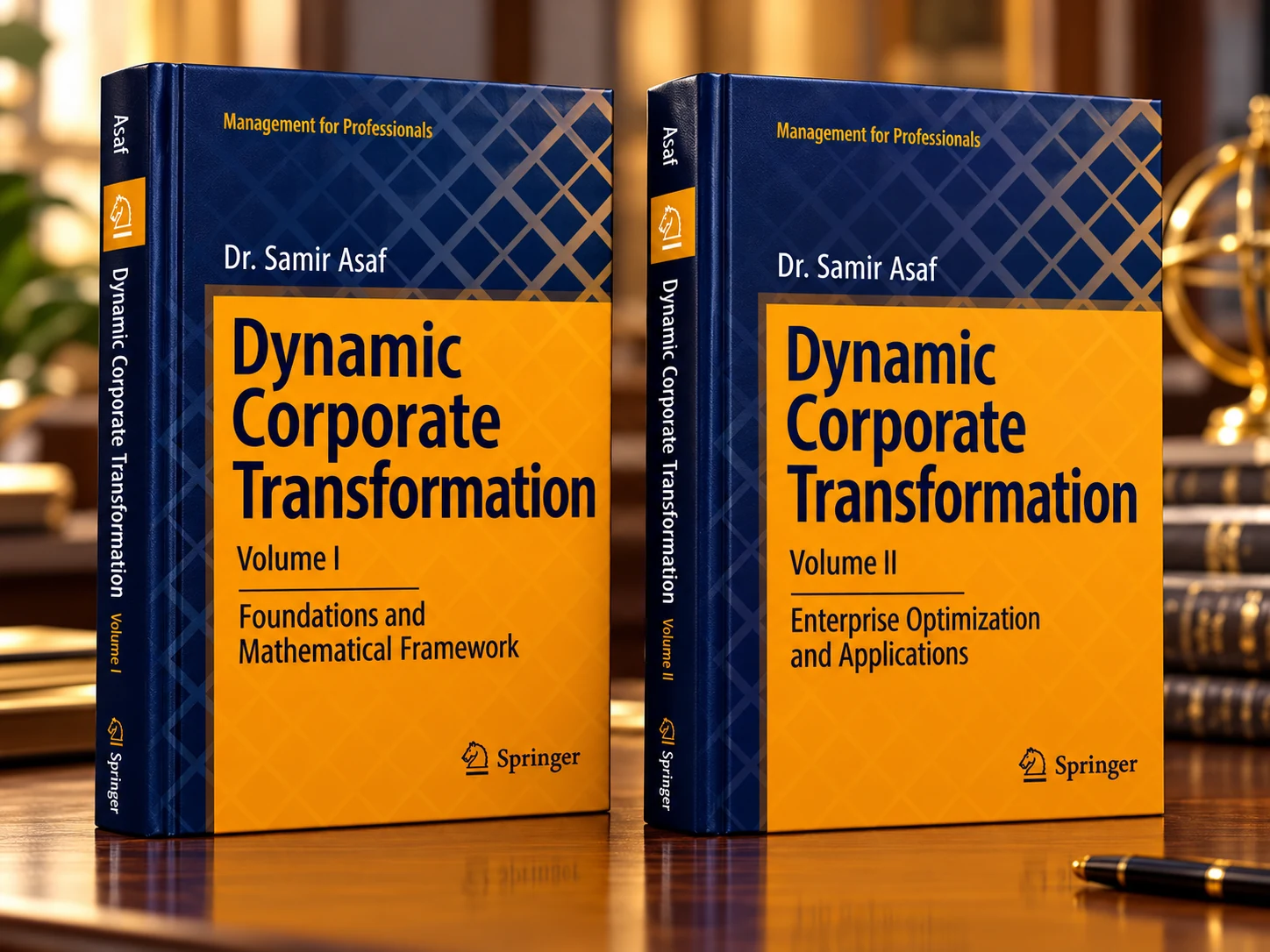
Dynamic Corporate Transformation — Volume I: Foundations and Mathematical Framework; Volume II: Enterprise Optimization & Applications
Jump to any chapter

Volume I: Foundations and Mathematical Framework

  1. Ch. 1Introduction to Dynamic Corporate Transformation
  2. Ch. 2Enterprise Systems and Transformation
  3. Ch. 3Mathematical Foundations
  4. Ch. 4Enterprise Modeling Principles
  5. Ch. 5Enterprise State Representation
  6. Ch. 6Enterprise Transformation Operators
  7. Ch. 7Dynamic Enterprise Systems
  8. Ch. 8Stochastic Enterprise Dynamics
  9. Ch. 9Enterprise State Architecture
  10. Ch. 10Enterprise Capital Architecture
  11. Ch. 11Enterprise Performance Architecture
  12. Ch. 12Enterprise Risk, Resilience, and Robustness Architecture
  13. Ch. 13Unified Enterprise Transformation Architecture
  14. Ch. 14Mathematical Analysis of the Unified Enterprise Transformation Architecture
  15. Ch. 15Mathematical Formulation of Enterprise Optimization
  16. Ch. 16Synthesis, Future Directions, and Transition to Volume II

Volume II: Enterprise Optimization & Applications

  1. Ch. 1Introduction to Enterprise Optimization
  2. Ch. 2The General Enterprise Optimization Problem Revisited
  3. Ch. 3Convex Enterprise Optimization
  4. Ch. 4Nonlinear and Mixed-Integer Enterprise Optimization
  5. Ch. 5Dynamic Enterprise Optimization
  6. Ch. 6Optimal Control of Enterprise Systems
  7. Ch. 7Dynamic Programming for Enterprise Systems
  8. Ch. 8Hamilton–Jacobi–Bellman Enterprise Framework
  9. Ch. 9Stochastic Enterprise Optimization
  10. Ch. 10Neuro-Fuzzy Robust Enterprise Optimization
  11. Ch. 11Distributionally Robust Enterprise Optimization
  12. Ch. 12Multi-Objective Enterprise Optimization
  13. Ch. 13Machine Learning for Enterprise Transformation
  14. Ch. 14Artificial Intelligence for Enterprise Optimization
  15. Ch. 15Enterprise Digital Twins and Autonomous Enterprise Transformation
  16. Ch. 16Enterprise Applications and Integrated Transformation Case Studies

Dynamic Corporate Transformation

Springer Nature · Management for Professionals · Forthcoming 2027

  • Volume I — Foundations and Mathematical Framework
  • Volume II — Enterprise Optimization & Applications
Buy Volume I: Dynamic Corporate Transformation: Foundations and Mathematical FrameworkBuy Volume II: Dynamic Corporate Transformation: Enterprise Optimization & Applications
Jump to any chapter

Volume I: Foundations and Mathematical Framework

  1. Ch. 1Introduction to Dynamic Corporate Transformation
  2. Ch. 2Enterprise Systems and Transformation
  3. Ch. 3Mathematical Foundations
  4. Ch. 4Enterprise Modeling Principles
  5. Ch. 5Enterprise State Representation
  6. Ch. 6Enterprise Transformation Operators
  7. Ch. 7Dynamic Enterprise Systems
  8. Ch. 8Stochastic Enterprise Dynamics
  9. Ch. 9Enterprise State Architecture
  10. Ch. 10Enterprise Capital Architecture
  11. Ch. 11Enterprise Performance Architecture
  12. Ch. 12Enterprise Risk, Resilience, and Robustness Architecture
  13. Ch. 13Unified Enterprise Transformation Architecture
  14. Ch. 14Mathematical Analysis of the Unified Enterprise Transformation Architecture
  15. Ch. 15Mathematical Formulation of Enterprise Optimization
  16. Ch. 16Synthesis, Future Directions, and Transition to Volume II

Volume II: Enterprise Optimization & Applications

  1. Ch. 1Introduction to Enterprise Optimization
  2. Ch. 2The General Enterprise Optimization Problem Revisited
  3. Ch. 3Convex Enterprise Optimization
  4. Ch. 4Nonlinear and Mixed-Integer Enterprise Optimization
  5. Ch. 5Dynamic Enterprise Optimization
  6. Ch. 6Optimal Control of Enterprise Systems
  7. Ch. 7Dynamic Programming for Enterprise Systems
  8. Ch. 8Hamilton–Jacobi–Bellman Enterprise Framework
  9. Ch. 9Stochastic Enterprise Optimization
  10. Ch. 10Neuro-Fuzzy Robust Enterprise Optimization
  11. Ch. 11Distributionally Robust Enterprise Optimization
  12. Ch. 12Multi-Objective Enterprise Optimization
  13. Ch. 13Machine Learning for Enterprise Transformation
  14. Ch. 14Artificial Intelligence for Enterprise Optimization
  15. Ch. 15Enterprise Digital Twins and Autonomous Enterprise Transformation
  16. Ch. 16Enterprise Applications and Integrated Transformation Case Studies