

Skip to content

DCT Lexicon · Governing Dynamics

Full Certificates

A full certificate is the consolidated evidence for a precisely stated claim about a transformation: feasibility, optimality, stability, risk and robustness, each with its method, residual, tolerance and grade.

DCT Governing Dynamics

In depth

Formal statement

A certificate is a tuple attached to a claim C\mathcal{C} about a decision xx: the evidence EE, its residual rr against a tolerance τ\tau, and the conditions under which the claim holds. The full certificate is the conjunction over the five properties.

Cert(C,x)=(E, r(E,x), τ, Assume),pass  ⟺  r≤τ\mathsf{Cert}(\mathcal{C}, x) = \big( E,\ r(E,x),\ \tau,\ \mathsf{Assume} \big),\qquad \mathsf{pass} \iff r \le \tauFull(x)  =  Feas(x)∧Opt(x)∧Stab(x)∧Riskα(x)∧RobW(x)\mathsf{Full}(x) \;=\; \mathsf{Feas}(x) \wedge \mathsf{Opt}(x) \wedge \mathsf{Stab}(x) \wedge \mathsf{Risk}_\alpha(x) \wedge \mathsf{Rob}_W(x)

DCT Governing Dynamics: the element's drawer (/governing-dynamics)

What each part certifies

A dual bound with zero gap certifies optimality; a Bellman residual ee bounds the value error by e/(1−β)e/(1-\beta); a Lyapunov matrix certifies stability; a fresh-sample binomial bound certifies a chance constraint; a robust kernel certifies viability under WW. Each is checkable without re-solving the problem.

DCT Governing Dynamics: the element's drawer (/governing-dynamics)

In DCT

Certification is the end of the cycle: the Helix's gates open on certificates, not on presentations. A transformation is ready to execute when its full certificate passes, and is re-certified whenever the world moves the assumptions it rests on.

DCT Governing Dynamics: the element's drawer (/governing-dynamics)

Limits

A certificate certifies a claim under its assumptions, nothing more. Its value lies in naming those assumptions; a passing certificate on a misdeclared model is a precise statement about the wrong company.

DCT Governing Dynamics: the element's drawer (/governing-dynamics)

Go next

  • Meridian GEOP: The full certificate is issued for the GEOP's chosen programme.
  • Chance Constraints and Certificates: Its risk part is a chance-constraint certificate (Pathway 10).
  • Lyapunov Stability and Semidefinite Programming: Its stability part is a Lyapunov certificate (Pathway 8).

DCT Governing Dynamics: the element's drawer (/governing-dynamics)

References

  • Asaf, Dynamic Corporate Transformation, Vols I–II (forthcoming 2027)
  • Boyd & Vandenberghe (2004), Convex Optimization, Ch. 5

DCT Governing Dynamics: the element's drawer (/governing-dynamics)

In the book: Vol. I, Ch. 14: Mathematical Analysis of the Unified Enterprise Transformation Architecture · Vol. I, Ch. 16: Synthesis, Future Directions, and Transition to Volume II · Vol. II, Ch. 16: Enterprise Applications and Integrated Transformation Case Studies

Related: Meridian GEOP · Chance Constraints and Certificates · Lyapunov Stability and Semidefinite Programming

GD.23
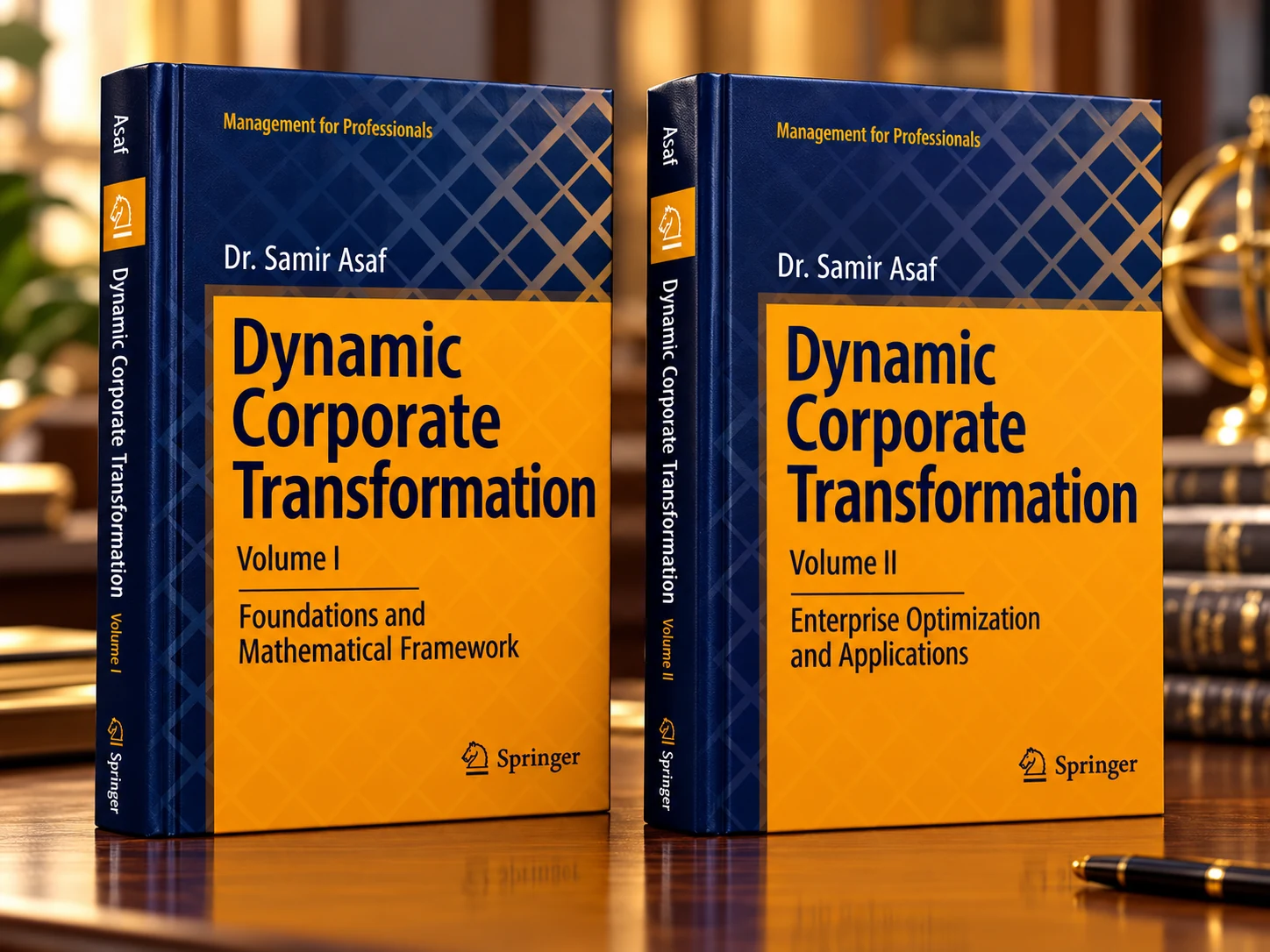
Dynamic Corporate Transformation — Volume I: Foundations and Mathematical Framework; Volume II: Enterprise Optimization & Applications
Jump to any chapter

Volume I: Foundations and Mathematical Framework

  1. Ch. 1Introduction to Dynamic Corporate Transformation
  2. Ch. 2Enterprise Systems and Transformation
  3. Ch. 3Mathematical Foundations
  4. Ch. 4Enterprise Modeling Principles
  5. Ch. 5Enterprise State Representation
  6. Ch. 6Enterprise Transformation Operators
  7. Ch. 7Dynamic Enterprise Systems
  8. Ch. 8Stochastic Enterprise Dynamics
  9. Ch. 9Enterprise State Architecture
  10. Ch. 10Enterprise Capital Architecture
  11. Ch. 11Enterprise Performance Architecture
  12. Ch. 12Enterprise Risk, Resilience, and Robustness Architecture
  13. Ch. 13Unified Enterprise Transformation Architecture
  14. Ch. 14Mathematical Analysis of the Unified Enterprise Transformation Architecture
  15. Ch. 15Mathematical Formulation of Enterprise Optimization
  16. Ch. 16Synthesis, Future Directions, and Transition to Volume II

Volume II: Enterprise Optimization & Applications

  1. Ch. 1Introduction to Enterprise Optimization
  2. Ch. 2The General Enterprise Optimization Problem Revisited
  3. Ch. 3Convex Enterprise Optimization
  4. Ch. 4Nonlinear and Mixed-Integer Enterprise Optimization
  5. Ch. 5Dynamic Enterprise Optimization
  6. Ch. 6Optimal Control of Enterprise Systems
  7. Ch. 7Dynamic Programming for Enterprise Systems
  8. Ch. 8Hamilton–Jacobi–Bellman Enterprise Framework
  9. Ch. 9Stochastic Enterprise Optimization
  10. Ch. 10Neuro-Fuzzy Robust Enterprise Optimization
  11. Ch. 11Distributionally Robust Enterprise Optimization
  12. Ch. 12Multi-Objective Enterprise Optimization
  13. Ch. 13Machine Learning for Enterprise Transformation
  14. Ch. 14Artificial Intelligence for Enterprise Optimization
  15. Ch. 15Enterprise Digital Twins and Autonomous Enterprise Transformation
  16. Ch. 16Enterprise Applications and Integrated Transformation Case Studies

Dynamic Corporate Transformation

Springer Nature · Management for Professionals · Forthcoming 2027

  • Volume I — Foundations and Mathematical Framework
  • Volume II — Enterprise Optimization & Applications
Buy Volume I: Dynamic Corporate Transformation: Foundations and Mathematical FrameworkBuy Volume II: Dynamic Corporate Transformation: Enterprise Optimization & Applications
Jump to any chapter

Volume I: Foundations and Mathematical Framework

  1. Ch. 1Introduction to Dynamic Corporate Transformation
  2. Ch. 2Enterprise Systems and Transformation
  3. Ch. 3Mathematical Foundations
  4. Ch. 4Enterprise Modeling Principles
  5. Ch. 5Enterprise State Representation
  6. Ch. 6Enterprise Transformation Operators
  7. Ch. 7Dynamic Enterprise Systems
  8. Ch. 8Stochastic Enterprise Dynamics
  9. Ch. 9Enterprise State Architecture
  10. Ch. 10Enterprise Capital Architecture
  11. Ch. 11Enterprise Performance Architecture
  12. Ch. 12Enterprise Risk, Resilience, and Robustness Architecture
  13. Ch. 13Unified Enterprise Transformation Architecture
  14. Ch. 14Mathematical Analysis of the Unified Enterprise Transformation Architecture
  15. Ch. 15Mathematical Formulation of Enterprise Optimization
  16. Ch. 16Synthesis, Future Directions, and Transition to Volume II

Volume II: Enterprise Optimization & Applications

  1. Ch. 1Introduction to Enterprise Optimization
  2. Ch. 2The General Enterprise Optimization Problem Revisited
  3. Ch. 3Convex Enterprise Optimization
  4. Ch. 4Nonlinear and Mixed-Integer Enterprise Optimization
  5. Ch. 5Dynamic Enterprise Optimization
  6. Ch. 6Optimal Control of Enterprise Systems
  7. Ch. 7Dynamic Programming for Enterprise Systems
  8. Ch. 8Hamilton–Jacobi–Bellman Enterprise Framework
  9. Ch. 9Stochastic Enterprise Optimization
  10. Ch. 10Neuro-Fuzzy Robust Enterprise Optimization
  11. Ch. 11Distributionally Robust Enterprise Optimization
  12. Ch. 12Multi-Objective Enterprise Optimization
  13. Ch. 13Machine Learning for Enterprise Transformation
  14. Ch. 14Artificial Intelligence for Enterprise Optimization
  15. Ch. 15Enterprise Digital Twins and Autonomous Enterprise Transformation
  16. Ch. 16Enterprise Applications and Integrated Transformation Case Studies