

Skip to content

DCT Lexicon · Governing Dynamics

Lyapunov Stability and Semidefinite Programming

A Lyapunov function is an energy that the enterprise's dynamics can only dissipate. Finding one proves stability without solving the dynamics; semidefinite programming finds one by convex optimisation.

DCT Governing Dynamics

In depth

Formal statement

For x˙=f(x)\dot x = f(x) with equilibrium 00, a function VV with V(0)=0V(0) = 0, V(x)>0V(x) > 0 elsewhere, and a strictly negative derivative along trajectories certifies asymptotic stability. For linear dynamics the search is a linear matrix inequality.

V˙(x)=∇V(x)⊤f(x)<0∀x≠0\dot V(x) = \nabla V(x)^{\top} f(x) < 0 \quad \forall x \neq 0∃ P≻0:    A⊤P+PA≺0⟺max⁡iRe λi(A)<0\exists\, P \succ 0:\;\; A^{\top} P + P A \prec 0 \quad\Longleftrightarrow\quad \max_i \mathrm{Re}\,\lambda_i(A) < 0∃ P≻0:    A⊤PA−P≺0⟺ρ(A)<1(discrete time)\exists\, P \succ 0:\;\; A^{\top} P A - P \prec 0 \quad\Longleftrightarrow\quad \rho(A) < 1 \qquad \text{(discrete time)}

DCT Governing Dynamics: the element's drawer (/governing-dynamics)

Lyapunov's second method, and SOS

A strict Lyapunov function proves asymptotic stability; radial unboundedness makes it global. For polynomial dynamics, requiring VV and −V˙-\dot V to be sums of squares turns the search into a semidefinite program, which is sufficient but not necessary.

V∈Σ[x],−∇V⊤f∈Σ[x]V \in \Sigma[x],\qquad -\nabla V^{\top} f \in \Sigma[x]

DCT Governing Dynamics: the element's drawer (/governing-dynamics)

In DCT

The coupled architectures are stable when their interaction matrix has spectral radius below one. A Lyapunov certificate makes this checkable and robust: if a single PP works for every vertex of an uncertainty polytope, the coupling is stable for every matrix in the polytope.

DCT Governing Dynamics: the element's drawer (/governing-dynamics)

Limits

A failed search proves nothing: the absence of a quadratic or low-degree SOS certificate does not imply instability. "Where conditions permit" is the honest qualification.

DCT Governing Dynamics: the element's drawer (/governing-dynamics)

Go next

  • Robust Viability: Robust Lyapunov certificates give robust viability (Pathway 8).
  • Full Certificates: A stability certificate is part of the full certificate.
  • Tangent Dynamics: The certificate's linear case is the spectrum of the tangent dynamics.

DCT Governing Dynamics: the element's drawer (/governing-dynamics)

References

  • Lyapunov (1892)
  • Boyd, El Ghaoui, Feron & Balakrishnan (1994), Linear Matrix Inequalities in System and Control Theory
  • Parrilo (2000), Structured Semidefinite Programs and Semialgebraic Geometry Methods

DCT Governing Dynamics: the element's drawer (/governing-dynamics)

In the book: Vol. I, Ch. 7: Dynamic Enterprise Systems · Vol. I, Ch. 14: Mathematical Analysis of the Unified Enterprise Transformation Architecture · Vol. II, Ch. 6: Optimal Control of Enterprise Systems

Related: Robust Viability · Full Certificates · Tangent Dynamics

GD.10
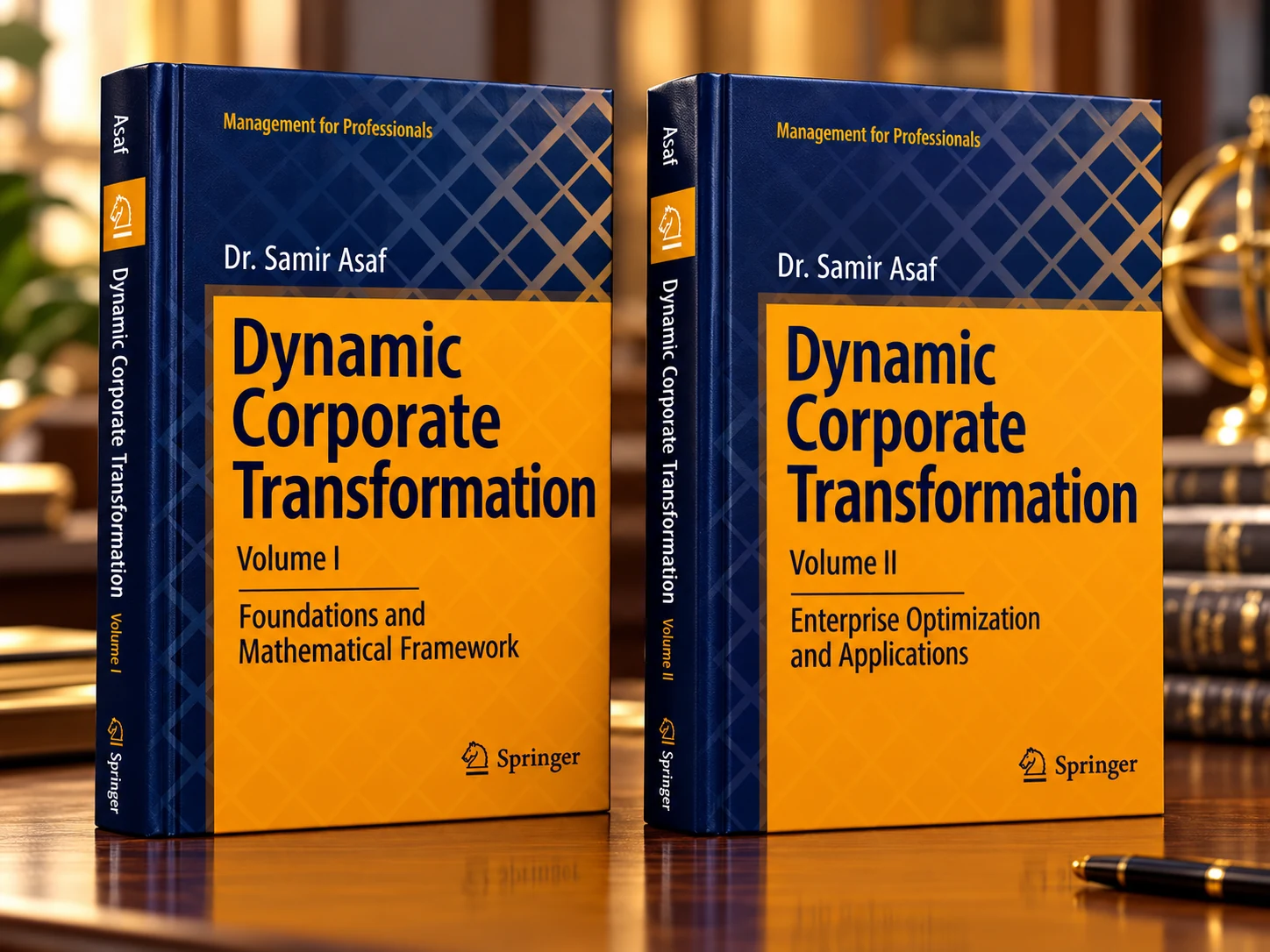
Dynamic Corporate Transformation — Volume I: Foundations and Mathematical Framework; Volume II: Enterprise Optimization & Applications
Jump to any chapter

Volume I: Foundations and Mathematical Framework

  1. Ch. 1Introduction to Dynamic Corporate Transformation
  2. Ch. 2Enterprise Systems and Transformation
  3. Ch. 3Mathematical Foundations
  4. Ch. 4Enterprise Modeling Principles
  5. Ch. 5Enterprise State Representation
  6. Ch. 6Enterprise Transformation Operators
  7. Ch. 7Dynamic Enterprise Systems
  8. Ch. 8Stochastic Enterprise Dynamics
  9. Ch. 9Enterprise State Architecture
  10. Ch. 10Enterprise Capital Architecture
  11. Ch. 11Enterprise Performance Architecture
  12. Ch. 12Enterprise Risk, Resilience, and Robustness Architecture
  13. Ch. 13Unified Enterprise Transformation Architecture
  14. Ch. 14Mathematical Analysis of the Unified Enterprise Transformation Architecture
  15. Ch. 15Mathematical Formulation of Enterprise Optimization
  16. Ch. 16Synthesis, Future Directions, and Transition to Volume II

Volume II: Enterprise Optimization & Applications

  1. Ch. 1Introduction to Enterprise Optimization
  2. Ch. 2The General Enterprise Optimization Problem Revisited
  3. Ch. 3Convex Enterprise Optimization
  4. Ch. 4Nonlinear and Mixed-Integer Enterprise Optimization
  5. Ch. 5Dynamic Enterprise Optimization
  6. Ch. 6Optimal Control of Enterprise Systems
  7. Ch. 7Dynamic Programming for Enterprise Systems
  8. Ch. 8Hamilton–Jacobi–Bellman Enterprise Framework
  9. Ch. 9Stochastic Enterprise Optimization
  10. Ch. 10Neuro-Fuzzy Robust Enterprise Optimization
  11. Ch. 11Distributionally Robust Enterprise Optimization
  12. Ch. 12Multi-Objective Enterprise Optimization
  13. Ch. 13Machine Learning for Enterprise Transformation
  14. Ch. 14Artificial Intelligence for Enterprise Optimization
  15. Ch. 15Enterprise Digital Twins and Autonomous Enterprise Transformation
  16. Ch. 16Enterprise Applications and Integrated Transformation Case Studies

Dynamic Corporate Transformation

Springer Nature · Management for Professionals · Forthcoming 2027

  • Volume I — Foundations and Mathematical Framework
  • Volume II — Enterprise Optimization & Applications
Buy Volume I: Dynamic Corporate Transformation: Foundations and Mathematical FrameworkBuy Volume II: Dynamic Corporate Transformation: Enterprise Optimization & Applications
Jump to any chapter

Volume I: Foundations and Mathematical Framework

  1. Ch. 1Introduction to Dynamic Corporate Transformation
  2. Ch. 2Enterprise Systems and Transformation
  3. Ch. 3Mathematical Foundations
  4. Ch. 4Enterprise Modeling Principles
  5. Ch. 5Enterprise State Representation
  6. Ch. 6Enterprise Transformation Operators
  7. Ch. 7Dynamic Enterprise Systems
  8. Ch. 8Stochastic Enterprise Dynamics
  9. Ch. 9Enterprise State Architecture
  10. Ch. 10Enterprise Capital Architecture
  11. Ch. 11Enterprise Performance Architecture
  12. Ch. 12Enterprise Risk, Resilience, and Robustness Architecture
  13. Ch. 13Unified Enterprise Transformation Architecture
  14. Ch. 14Mathematical Analysis of the Unified Enterprise Transformation Architecture
  15. Ch. 15Mathematical Formulation of Enterprise Optimization
  16. Ch. 16Synthesis, Future Directions, and Transition to Volume II

Volume II: Enterprise Optimization & Applications

  1. Ch. 1Introduction to Enterprise Optimization
  2. Ch. 2The General Enterprise Optimization Problem Revisited
  3. Ch. 3Convex Enterprise Optimization
  4. Ch. 4Nonlinear and Mixed-Integer Enterprise Optimization
  5. Ch. 5Dynamic Enterprise Optimization
  6. Ch. 6Optimal Control of Enterprise Systems
  7. Ch. 7Dynamic Programming for Enterprise Systems
  8. Ch. 8Hamilton–Jacobi–Bellman Enterprise Framework
  9. Ch. 9Stochastic Enterprise Optimization
  10. Ch. 10Neuro-Fuzzy Robust Enterprise Optimization
  11. Ch. 11Distributionally Robust Enterprise Optimization
  12. Ch. 12Multi-Objective Enterprise Optimization
  13. Ch. 13Machine Learning for Enterprise Transformation
  14. Ch. 14Artificial Intelligence for Enterprise Optimization
  15. Ch. 15Enterprise Digital Twins and Autonomous Enterprise Transformation
  16. Ch. 16Enterprise Applications and Integrated Transformation Case Studies