

Skip to content

DCT Lexicon · Governing Dynamics

Tangent Dynamics

Tangent dynamics describe how the enterprise moves locally: the velocity of a trajectory, its sensitivity to a control, and how a small perturbation of today's state propagates forward.

DCT Governing Dynamics

In depth

Formal statement

For dynamics x˙=f(x,u)\dot x = f(x,u) on a manifold MM, the vector field f(⋅,u)f(\cdot,u) is a section of the tangent bundle TMTM. Linearising along a nominal trajectory (xˉ,uˉ)(\bar x,\bar u) gives the variational equation, whose solution is the sensitivity of the state to its initial condition.

δx˙  =  A(t) δx+B(t) δu,A=∂xf(xˉ,uˉ),  B=∂uf(xˉ,uˉ)\delta \dot x \;=\; A(t)\,\delta x + B(t)\,\delta u,\qquad A = \partial_x f(\bar x,\bar u),\; B = \partial_u f(\bar x,\bar u)∂x(t)∂x0  =  Φ(t,0),Φ˙=A(t) Φ,    Φ(0,0)=I\frac{\partial x(t)}{\partial x_0} \;=\; \Phi(t,0),\qquad \dot\Phi = A(t)\,\Phi,\;\; \Phi(0,0) = I

DCT Governing Dynamics: the element's drawer (/governing-dynamics)

Hartman–Grobman

Near a hyperbolic equilibrium (no eigenvalue of the Jacobian on the imaginary axis), the nonlinear flow is topologically conjugate to its linearisation. Local stability questions therefore reduce to the spectrum of AA.

DCT Governing Dynamics: the element's drawer (/governing-dynamics)

In DCT

The architectural Jacobian of the unified architecture is a tangent object: it tells how a shock in one architecture moves the others. Its spectral radius decides whether coupling amplifies or damps, which is why tangent dynamics feed directly into Lyapunov certificates.

DCT Governing Dynamics: the element's drawer (/governing-dynamics)

Limits

Linearisation is local. Lumpy decisions, regime switches and constraint activation make ff nonsmooth, where Clarke generalised Jacobians replace ∂xf\partial_x f.

DCT Governing Dynamics: the element's drawer (/governing-dynamics)

Go next

  • Lyapunov Stability and Semidefinite Programming: Lyapunov analysis turns the local spectrum into a certificate of stability (Pathway 2).
  • Equilibrium and Fixed-Point Theorems: Equilibria are where the tangent field vanishes.
  • Forward–Backward SDEs and Costates: Costates evolve by the adjoint of the same variational equation.
  • Hausdorff State Manifolds: Tangent vectors live in the tangent spaces of the state manifold.

DCT Governing Dynamics: the element's drawer (/governing-dynamics)

References

  • Hartman (1964), Ordinary Differential Equations
  • Khalil (2002), Nonlinear Systems

DCT Governing Dynamics: the element's drawer (/governing-dynamics)

In the book: Vol. I, Ch. 7: Dynamic Enterprise Systems · Vol. I, Ch. 3: Mathematical Foundations

Related: Lyapunov Stability and Semidefinite Programming · Equilibrium and Fixed-Point Theorems · Forward–Backward SDEs and Costates · Hausdorff State Manifolds

GD.03
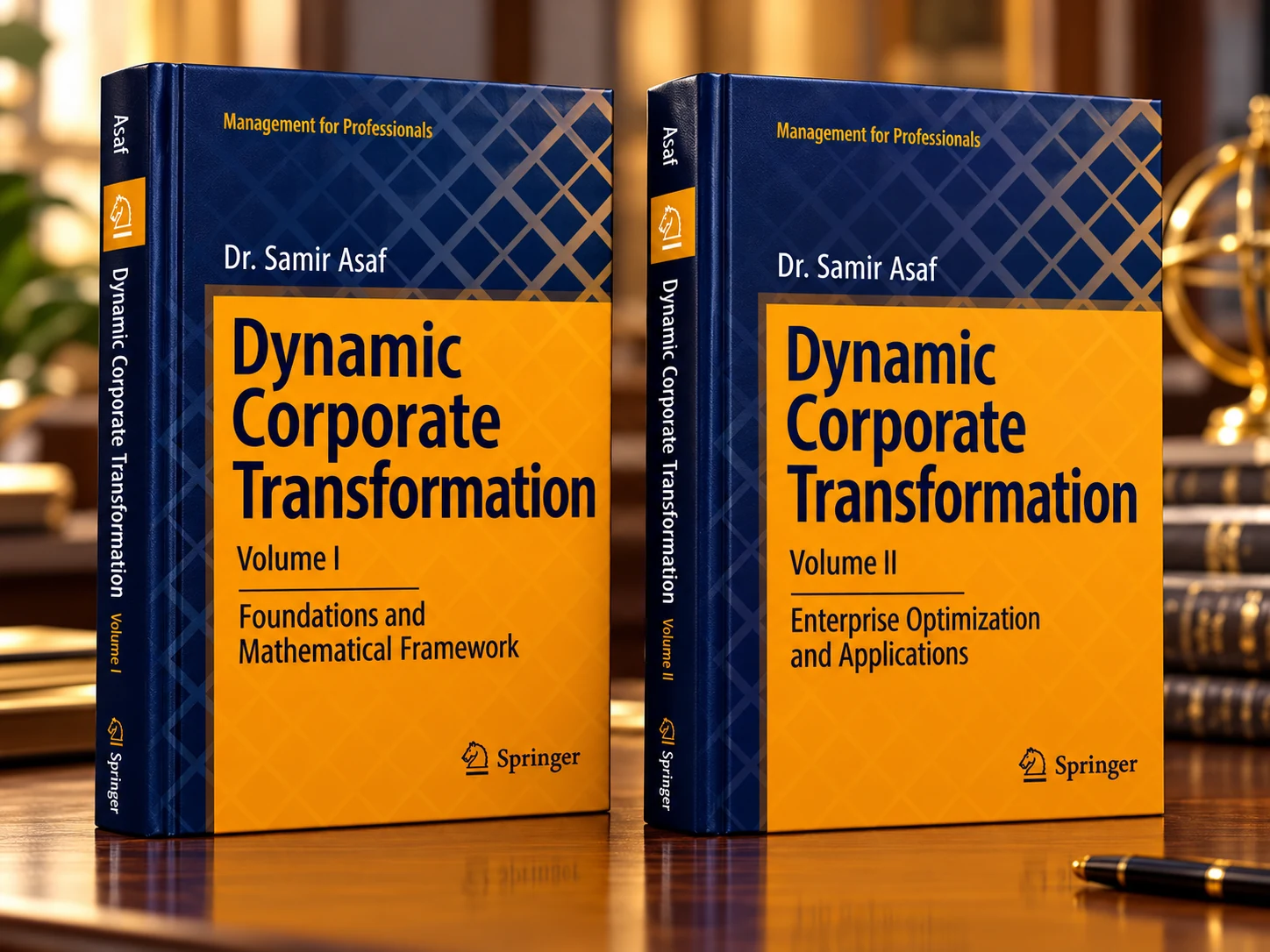
Dynamic Corporate Transformation — Volume I: Foundations and Mathematical Framework; Volume II: Enterprise Optimization & Applications
Jump to any chapter

Volume I: Foundations and Mathematical Framework

  1. Ch. 1Introduction to Dynamic Corporate Transformation
  2. Ch. 2Enterprise Systems and Transformation
  3. Ch. 3Mathematical Foundations
  4. Ch. 4Enterprise Modeling Principles
  5. Ch. 5Enterprise State Representation
  6. Ch. 6Enterprise Transformation Operators
  7. Ch. 7Dynamic Enterprise Systems
  8. Ch. 8Stochastic Enterprise Dynamics
  9. Ch. 9Enterprise State Architecture
  10. Ch. 10Enterprise Capital Architecture
  11. Ch. 11Enterprise Performance Architecture
  12. Ch. 12Enterprise Risk, Resilience, and Robustness Architecture
  13. Ch. 13Unified Enterprise Transformation Architecture
  14. Ch. 14Mathematical Analysis of the Unified Enterprise Transformation Architecture
  15. Ch. 15Mathematical Formulation of Enterprise Optimization
  16. Ch. 16Synthesis, Future Directions, and Transition to Volume II

Volume II: Enterprise Optimization & Applications

  1. Ch. 1Introduction to Enterprise Optimization
  2. Ch. 2The General Enterprise Optimization Problem Revisited
  3. Ch. 3Convex Enterprise Optimization
  4. Ch. 4Nonlinear and Mixed-Integer Enterprise Optimization
  5. Ch. 5Dynamic Enterprise Optimization
  6. Ch. 6Optimal Control of Enterprise Systems
  7. Ch. 7Dynamic Programming for Enterprise Systems
  8. Ch. 8Hamilton–Jacobi–Bellman Enterprise Framework
  9. Ch. 9Stochastic Enterprise Optimization
  10. Ch. 10Neuro-Fuzzy Robust Enterprise Optimization
  11. Ch. 11Distributionally Robust Enterprise Optimization
  12. Ch. 12Multi-Objective Enterprise Optimization
  13. Ch. 13Machine Learning for Enterprise Transformation
  14. Ch. 14Artificial Intelligence for Enterprise Optimization
  15. Ch. 15Enterprise Digital Twins and Autonomous Enterprise Transformation
  16. Ch. 16Enterprise Applications and Integrated Transformation Case Studies

Dynamic Corporate Transformation

Springer Nature · Management for Professionals · Forthcoming 2027

  • Volume I — Foundations and Mathematical Framework
  • Volume II — Enterprise Optimization & Applications
Buy Volume I: Dynamic Corporate Transformation: Foundations and Mathematical FrameworkBuy Volume II: Dynamic Corporate Transformation: Enterprise Optimization & Applications
Jump to any chapter

Volume I: Foundations and Mathematical Framework

  1. Ch. 1Introduction to Dynamic Corporate Transformation
  2. Ch. 2Enterprise Systems and Transformation
  3. Ch. 3Mathematical Foundations
  4. Ch. 4Enterprise Modeling Principles
  5. Ch. 5Enterprise State Representation
  6. Ch. 6Enterprise Transformation Operators
  7. Ch. 7Dynamic Enterprise Systems
  8. Ch. 8Stochastic Enterprise Dynamics
  9. Ch. 9Enterprise State Architecture
  10. Ch. 10Enterprise Capital Architecture
  11. Ch. 11Enterprise Performance Architecture
  12. Ch. 12Enterprise Risk, Resilience, and Robustness Architecture
  13. Ch. 13Unified Enterprise Transformation Architecture
  14. Ch. 14Mathematical Analysis of the Unified Enterprise Transformation Architecture
  15. Ch. 15Mathematical Formulation of Enterprise Optimization
  16. Ch. 16Synthesis, Future Directions, and Transition to Volume II

Volume II: Enterprise Optimization & Applications

  1. Ch. 1Introduction to Enterprise Optimization
  2. Ch. 2The General Enterprise Optimization Problem Revisited
  3. Ch. 3Convex Enterprise Optimization
  4. Ch. 4Nonlinear and Mixed-Integer Enterprise Optimization
  5. Ch. 5Dynamic Enterprise Optimization
  6. Ch. 6Optimal Control of Enterprise Systems
  7. Ch. 7Dynamic Programming for Enterprise Systems
  8. Ch. 8Hamilton–Jacobi–Bellman Enterprise Framework
  9. Ch. 9Stochastic Enterprise Optimization
  10. Ch. 10Neuro-Fuzzy Robust Enterprise Optimization
  11. Ch. 11Distributionally Robust Enterprise Optimization
  12. Ch. 12Multi-Objective Enterprise Optimization
  13. Ch. 13Machine Learning for Enterprise Transformation
  14. Ch. 14Artificial Intelligence for Enterprise Optimization
  15. Ch. 15Enterprise Digital Twins and Autonomous Enterprise Transformation
  16. Ch. 16Enterprise Applications and Integrated Transformation Case Studies