

Skip to content

DCT Lexicon · Governing Dynamics

Equilibrium and Fixed-Point Theorems

Equilibrium and fixed-point theorems answer whether a steady configuration of the enterprise exists, whether it is unique, and whether iteration reaches it.

DCT Governing Dynamics

In depth

Formal statement

A transformation operator T:X→XT : X \to X has a fixed point x⋆=Tx⋆x^\star = T x^\star. Existence, uniqueness and convergence follow from different structures on XX and TT.

∥Tx−Ty∥≤ρ ∥x−y∥,    ρ<1  ⟹  xk+1=Txk→x⋆,    ∥xk−x⋆∥≤ρk1−ρ∥x1−x0∥\|Tx - Ty\| \le \rho\,\|x - y\|,\;\; \rho < 1 \;\Longrightarrow\; x_{k+1} = T x_k \to x^\star,\;\; \|x_k - x^\star\| \le \frac{\rho^k}{1-\rho}\|x_1 - x_0\|(I−A)−1  =  ∑k≥0Akwhenever ρ(A)<1(I - A)^{-1} \;=\; \sum_{k \ge 0} A^k \quad \text{whenever } \rho(A) < 1

DCT Governing Dynamics: the element's drawer (/governing-dynamics)

Banach, Brouwer and Kakutani

Banach gives existence, uniqueness and geometric convergence for contractions on complete metric spaces. Brouwer gives existence, without uniqueness, for continuous self-maps of compact convex sets. Kakutani extends Brouwer to upper hemicontinuous, convex-valued correspondences, which is the setting of strategic equilibria.

DCT Governing Dynamics: the element's drawer (/governing-dynamics)

In DCT

The coupling register is a fixed-point problem: second-round effects between architectures sum as a Neumann series, and the spectral radius ρ\rho of the coupling matrix decides whether the echo of a shock dies out. Bellman's operator is a contraction in the sup norm, which is why value iteration converges.

DCT Governing Dynamics: the element's drawer (/governing-dynamics)

Limits

Existence without uniqueness is common (Brouwer, Kakutani), and multiple equilibria make comparative statics ill-defined. A spectral radius at or above one means no finite total effect: the register is unstable, not merely large.

DCT Governing Dynamics: the element's drawer (/governing-dynamics)

Go next

  • Bellman Recursion: The Bellman operator is a β\beta-contraction (Pathway 3).
  • Lyapunov Stability and Semidefinite Programming: Stability of an equilibrium is certified by a Lyapunov function.
  • Tangent Dynamics: The local behaviour near the fixed point is read from the tangent dynamics.

DCT Governing Dynamics: the element's drawer (/governing-dynamics)

References

  • Banach (1922)
  • Kakutani (1941)
  • Granas & Dugundji (2003), Fixed Point Theory

DCT Governing Dynamics: the element's drawer (/governing-dynamics)

In the book: Vol. I, Ch. 6: Enterprise Transformation Operators · Vol. I, Ch. 14: Mathematical Analysis of the Unified Enterprise Transformation Architecture · Vol. I, Ch. 7: Dynamic Enterprise Systems

Related: Bellman Recursion · Lyapunov Stability and Semidefinite Programming · Tangent Dynamics

GD.04
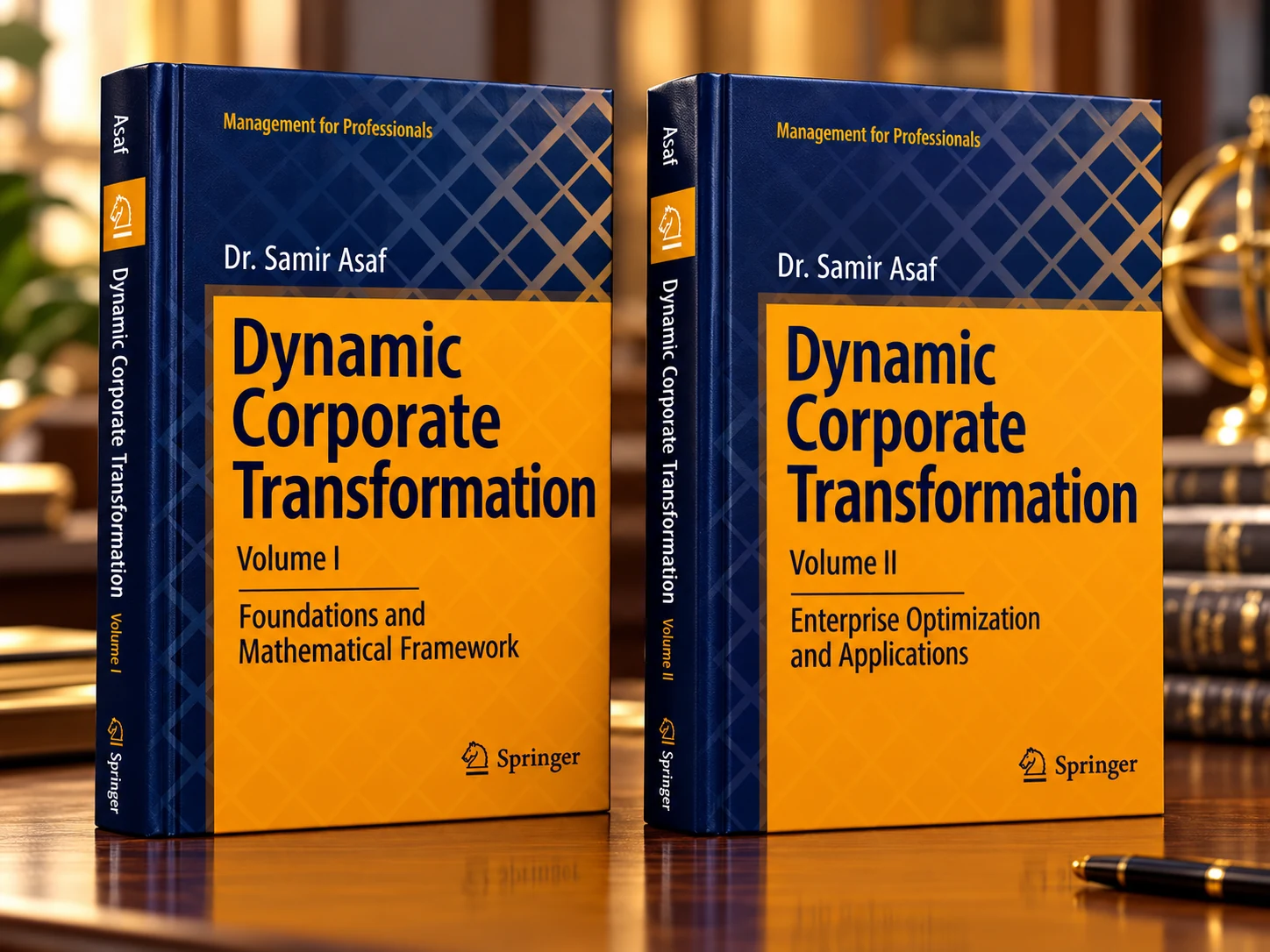
Dynamic Corporate Transformation — Volume I: Foundations and Mathematical Framework; Volume II: Enterprise Optimization & Applications
Jump to any chapter

Volume I: Foundations and Mathematical Framework

  1. Ch. 1Introduction to Dynamic Corporate Transformation
  2. Ch. 2Enterprise Systems and Transformation
  3. Ch. 3Mathematical Foundations
  4. Ch. 4Enterprise Modeling Principles
  5. Ch. 5Enterprise State Representation
  6. Ch. 6Enterprise Transformation Operators
  7. Ch. 7Dynamic Enterprise Systems
  8. Ch. 8Stochastic Enterprise Dynamics
  9. Ch. 9Enterprise State Architecture
  10. Ch. 10Enterprise Capital Architecture
  11. Ch. 11Enterprise Performance Architecture
  12. Ch. 12Enterprise Risk, Resilience, and Robustness Architecture
  13. Ch. 13Unified Enterprise Transformation Architecture
  14. Ch. 14Mathematical Analysis of the Unified Enterprise Transformation Architecture
  15. Ch. 15Mathematical Formulation of Enterprise Optimization
  16. Ch. 16Synthesis, Future Directions, and Transition to Volume II

Volume II: Enterprise Optimization & Applications

  1. Ch. 1Introduction to Enterprise Optimization
  2. Ch. 2The General Enterprise Optimization Problem Revisited
  3. Ch. 3Convex Enterprise Optimization
  4. Ch. 4Nonlinear and Mixed-Integer Enterprise Optimization
  5. Ch. 5Dynamic Enterprise Optimization
  6. Ch. 6Optimal Control of Enterprise Systems
  7. Ch. 7Dynamic Programming for Enterprise Systems
  8. Ch. 8Hamilton–Jacobi–Bellman Enterprise Framework
  9. Ch. 9Stochastic Enterprise Optimization
  10. Ch. 10Neuro-Fuzzy Robust Enterprise Optimization
  11. Ch. 11Distributionally Robust Enterprise Optimization
  12. Ch. 12Multi-Objective Enterprise Optimization
  13. Ch. 13Machine Learning for Enterprise Transformation
  14. Ch. 14Artificial Intelligence for Enterprise Optimization
  15. Ch. 15Enterprise Digital Twins and Autonomous Enterprise Transformation
  16. Ch. 16Enterprise Applications and Integrated Transformation Case Studies

Dynamic Corporate Transformation

Springer Nature · Management for Professionals · Forthcoming 2027

  • Volume I — Foundations and Mathematical Framework
  • Volume II — Enterprise Optimization & Applications
Buy Volume I: Dynamic Corporate Transformation: Foundations and Mathematical FrameworkBuy Volume II: Dynamic Corporate Transformation: Enterprise Optimization & Applications
Jump to any chapter

Volume I: Foundations and Mathematical Framework

  1. Ch. 1Introduction to Dynamic Corporate Transformation
  2. Ch. 2Enterprise Systems and Transformation
  3. Ch. 3Mathematical Foundations
  4. Ch. 4Enterprise Modeling Principles
  5. Ch. 5Enterprise State Representation
  6. Ch. 6Enterprise Transformation Operators
  7. Ch. 7Dynamic Enterprise Systems
  8. Ch. 8Stochastic Enterprise Dynamics
  9. Ch. 9Enterprise State Architecture
  10. Ch. 10Enterprise Capital Architecture
  11. Ch. 11Enterprise Performance Architecture
  12. Ch. 12Enterprise Risk, Resilience, and Robustness Architecture
  13. Ch. 13Unified Enterprise Transformation Architecture
  14. Ch. 14Mathematical Analysis of the Unified Enterprise Transformation Architecture
  15. Ch. 15Mathematical Formulation of Enterprise Optimization
  16. Ch. 16Synthesis, Future Directions, and Transition to Volume II

Volume II: Enterprise Optimization & Applications

  1. Ch. 1Introduction to Enterprise Optimization
  2. Ch. 2The General Enterprise Optimization Problem Revisited
  3. Ch. 3Convex Enterprise Optimization
  4. Ch. 4Nonlinear and Mixed-Integer Enterprise Optimization
  5. Ch. 5Dynamic Enterprise Optimization
  6. Ch. 6Optimal Control of Enterprise Systems
  7. Ch. 7Dynamic Programming for Enterprise Systems
  8. Ch. 8Hamilton–Jacobi–Bellman Enterprise Framework
  9. Ch. 9Stochastic Enterprise Optimization
  10. Ch. 10Neuro-Fuzzy Robust Enterprise Optimization
  11. Ch. 11Distributionally Robust Enterprise Optimization
  12. Ch. 12Multi-Objective Enterprise Optimization
  13. Ch. 13Machine Learning for Enterprise Transformation
  14. Ch. 14Artificial Intelligence for Enterprise Optimization
  15. Ch. 15Enterprise Digital Twins and Autonomous Enterprise Transformation
  16. Ch. 16Enterprise Applications and Integrated Transformation Case Studies