

Skip to content

DCT Lexicon · Governing Dynamics

Hausdorff State Manifolds

The enterprise's state lives on a space where distinct configurations can be told apart and local coordinates make sense: a Hausdorff manifold, so that limits are unique and calculus is local.

DCT Governing Dynamics

In depth

Formal statement

A topological space MM is Hausdorff if any two distinct points have disjoint neighbourhoods. A smooth nn-manifold is a second-countable Hausdorff space covered by charts φα:Uα→Rn\varphi_\alpha : U_\alpha \to \mathbb{R}^n whose transition maps are smooth.

x≠y  ⟹  ∃ U∋x,  V∋y open,  U∩V=∅x \neq y \;\Longrightarrow\; \exists\, U \ni x,\; V \ni y \text{ open},\; U \cap V = \varnothingφβ∘φα−1∈C∞(φα(Uα∩Uβ))\varphi_\beta \circ \varphi_\alpha^{-1} \in C^\infty\big(\varphi_\alpha(U_\alpha \cap U_\beta)\big)

DCT Governing Dynamics: the element's drawer (/governing-dynamics)

Uniqueness of limits

In a Hausdorff space every convergent sequence has exactly one limit. Without it, an estimation procedure could converge to two different enterprise states at once, and no certificate could name the state it certifies.

DCT Governing Dynamics: the element's drawer (/governing-dynamics)

In DCT

The state manifold is where every other element is posed: kernels act on it, tangent dynamics differentiate on it, viability kernels are subsets of it. Treating the state as a point of a manifold, rather than a vector of KPIs, is what lets DCT speak of directions of change and of distances between strategic positions.

DCT Governing Dynamics: the element's drawer (/governing-dynamics)

Limits

Second countability and paracompactness matter: they guarantee partitions of unity, hence Riemannian metrics and integration. Constraint sets with corners are manifolds with corners, where tangent cones replace tangent spaces.

DCT Governing Dynamics: the element's drawer (/governing-dynamics)

Go next

  • Tangent Dynamics: Tangent dynamics differentiate trajectories on the manifold (Pathway 2).
  • Viability Kernels: Viability kernels are the subsets of the manifold that can be kept feasible.
  • Probability Kernels: Kernels place probability on the manifold's Borel sets.

DCT Governing Dynamics: the element's drawer (/governing-dynamics)

References

  • Lee (2012), Introduction to Smooth Manifolds
  • Munkres (2000), Topology

DCT Governing Dynamics: the element's drawer (/governing-dynamics)

In the book: Vol. I, Ch. 3: Mathematical Foundations · Vol. I, Ch. 5: Enterprise State Representation

Related: Tangent Dynamics · Viability Kernels · Probability Kernels

GD.02
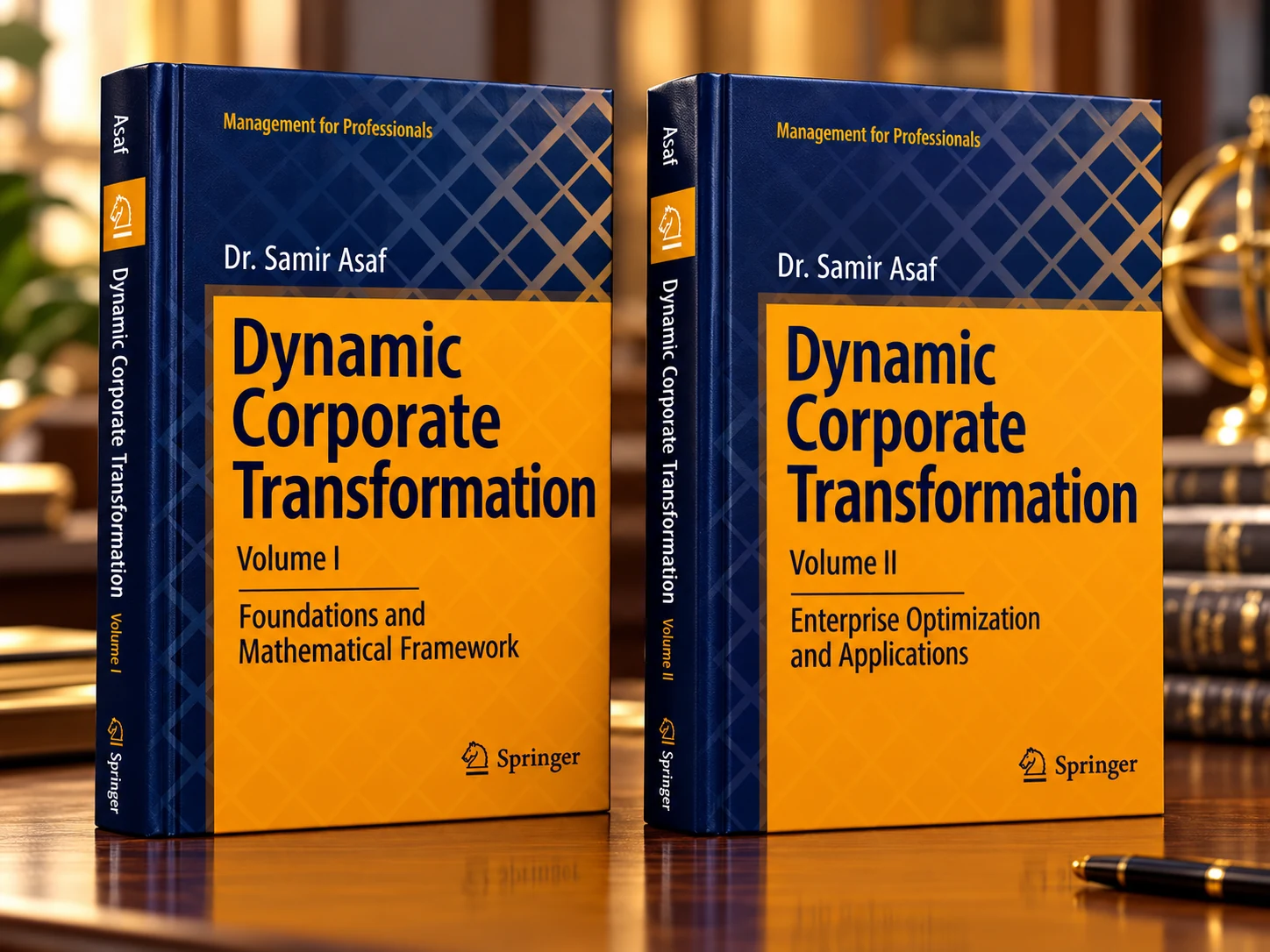
Dynamic Corporate Transformation — Volume I: Foundations and Mathematical Framework; Volume II: Enterprise Optimization & Applications
Jump to any chapter

Volume I: Foundations and Mathematical Framework

  1. Ch. 1Introduction to Dynamic Corporate Transformation
  2. Ch. 2Enterprise Systems and Transformation
  3. Ch. 3Mathematical Foundations
  4. Ch. 4Enterprise Modeling Principles
  5. Ch. 5Enterprise State Representation
  6. Ch. 6Enterprise Transformation Operators
  7. Ch. 7Dynamic Enterprise Systems
  8. Ch. 8Stochastic Enterprise Dynamics
  9. Ch. 9Enterprise State Architecture
  10. Ch. 10Enterprise Capital Architecture
  11. Ch. 11Enterprise Performance Architecture
  12. Ch. 12Enterprise Risk, Resilience, and Robustness Architecture
  13. Ch. 13Unified Enterprise Transformation Architecture
  14. Ch. 14Mathematical Analysis of the Unified Enterprise Transformation Architecture
  15. Ch. 15Mathematical Formulation of Enterprise Optimization
  16. Ch. 16Synthesis, Future Directions, and Transition to Volume II

Volume II: Enterprise Optimization & Applications

  1. Ch. 1Introduction to Enterprise Optimization
  2. Ch. 2The General Enterprise Optimization Problem Revisited
  3. Ch. 3Convex Enterprise Optimization
  4. Ch. 4Nonlinear and Mixed-Integer Enterprise Optimization
  5. Ch. 5Dynamic Enterprise Optimization
  6. Ch. 6Optimal Control of Enterprise Systems
  7. Ch. 7Dynamic Programming for Enterprise Systems
  8. Ch. 8Hamilton–Jacobi–Bellman Enterprise Framework
  9. Ch. 9Stochastic Enterprise Optimization
  10. Ch. 10Neuro-Fuzzy Robust Enterprise Optimization
  11. Ch. 11Distributionally Robust Enterprise Optimization
  12. Ch. 12Multi-Objective Enterprise Optimization
  13. Ch. 13Machine Learning for Enterprise Transformation
  14. Ch. 14Artificial Intelligence for Enterprise Optimization
  15. Ch. 15Enterprise Digital Twins and Autonomous Enterprise Transformation
  16. Ch. 16Enterprise Applications and Integrated Transformation Case Studies

Dynamic Corporate Transformation

Springer Nature · Management for Professionals · Forthcoming 2027

  • Volume I — Foundations and Mathematical Framework
  • Volume II — Enterprise Optimization & Applications
Buy Volume I: Dynamic Corporate Transformation: Foundations and Mathematical FrameworkBuy Volume II: Dynamic Corporate Transformation: Enterprise Optimization & Applications
Jump to any chapter

Volume I: Foundations and Mathematical Framework

  1. Ch. 1Introduction to Dynamic Corporate Transformation
  2. Ch. 2Enterprise Systems and Transformation
  3. Ch. 3Mathematical Foundations
  4. Ch. 4Enterprise Modeling Principles
  5. Ch. 5Enterprise State Representation
  6. Ch. 6Enterprise Transformation Operators
  7. Ch. 7Dynamic Enterprise Systems
  8. Ch. 8Stochastic Enterprise Dynamics
  9. Ch. 9Enterprise State Architecture
  10. Ch. 10Enterprise Capital Architecture
  11. Ch. 11Enterprise Performance Architecture
  12. Ch. 12Enterprise Risk, Resilience, and Robustness Architecture
  13. Ch. 13Unified Enterprise Transformation Architecture
  14. Ch. 14Mathematical Analysis of the Unified Enterprise Transformation Architecture
  15. Ch. 15Mathematical Formulation of Enterprise Optimization
  16. Ch. 16Synthesis, Future Directions, and Transition to Volume II

Volume II: Enterprise Optimization & Applications

  1. Ch. 1Introduction to Enterprise Optimization
  2. Ch. 2The General Enterprise Optimization Problem Revisited
  3. Ch. 3Convex Enterprise Optimization
  4. Ch. 4Nonlinear and Mixed-Integer Enterprise Optimization
  5. Ch. 5Dynamic Enterprise Optimization
  6. Ch. 6Optimal Control of Enterprise Systems
  7. Ch. 7Dynamic Programming for Enterprise Systems
  8. Ch. 8Hamilton–Jacobi–Bellman Enterprise Framework
  9. Ch. 9Stochastic Enterprise Optimization
  10. Ch. 10Neuro-Fuzzy Robust Enterprise Optimization
  11. Ch. 11Distributionally Robust Enterprise Optimization
  12. Ch. 12Multi-Objective Enterprise Optimization
  13. Ch. 13Machine Learning for Enterprise Transformation
  14. Ch. 14Artificial Intelligence for Enterprise Optimization
  15. Ch. 15Enterprise Digital Twins and Autonomous Enterprise Transformation
  16. Ch. 16Enterprise Applications and Integrated Transformation Case Studies