

Skip to content

DCT Lexicon · Readiness and stability

Half-life rule

The board's rule that any deviation must halve within a stated time; a company that keeps a share ρ of every deviation each quarter has a half-life of ln 2 / ln(1/ρ) quarters.

Drafted for the author's approval from Vol. I, Figure 14.1 and Worked Examples 14.1 and 16.1

In depth

In the book

A company that keeps a share ρ\rho of every deviation each quarter has a half-life of ln⁡2/ln⁡(1/ρ)\ln 2/\ln(1/\rho) quarters (left) and amplifies a permanent change 1/(1−ρ)1/(1-\rho) times (right).

Vol. I, Figure 14.1 caption (Theorems 14.3(i) and 14.4(iii)), verbatim

Formal statement

t1/2=ln⁡2ln⁡(1/ρ),t1/2≤tˉ  ⟺  ρ≤2−1/tˉ.t_{1/2} = \frac{\ln 2}{\ln(1/\rho)}, \qquad t_{1/2} \le \bar t \iff \rho \le 2^{-1/\bar t}.

Vol. I, Figure 14.1, retypeset

Executive example

A half-life of at most four quarters means a spectral radius of at most 0.84. … The register’s ceilings certify the feedback core: a spectral radius of 0.80, a half-life of 3.1 quarters inside the board’s four-quarter rule, and a worst-case multiplier of 5 (Theorem 16.5(ii)).

Vol. I, Worked Examples 14.1 (Step 3) and 16.1 (Step 3), verbatim

Common misreading

A common mistake is to collect layer-by-layer stability attestations and call the company stable.

Vol. I, LOS 14.2, verbatim

How AXIOM uses it

The board declares the half-life rule. The Stability & coupling tab shows a shock of 100 fading quarter by quarter at the coupling strength AXIOM measured, against the rule as a dashed line.

Drafted for the author's approval, from the Stability & coupling tab

In the book: Vol. I, Ch. 14: Mathematical Analysis of the Unified Enterprise Transformation Architecture · Vol. I, Ch. 16: Synthesis, Future Directions, and Transition to Volume II

Related: Spectral radius · Gain audit · Lyapunov Stability and Semidefinite Programming

V1.Thm.14.3 · V1.Thm.14.4 · V1.WE.14.1 · V1.WE.16.1
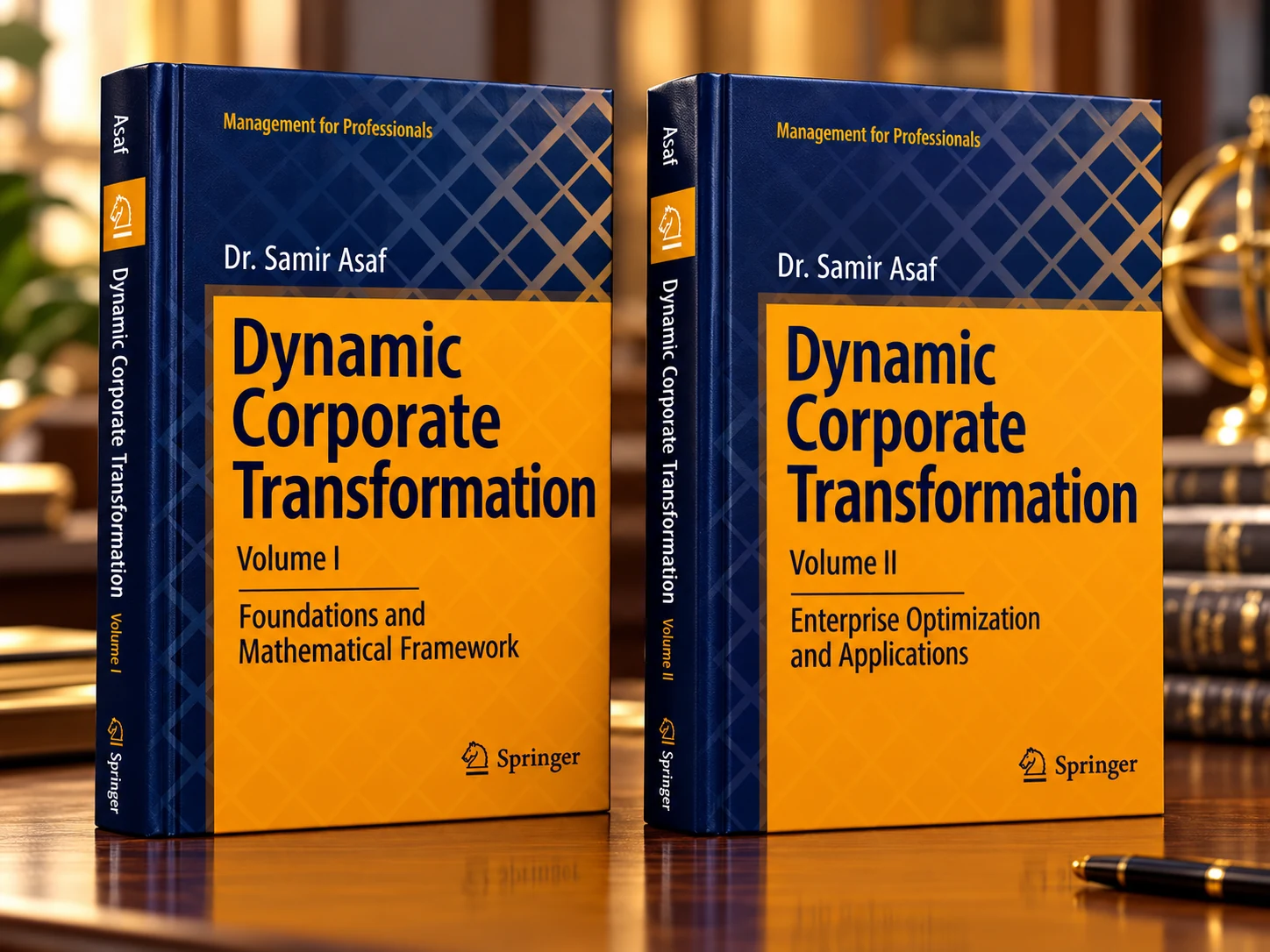
Dynamic Corporate Transformation — Volume I: Foundations and Mathematical Framework; Volume II: Enterprise Optimization & Applications
Jump to any chapter

Volume I: Foundations and Mathematical Framework

  1. Ch. 1Introduction to Dynamic Corporate Transformation
  2. Ch. 2Enterprise Systems and Transformation
  3. Ch. 3Mathematical Foundations
  4. Ch. 4Enterprise Modeling Principles
  5. Ch. 5Enterprise State Representation
  6. Ch. 6Enterprise Transformation Operators
  7. Ch. 7Dynamic Enterprise Systems
  8. Ch. 8Stochastic Enterprise Dynamics
  9. Ch. 9Enterprise State Architecture
  10. Ch. 10Enterprise Capital Architecture
  11. Ch. 11Enterprise Performance Architecture
  12. Ch. 12Enterprise Risk, Resilience, and Robustness Architecture
  13. Ch. 13Unified Enterprise Transformation Architecture
  14. Ch. 14Mathematical Analysis of the Unified Enterprise Transformation Architecture
  15. Ch. 15Mathematical Formulation of Enterprise Optimization
  16. Ch. 16Synthesis, Future Directions, and Transition to Volume II

Volume II: Enterprise Optimization & Applications

  1. Ch. 1Introduction to Enterprise Optimization
  2. Ch. 2The General Enterprise Optimization Problem Revisited
  3. Ch. 3Convex Enterprise Optimization
  4. Ch. 4Nonlinear and Mixed-Integer Enterprise Optimization
  5. Ch. 5Dynamic Enterprise Optimization
  6. Ch. 6Optimal Control of Enterprise Systems
  7. Ch. 7Dynamic Programming for Enterprise Systems
  8. Ch. 8Hamilton–Jacobi–Bellman Enterprise Framework
  9. Ch. 9Stochastic Enterprise Optimization
  10. Ch. 10Neuro-Fuzzy Robust Enterprise Optimization
  11. Ch. 11Distributionally Robust Enterprise Optimization
  12. Ch. 12Multi-Objective Enterprise Optimization
  13. Ch. 13Machine Learning for Enterprise Transformation
  14. Ch. 14Artificial Intelligence for Enterprise Optimization
  15. Ch. 15Enterprise Digital Twins and Autonomous Enterprise Transformation
  16. Ch. 16Enterprise Applications and Integrated Transformation Case Studies

Dynamic Corporate Transformation

Springer Nature · Management for Professionals · Forthcoming 2027

  • Volume I — Foundations and Mathematical Framework
  • Volume II — Enterprise Optimization & Applications
Buy Volume I: Dynamic Corporate Transformation: Foundations and Mathematical FrameworkBuy Volume II: Dynamic Corporate Transformation: Enterprise Optimization & Applications
Jump to any chapter

Volume I: Foundations and Mathematical Framework

  1. Ch. 1Introduction to Dynamic Corporate Transformation
  2. Ch. 2Enterprise Systems and Transformation
  3. Ch. 3Mathematical Foundations
  4. Ch. 4Enterprise Modeling Principles
  5. Ch. 5Enterprise State Representation
  6. Ch. 6Enterprise Transformation Operators
  7. Ch. 7Dynamic Enterprise Systems
  8. Ch. 8Stochastic Enterprise Dynamics
  9. Ch. 9Enterprise State Architecture
  10. Ch. 10Enterprise Capital Architecture
  11. Ch. 11Enterprise Performance Architecture
  12. Ch. 12Enterprise Risk, Resilience, and Robustness Architecture
  13. Ch. 13Unified Enterprise Transformation Architecture
  14. Ch. 14Mathematical Analysis of the Unified Enterprise Transformation Architecture
  15. Ch. 15Mathematical Formulation of Enterprise Optimization
  16. Ch. 16Synthesis, Future Directions, and Transition to Volume II

Volume II: Enterprise Optimization & Applications

  1. Ch. 1Introduction to Enterprise Optimization
  2. Ch. 2The General Enterprise Optimization Problem Revisited
  3. Ch. 3Convex Enterprise Optimization
  4. Ch. 4Nonlinear and Mixed-Integer Enterprise Optimization
  5. Ch. 5Dynamic Enterprise Optimization
  6. Ch. 6Optimal Control of Enterprise Systems
  7. Ch. 7Dynamic Programming for Enterprise Systems
  8. Ch. 8Hamilton–Jacobi–Bellman Enterprise Framework
  9. Ch. 9Stochastic Enterprise Optimization
  10. Ch. 10Neuro-Fuzzy Robust Enterprise Optimization
  11. Ch. 11Distributionally Robust Enterprise Optimization
  12. Ch. 12Multi-Objective Enterprise Optimization
  13. Ch. 13Machine Learning for Enterprise Transformation
  14. Ch. 14Artificial Intelligence for Enterprise Optimization
  15. Ch. 15Enterprise Digital Twins and Autonomous Enterprise Transformation
  16. Ch. 16Enterprise Applications and Integrated Transformation Case Studies