

Skip to content

DCT Lexicon · Risk and uncertainty

Chance of reaching the value target

P(uplift ≥ target)

The probability that the plan's value uplift reaches a declared target, read on the simulated paths with its standard error.

Drafted for the author's approval from Vol. I, Definition 12.10 (the survival function) and Section 8.9

In depth

In the book

Fix a viable set KK: the constraints whose breach ends the current regime—insolvency, loss of a licence, a covenant default without cure. The survival function S(k)=P(xj∈K for all j≤k)S(k) = \mathbb{P}(x_j \in K \text{ for all } j \le k) is the probability that the company has remained viable through period kk, and survivability is its computation, bounding, and management.

Vol. I, Definition 12.10 (Enterprise Survivability), verbatim

Formal statement

S(x)=P(ΔV≥x),p^=1N∑i=1N1{ΔVi≥x},se(p^)=p^(1−p^)/N.S(x) = \mathbb{P}(\Delta V \ge x), \qquad \hat p = \frac{1}{N}\sum_{i=1}^{N} \mathbf{1}\{\Delta V_i \ge x\}, \qquad \mathrm{se}(\hat p) = \sqrt{\hat p(1-\hat p)/N}.

Drafted for the author's approval: the survival function read on value, estimated as in Vol. I, Section 8.9

How to read it

The book's survival function is read over time, on a viable set. AXIOM reads the same object on value: for every target the board could set, the share of simulated futures in which the plan's uplift reaches it. The curve falls as the target rises; the slider on the Probability of success tab reads points the engine computed and never interpolates its own.

Drafted for the author's approval

Common misreading

A common mistake is to report a simulated probability without its error bar, or to trust a few hundred paths for a rare event.

Vol. I, LOS 8.5, verbatim

How AXIOM uses it

The target is the board's declaration, with an owner. Without one the chance is shown as absent, with that reason, and the survival curve is still drawn. The chance is computed on the 100,000 certified paths, with its standard error.

Drafted for the author's approval, from AXIOM's method passport "Chance of reaching the value target" (D-087)

In the book: Vol. I, Ch. 12: Enterprise Risk, Resilience, and Robustness Architecture · Vol. I, Ch. 8: Stochastic Enterprise Dynamics

Related: Monte Carlo simulation · Standard error · Expected value uplift · Percentiles (P10, P50, P90) and bands

V1.Def.12.10 · V1.ME.8.MonteCarlo · V1.Thm.8.5
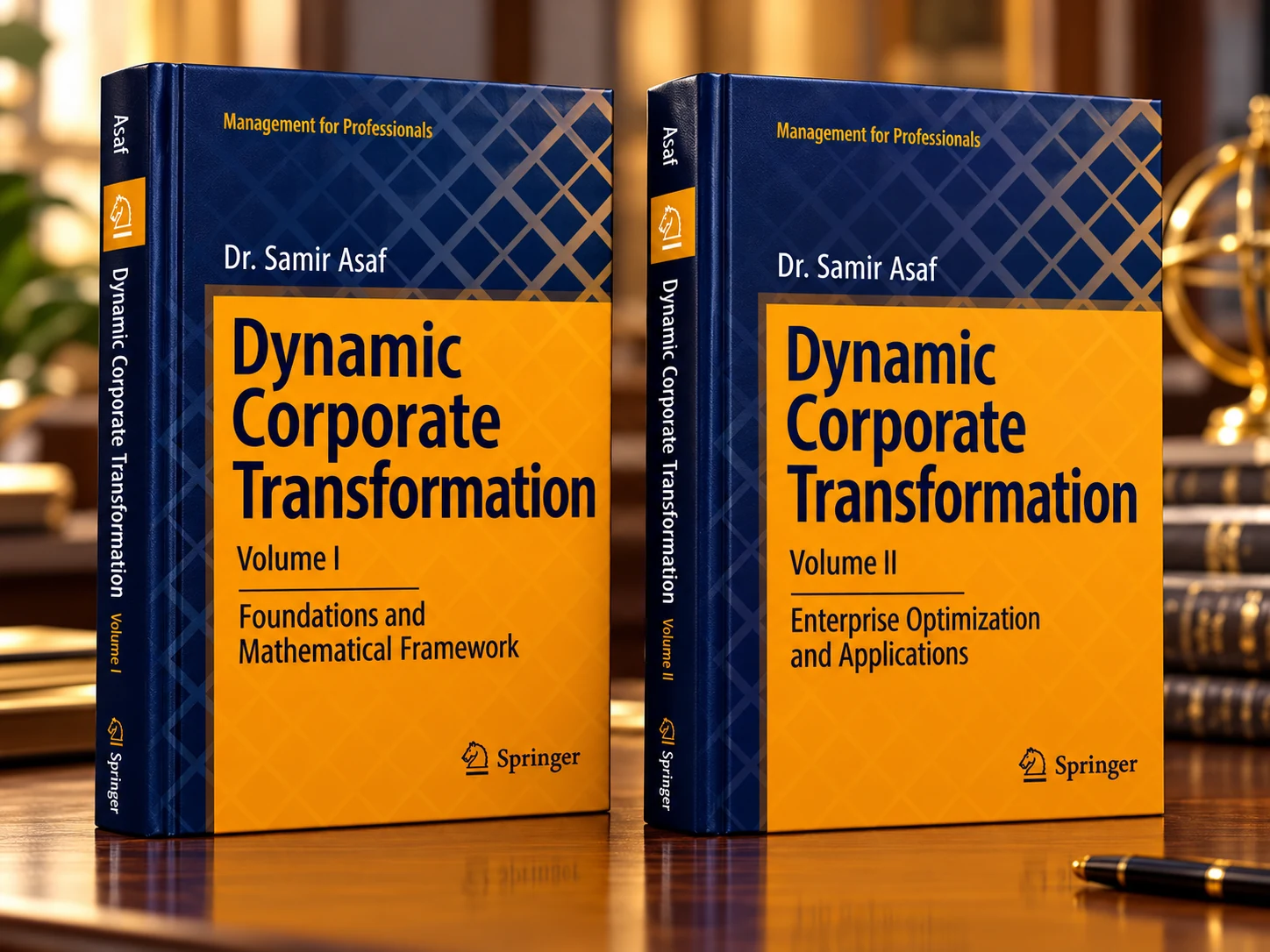
Dynamic Corporate Transformation — Volume I: Foundations and Mathematical Framework; Volume II: Enterprise Optimization & Applications
Jump to any chapter

Volume I: Foundations and Mathematical Framework

  1. Ch. 1Introduction to Dynamic Corporate Transformation
  2. Ch. 2Enterprise Systems and Transformation
  3. Ch. 3Mathematical Foundations
  4. Ch. 4Enterprise Modeling Principles
  5. Ch. 5Enterprise State Representation
  6. Ch. 6Enterprise Transformation Operators
  7. Ch. 7Dynamic Enterprise Systems
  8. Ch. 8Stochastic Enterprise Dynamics
  9. Ch. 9Enterprise State Architecture
  10. Ch. 10Enterprise Capital Architecture
  11. Ch. 11Enterprise Performance Architecture
  12. Ch. 12Enterprise Risk, Resilience, and Robustness Architecture
  13. Ch. 13Unified Enterprise Transformation Architecture
  14. Ch. 14Mathematical Analysis of the Unified Enterprise Transformation Architecture
  15. Ch. 15Mathematical Formulation of Enterprise Optimization
  16. Ch. 16Synthesis, Future Directions, and Transition to Volume II

Volume II: Enterprise Optimization & Applications

  1. Ch. 1Introduction to Enterprise Optimization
  2. Ch. 2The General Enterprise Optimization Problem Revisited
  3. Ch. 3Convex Enterprise Optimization
  4. Ch. 4Nonlinear and Mixed-Integer Enterprise Optimization
  5. Ch. 5Dynamic Enterprise Optimization
  6. Ch. 6Optimal Control of Enterprise Systems
  7. Ch. 7Dynamic Programming for Enterprise Systems
  8. Ch. 8Hamilton–Jacobi–Bellman Enterprise Framework
  9. Ch. 9Stochastic Enterprise Optimization
  10. Ch. 10Neuro-Fuzzy Robust Enterprise Optimization
  11. Ch. 11Distributionally Robust Enterprise Optimization
  12. Ch. 12Multi-Objective Enterprise Optimization
  13. Ch. 13Machine Learning for Enterprise Transformation
  14. Ch. 14Artificial Intelligence for Enterprise Optimization
  15. Ch. 15Enterprise Digital Twins and Autonomous Enterprise Transformation
  16. Ch. 16Enterprise Applications and Integrated Transformation Case Studies

Dynamic Corporate Transformation

Springer Nature · Management for Professionals · Forthcoming 2027

  • Volume I — Foundations and Mathematical Framework
  • Volume II — Enterprise Optimization & Applications
Buy Volume I: Dynamic Corporate Transformation: Foundations and Mathematical FrameworkBuy Volume II: Dynamic Corporate Transformation: Enterprise Optimization & Applications
Jump to any chapter

Volume I: Foundations and Mathematical Framework

  1. Ch. 1Introduction to Dynamic Corporate Transformation
  2. Ch. 2Enterprise Systems and Transformation
  3. Ch. 3Mathematical Foundations
  4. Ch. 4Enterprise Modeling Principles
  5. Ch. 5Enterprise State Representation
  6. Ch. 6Enterprise Transformation Operators
  7. Ch. 7Dynamic Enterprise Systems
  8. Ch. 8Stochastic Enterprise Dynamics
  9. Ch. 9Enterprise State Architecture
  10. Ch. 10Enterprise Capital Architecture
  11. Ch. 11Enterprise Performance Architecture
  12. Ch. 12Enterprise Risk, Resilience, and Robustness Architecture
  13. Ch. 13Unified Enterprise Transformation Architecture
  14. Ch. 14Mathematical Analysis of the Unified Enterprise Transformation Architecture
  15. Ch. 15Mathematical Formulation of Enterprise Optimization
  16. Ch. 16Synthesis, Future Directions, and Transition to Volume II

Volume II: Enterprise Optimization & Applications

  1. Ch. 1Introduction to Enterprise Optimization
  2. Ch. 2The General Enterprise Optimization Problem Revisited
  3. Ch. 3Convex Enterprise Optimization
  4. Ch. 4Nonlinear and Mixed-Integer Enterprise Optimization
  5. Ch. 5Dynamic Enterprise Optimization
  6. Ch. 6Optimal Control of Enterprise Systems
  7. Ch. 7Dynamic Programming for Enterprise Systems
  8. Ch. 8Hamilton–Jacobi–Bellman Enterprise Framework
  9. Ch. 9Stochastic Enterprise Optimization
  10. Ch. 10Neuro-Fuzzy Robust Enterprise Optimization
  11. Ch. 11Distributionally Robust Enterprise Optimization
  12. Ch. 12Multi-Objective Enterprise Optimization
  13. Ch. 13Machine Learning for Enterprise Transformation
  14. Ch. 14Artificial Intelligence for Enterprise Optimization
  15. Ch. 15Enterprise Digital Twins and Autonomous Enterprise Transformation
  16. Ch. 16Enterprise Applications and Integrated Transformation Case Studies