

NFL
Case Studies
Sixteen real decisions behind Volume II, told from the published record.
Every chapter of Volume II carries an In Practice case: a real organization that took a decision of the chapter's kind, told from its published record. Each case sets out the decision, the method, the result and what it took to make it work, then what Meridian, the book's case company, takes from it and four questions for a board.
The cards give a preview. The full two-page case is in the chapter, after its Worked Example and before its AXIOM Lab.
16 organizations · 15 sectors · 4 Franz Edelman Awards · 1 INFORMS Wagner Prize
Client engagements
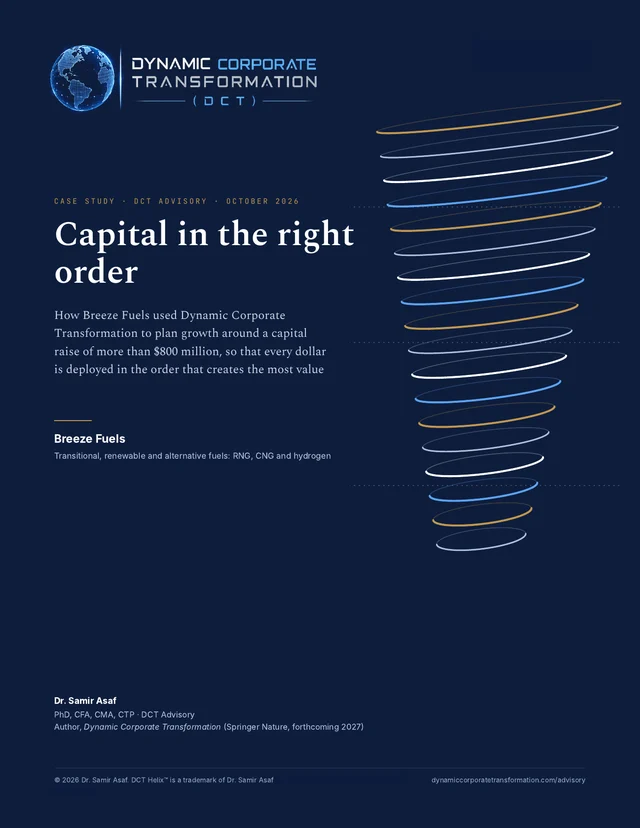
Breeze Fuels: Capital in the right order
Planning growth around a raise of more than $800 million, certified before it was sized.
Public-company analyses
These organizations did not use DCT; each case reads a published decision in DCT's terms.
1 of 16 cases
Chapter 4Enterprise Optimization Foundations Nonlinear and Mixed-Integer Enterprise Optimization
Company and organization names identify the organizations whose published decisions the cases discuss. They are trademarks of their respective owners; no affiliation with or endorsement by them is implied.
Meridian Group
a diversified industrial-technology company whose board is weighing digital transformation, restructuring, and operational turnaround as competing paths forward (Steven M. Howard, endorsement)
Meridian is fictional; its numbers are the book's declarations.
Meridian's board meets in three weeks to choose among the digital pivot, the restructuring, and the turnaround.
Vol. I, Ch. 1, AXIOM Lab 1.1
Four transformations, read through the Helix lens
Four well-documented transformations, read through DCT Helix. None of these companies used DCT Helix; each reading is the author’s interpretation of public sources, with the sources listed.
DCT Helix white paper (October 2026), pages 38–41 (verbatim, with the white paper’s own references)
- DBSDBS laid its platforms first, then let each business step on its own clock.8.4% → 18.0%return on equity, 2009 to 2023
- MicrosoftMicrosoft let each business move on its own clock and made culture the shared rung.$86.8bn → $331.8bnrevenue, fiscal 2014 to fiscal 2026
- FordFord secured financing early, ran one plan and made the truth visible every week.−$14.7bn → +$6.6bnnet income, 2008 to 2010
- DanaherDanaher’s improvement engine compounds, and every acquisition runs through it.2,063%total shareholder return over 25 years to 2025, vs 728% for the S&P 500
Each retrospective reading states that the company did not use DCT Helix and that the reading is the author's interpretation of public sources.

Jump to any chapter
Volume I: Foundations and Mathematical Framework
- Ch. 1Introduction to Dynamic Corporate Transformation
- Ch. 2Enterprise Systems and Transformation
- Ch. 3Mathematical Foundations
- Ch. 4Enterprise Modeling Principles
- Ch. 5Enterprise State Representation
- Ch. 6Enterprise Transformation Operators
- Ch. 7Dynamic Enterprise Systems
- Ch. 8Stochastic Enterprise Dynamics
- Ch. 9Enterprise State Architecture
- Ch. 10Enterprise Capital Architecture
- Ch. 11Enterprise Performance Architecture
- Ch. 12Enterprise Risk, Resilience, and Robustness Architecture
- Ch. 13Unified Enterprise Transformation Architecture
- Ch. 14Mathematical Analysis of the Unified Enterprise Transformation Architecture
- Ch. 15Mathematical Formulation of Enterprise Optimization
- Ch. 16Synthesis, Future Directions, and Transition to Volume II
Volume II: Enterprise Optimization & Applications
- Ch. 1Introduction to Enterprise Optimization
- Ch. 2The General Enterprise Optimization Problem Revisited
- Ch. 3Convex Enterprise Optimization
- Ch. 4Nonlinear and Mixed-Integer Enterprise Optimization
- Ch. 5Dynamic Enterprise Optimization
- Ch. 6Optimal Control of Enterprise Systems
- Ch. 7Dynamic Programming for Enterprise Systems
- Ch. 8Hamilton–Jacobi–Bellman Enterprise Framework
- Ch. 9Stochastic Enterprise Optimization
- Ch. 10Neuro-Fuzzy Robust Enterprise Optimization
- Ch. 11Distributionally Robust Enterprise Optimization
- Ch. 12Multi-Objective Enterprise Optimization
- Ch. 13Machine Learning for Enterprise Transformation
- Ch. 14Artificial Intelligence for Enterprise Optimization
- Ch. 15Enterprise Digital Twins and Autonomous Enterprise Transformation
- Ch. 16Enterprise Applications and Integrated Transformation Case Studies
Dynamic Corporate Transformation
Springer Nature · Management for Professionals · Forthcoming 2027
- Volume I — Foundations and Mathematical Framework
- Volume II — Enterprise Optimization & Applications
Buy Volume I: Dynamic Corporate Transformation: Foundations and Mathematical FrameworkBuy Volume II: Dynamic Corporate Transformation: Enterprise Optimization & Applications
Jump to any chapter
Volume I: Foundations and Mathematical Framework
- Ch. 1Introduction to Dynamic Corporate Transformation
- Ch. 2Enterprise Systems and Transformation
- Ch. 3Mathematical Foundations
- Ch. 4Enterprise Modeling Principles
- Ch. 5Enterprise State Representation
- Ch. 6Enterprise Transformation Operators
- Ch. 7Dynamic Enterprise Systems
- Ch. 8Stochastic Enterprise Dynamics
- Ch. 9Enterprise State Architecture
- Ch. 10Enterprise Capital Architecture
- Ch. 11Enterprise Performance Architecture
- Ch. 12Enterprise Risk, Resilience, and Robustness Architecture
- Ch. 13Unified Enterprise Transformation Architecture
- Ch. 14Mathematical Analysis of the Unified Enterprise Transformation Architecture
- Ch. 15Mathematical Formulation of Enterprise Optimization
- Ch. 16Synthesis, Future Directions, and Transition to Volume II
Volume II: Enterprise Optimization & Applications
- Ch. 1Introduction to Enterprise Optimization
- Ch. 2The General Enterprise Optimization Problem Revisited
- Ch. 3Convex Enterprise Optimization
- Ch. 4Nonlinear and Mixed-Integer Enterprise Optimization
- Ch. 5Dynamic Enterprise Optimization
- Ch. 6Optimal Control of Enterprise Systems
- Ch. 7Dynamic Programming for Enterprise Systems
- Ch. 8Hamilton–Jacobi–Bellman Enterprise Framework
- Ch. 9Stochastic Enterprise Optimization
- Ch. 10Neuro-Fuzzy Robust Enterprise Optimization
- Ch. 11Distributionally Robust Enterprise Optimization
- Ch. 12Multi-Objective Enterprise Optimization
- Ch. 13Machine Learning for Enterprise Transformation
- Ch. 14Artificial Intelligence for Enterprise Optimization
- Ch. 15Enterprise Digital Twins and Autonomous Enterprise Transformation
- Ch. 16Enterprise Applications and Integrated Transformation Case Studies